This weekend marks the tenth anniversary of the most lethal terrorist attack on American soil. OTB’s writers offer their thoughts on our progress.
Doug Mataconis:
For most people, the biggest change that has happened since September 11th, 2001 has been the extent to which, almost overnight, the United States has transformed into something resembling a Fortress Society. It’s hard to notice unless you live in New York or Washington, D.C., or if you fly on a frequent basis, but it’s still there and it’s far different from the way America used to be. As Kevin Drum notes, in his book CBS reporter Bob Schieffer is old enough to remember a far different time:
These days, friends are never really sure I’m serious when I tell them that the Pentagon, like most of official Washington, was still open to the public in the 1970s….No one was required to show identification to enter the building, nor were security passes required….During the time that Jim Schlesinger was secretary of defense, I would sometimes drop by on a Saturday morning, and if his door was open, I would stick my head in and ask if anything was going on.
Much of this openness ended long before September 2001, of course. If the international terrorism of the 1980s didn’t do it, then the Oklahoma City Bombing certainly did result in a dramatic increase in government building security. It wasn’t until after September 11th, though, that the average American would have been likely to notice much of it. Today, it would be impossible for a visitor to New York City, for example, to fail to notice the increased police presence in Midtown Manhattan or, depending on the state of the terror alerts, the police carrying automatic weapons and conducting random bag searches on the subways and commuter trains that New Yorkers rely on daily. In Washington, D.C., the presence of the security state is even more omnipresent:
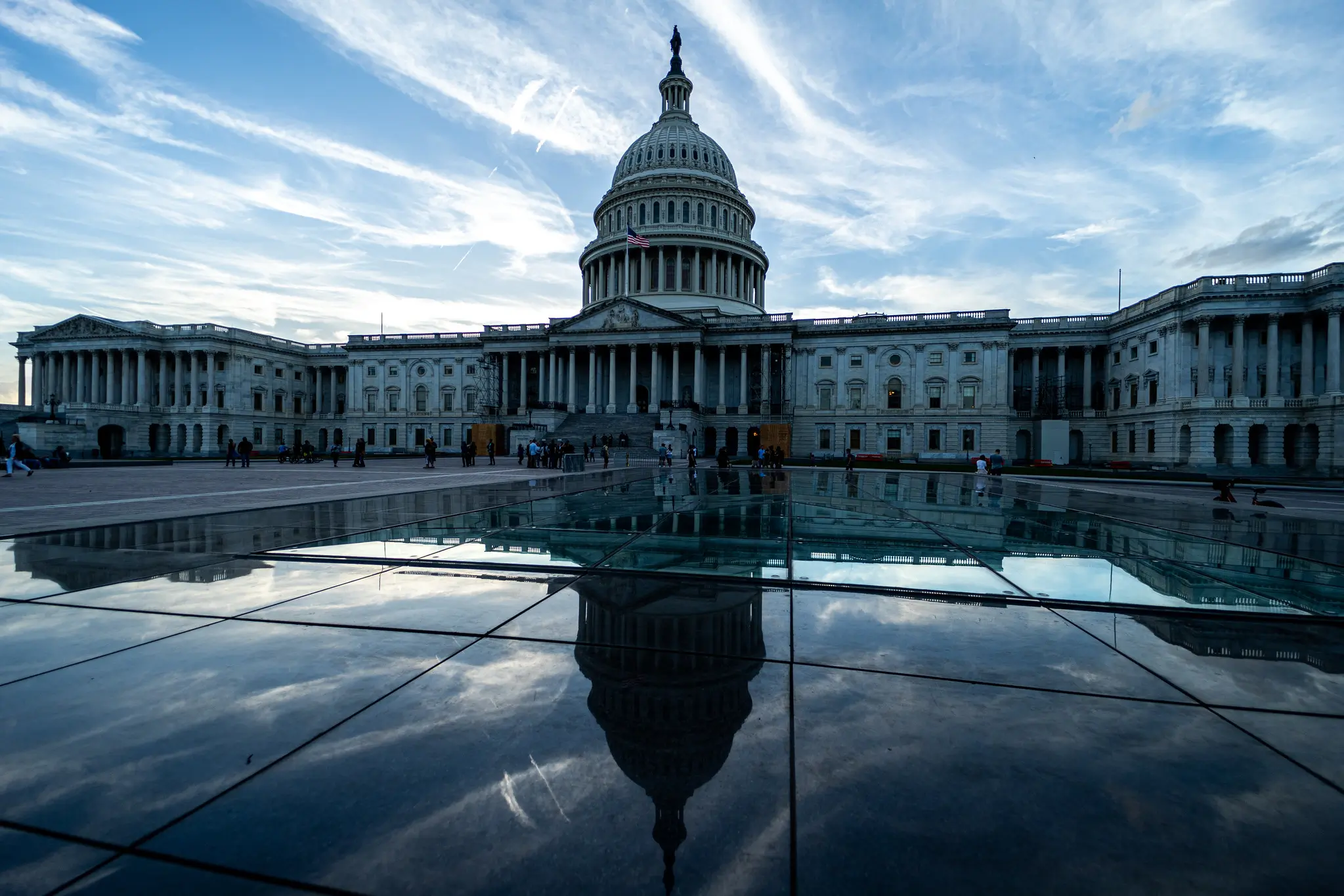
Some things are obvious: the Capitol Hill police armed with assault rifles, standing on the Capitol steps; concrete barricades blocking the once-grand entrances to other federal buildings; the surface-to-air missile battery protecting the White House; the National Archives security guards, almost as old as the Declaration of Independence enshrined inside, slowly waving a magnetic wand over all who enter. But most of the post-9/11 security measures have simply been embedded in the landscape and culture of the nation’s capital.
From the reflecting pool at the foot of the Capitol to the reflecting pool in front of the Lincoln Memorial, government cameras take pictures of citizens, who smile for Big Brother and snap their own pictures of the government cameras. In the $561 million underground Capitol visitors center, completed in 2008, people clutching gallery passes from a senator’s or representative’s office are funneled through magnetometers, to witness a secure Congress in its sealed chambers.
This is far different from Washington I visited as a child thirty-odd years ago, when you could walk up the steps of the Capitol and pass maybe one or two Capitol Hill Police Officers and stand in line for one of the daily White House tours. Things started to change in the 1990s when Pennsylvania Avenue was closed, never to reopen to vehicle traffic again most likely, in response to the OKC attack. After September 11th, though, the security became both more pervasive and more invisible. Most importantly, though, now that these security measures are in place the likelihood is that they are here to stay. It’s rare that security precautions get downgraded, and since we’re fighting a “War On Terror,” there will always be a risk of another attack that politicians can point to as a reason to keep all of it in place, including the intrusive TSA pat downs that persist despite the fact that everyone seems to dislike them.
In addition to the fortress society, though, we’ve also created a series of laws that have chipped away at civil liberties and fundamentally changed the criminal justice system and enhanced the power of police to act even when the focus of their investigation has nothing to do with terrorism:
Not all new tactics in combating terrorism in the United States were based on existing laws. “In electronic surveillance, you did have a big change,” said John C. Yoo, a law professor at the University of California, Berkeley, who became known for his aggressive legal advice and expansive view of executive power as a Justice Department official in the Bush administration.
In 2002, for instance, a special federal appeals court, the United States Foreign Intelligence Surveillance Court of Review, granted the Justice Department broad new powers to use wiretaps obtained for intelligence operations in criminal cases. “This revolutionizes our ability to investigate terrorists and prosecute terrorist acts,” Mr. Ashcroft said at the time.
After revelations concerning the warrantless wiretapping of international communications, Congress largely endorsed the program. Those legal changes, joined with striking advances in technology, have allowed the government broad ability to gather information.
“The Fourth Amendment has been seriously diluted,” said Professor Herman, who teaches at Brooklyn Law School. She added that she was struck by “the amount of surveillance that’s been unleashed with less and less judicial review and less and less individualized suspicion.”
The most extraordinary thing about the PATRIOT Act and other laws passed in the wake of 9/11, though, is the extent to which the powers it granted have expanded far beyond the investigation of terrorist threats to the American homeland. Consider, for example, the “sneak and peak” warrant, which allows police to enter a person’s home without their consent or knowledge and “look around” for evidence.” Prior to the PATRIOT Act, these warrants were not permitted for regular law enforcement and were generally reserved for investigation of cases involving foreign espionage. The advantages of such a warrant for police are rather obvious because they allow law enforcement to break into a persons home, seek evidence of a crime, and then obtain a regular search warrant based on what they saw during their surreptitious entry. During the three year period from 2006 to 2009, the number of “sneak and peak” warrants granted to law enforcement for drug investigations outnumbered those granted for terrorism investigations by a margin of more than 15-to-1. Other provisions of the Act have been used to gain access to bank accounts of Defendants in white collar fraud investigations and other routine crimes, thus allowing the police to collect evidence far easier, and with far less concern for civil liberties than they were able to do before the PATRIOT Act became law. For the most part, the Courts have accepted this, and the extent of the erosion of 4th Amendment rights over the past ten years cannot be understated.
In a new report (PDF), the ACLU documents other areas in which civil liberties have been impacted in ways we cannot even see by the Security State that has arisen since 2001:
Surveillance: The Obama administration, like the Bush administration before it, has used excessive secrecy to hide possibly unconstitutional surveillance….Hobbled by executive claims of secrecy, Senators Ron Wyden and Mark Udall have nevertheless warned their colleagues that the government is operating under a “reinterpretation” of the Patriot Act that is so broad that the public will be stunned and angered by its scope, and that the executive branch is engaging in dragnet surveillance in which “innocent Americans are getting swept up.”
Profiling: No area of American Muslim civil society was left untouched by discriminatory and illegitimate government action during the Bush years….To an alarming extent, the Obama administration has continued to embrace profiling as official government policy….There are increasing reports that the FBI is using Attorney General Ashcroft’s loosened profiling standards, together with broader authority to use paid informants, to conduct surveillance of American Muslims in case they might engage in wrongdoing.
Data mining: Nothing exemplifies the risks our national surveillance society poses to our privacy rights better than government “data mining.”….The range and number of these programs is breathtaking and their names Orwellian. Programs such as eGuardian, “Eagle Eyes,” “Patriot Reports,” and “See Something, Say Something” are now run by agencies including the Director of National Intelligence, the FBI, the Department of Defense, and the Department of Homeland Security….Without effective oversight, security agencies are now also engaged in a “land grab,” rushing into the legal vacuum to expand their monitoring powers far beyond anything seen in our history. Each of the over 300 million cell phones in the United States, for example, reveals its location to the mobile network carrier with ever-increasing accuracy, whenever it is turned on, and the Justice Department is aggressively using cell phones to monitor people’s location, claiming that it does not need a warrant.
There’s no denying that America still faces a threat from international terrorism, and that law enforcement, the military, and intelligence services need to act to protect our interests and our safety. At the same time, though, what we’ve seen over the past ten years is that the balance between liberty and safety has begun leaning far too much in the direction of safety and, as Benjamin Franklin once famously said, those who give up liberty to purchase a fleeting sense of safety don’t deserve either. My greatest fear is that we’ll see another terror attack some day in the future and see even more power granted to the state. Before that happens, we need to step back and ask ourselves whether the price we’ve paid over the past ten years was worth it.
James Joyner: The obvious answer to “Are we less free than we were on 9/11?” is Yes. But Doug’s contribution points to how long the trendline of trading freedom for security has been. We’ve had a lot of incidents over the years and reacted to each of them by ratcheting up precautions. This, by definition, comes at the cost of marginal freedom.
While I don’t like it one bit, it simply makes no sense to treat the White House, the Capitol, or the Pentagon as if they were a shopping mall; there are too many nuts out there and the national impact of an incident there is too high.
We have, however, gone ridiculously overboard in some cases. Not allowing citizens to carry firearms into a federal courthouse is a reasonable and prudent response to real dangers; requiring us to hand over our smart phones, however, is high-handed–and has nothing to do with security. While having to undergo three separate security checks to tour the non-working parts of the White House seems a bit silly, it’s at least related to the value of the target; having to go through a magnetometer to get into the White House gift shop down the road is absurd.
Indeed, security is often used as an excuse for other things. For example, patdowns to get into sports stadia conveniently also serves as a way to make it harder for fans to bring in their own food and drinks, thus driving up the sales of $8 beer and $6 hot dogs.
I’m actually less concerned about the Big Brother issues that Doug points to than I am with the daily indignities and intrusions of security theater. Data mining, if enough safeguards and firewalls are in place, is minimally intrusive and potentially enormously useful in gathering intelligence to prevent terrorist attacks and provide real security. Adding to people’s daily burdens in order to provide the false illusion of security rubs elevates low-level functionaries above the citizenry in a way that should outrage the heirs of the Declaration of Independence.
Further, as Steven Levitt and Stephen Dubner point out in Super Freakonomics, suppressing freedom isn’t free:
Think about the last time you went through an airport security line and were forced to remove your shoes, shuffle through the metal detector in stocking feet, and then hobble about while gathering up your belongings.
The beauty of terrorism— if you’re a terrorist— is that you can succeed even by failing. We perform this shoe routine thanks to a bumbling British national named Richard Reid, who, even though he couldn’t ignite his shoe bomb, exacted a huge price. Let’s say it takes an average of one minute to remove and replace your shoes in the airport security line. In the United States alone, this procedure happens roughly 560 million times per year. Five hundred and sixty million minutes equals more than 1,065 years— which, divided by 77.8 years (the average U.S. life expectancy at birth), yields a total of nearly 14 person- lives. So even though Richard Reid failed to kill a single person, he levied a tax that is the time equivalent of 14 lives per year.
And, of course, a lot of people will choose to drive who would instead have flown, because the extra hour or so the enhanced “security” procedures have added to each leg of the flight have diminished the time savings and increased the hassle of flying. This has almost certainly killed far more people than we’ve saved over the past decade.
Dave Schuler
I don’t have a great deal to add to what Doug and James have noted above. IMO the greatest casualty of the last decade whether in addressing the War on Terror or coping with the collapse of the housing bubble is the rule of law. Far too many of the actions we’ve taken place too much power in the hands of unseen and unaccountable judges, bureaucrats, and committees.