Are Republican Presidents Bad for the Economy?
Kevin Drum presents evidence from a year-old, unpublished paper by Princeton economist Larry Bartels [PDF] demonstrating substantial disparities in income equality between Democratic and Republican presidents in the postwar period. The results hold even if one allows a one-year lag although, curiously, Republicans outperform Democrats in election years.
One should note at the outset, though, that the differences, while statistically significant and reasonably consistent directionally, are within a rather narrow band of variation. Nonetheless, the results are interesting and may be explainable by the public policy preferences of the parties, i.e., Republicans value economic freedom (as manifested by deregulation and tax cuts, most notably) while Democrats value economic equality (as manifested by minimum wage laws, progressive taxation, direct subsidies to the poor, etc.) relatively more. On the other hand, it may well be explained by exogenous factors such as wars, the business cycle, changes in the international system, and so forth. So far as I can determine, Bartels makes no attempt to control for any of the vast number of things totally unrelated to presidential politics that impact the U.S. economy. (Not to mention the total exclusion of which party controlled Congress from the study.)
For example, most of the boom of the Clinton years was a result of the immense explosion in the high tech sector, especially the emergence of the World Wide Web. While Clinton deserves some credit for embracing these changes and stifling any urge to regulate it, it was hardly his doing. Likewise, the bursting of the dot.com bubble at the end of his administration was not his fault, but nor was it the fault of his successor, George W. Bush, whose numbers have been deflated by it.
The postwar presidents and, off the top of my head, major international/domestic issues and trends:
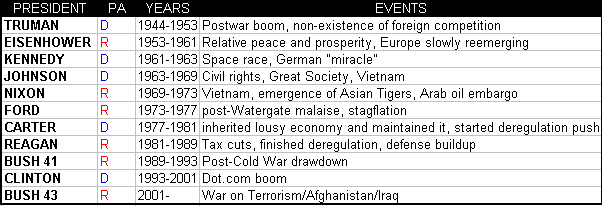
Truman, Eisenhower, and Clinton would have had to really botch things to have had less-than-stellar economies. Truman presided over the greatest relative economic prosperity that the U.S. has ever had, simply because the war had destroyed all the competitors. That hadn’t changed much for Eisenhower.
Kennedy’s term was cut short by an assassin’s bullet but his greatest contributions to the economy was a major tax cut, including a slashing of a confiscatory 90% rate on the very wealthy, and the inititation of the space race. Both poured a ton of money into the economy.
Johnson created massive public debt by deciding to have guns and butter simultaneously, a program that Republicans would dust off in future generations. The civil rights era happened mostly on his watch, somewhat of his doing although with a big assist from the courts. The Great Society program, under his leadership, also redistributed a lot of money. The combination of these things, though, created a massive uplifting for the very poor, especially blacks. One can argue that, in the longer term, they also impeded getting those groups into the middle class.
Nixon inherited Johnson’s mess and made some of his own. And then there was the 1973 OPEC embargo, which made things much worse. Ford and Carter never really recovered.
The economy boomed under Reagan, although not in the first couple of years. His massive tax cuts helped spur the economy but also created more inequality. The massive defense buildup drained the treasury in longer term but helped prime the pump.
Bush the Elder inherited a somewhat stagnant economy and had to endure the after effects of the post-Cold War defense build-down. The combination of that, poor campaign skills, and agreeing to raise taxes was a bad one for his re-election bid.
We’ve already discussed Clinton and Bush the Younger.
None of this is to say that the trends Bartels and Drum point to aren’t there or even that their explanations for the trends don’t have merit. But we need to look beyond a simple analysis of party affiliation and income distribution to know.
Update (1433): Steve Verdon weighs in with, “Political Business Cycles—Don’t Forget Those Recessions.”

It’s Guns and Butter, not Guns and Better… 😀
Kinda early for Kevin Drum to be judging the aftermath, economically, of OIF now, and not in 2-3 years though, IMO.
James, that’s a nice top-level summary. I suspect that the post-Cold War defense drawdown begun under Bush helps the Clinton-era growth, too, since it helped relieve deficit pressure and turned a lot of bright minds loose for peaceful commercial use.
I’d also lay some of the recession that commenced the 21st Century on Clinton’s counterproductive antitrust policy, exemplified in its jihad against Microsoft. Admittedly, Congress had quite a hand in that, and on a bipartisan basis too. Among the things the dot-com boom suffered was a determined campaign by the political class to bring it under the sway of the federal protection racket: IOW, force Silicon Valley to join the lobbying-and-donating ecology it had ignored.
The whole study is rife with convenient methods. The one year lag-time conveniently gives Democrats a win in every presidency. if the lag time is two to three years, or weighted evenly across four years, suddenly the data favors Republicans. Remember that presidents don’t get their first budget until October of their first year, so the data is only three months old. Second, I find it astounding that anyone can use data points that conveniently ignore the composition of Congress, especially considering the historic loss of 40 years of Democratic rule in 1994. That counts for nothing?
I don’t buy the idea that a President has that much of an effect that early, but there is a good explanation we can easily track.
Consumer spending, and therefore consumer confience is the major variable in GDP. If something happened on an ongoing basis only during Republican administrations , there might be a correlation that proves that the economy does better under Democrats.
In the heydays of the Clinton Administration, unemployment was at 5.2%. Today it is 5.2%. I wonder who it was that reported the news in the 90’s as the greatest economy ever and today’s as a weakened economy.
A quick google search after a reasoned approach – and voila – the conclusion
Oh dear. John Lott. I hope we can do better than that.
Funny, that was my thought on seeing Kevin Drum’s name on the other thing. 😉
is there a convenient ommission regarding Clinton’s .Com Boom, of Clinton’s Oval Office Boom Boom? The lies to congress and Impeachment that followed weren’t a terrible pick me up for the economy, leading to a recession in the first qtr of 2001.