Barack Obama: Unilateralist?
Oliver Kamm makes a rather surprising criticism of Barack Obama:
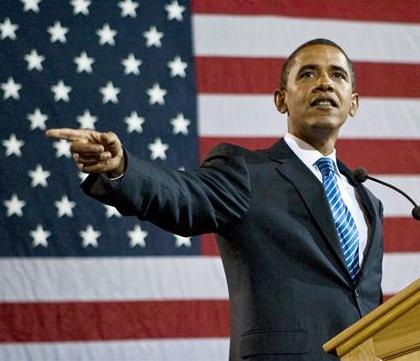
The problem with Obama is that he evinces little interest in the role of America’s European allies. There is a paradox here. Obama makes much (as he did in a long essay in Foreign Affairs last year) of the need to “rebuild our ties to our allies in Europe and Asia and strengthen our partnerships throughout the Americas and Africa”. Yet his approach to foreign policy shows scant regard for the opinions of European governments or the requirements of collective security. It is as if President Bush’s gratuitously brusque unilateralism has been retained but with a smiley face.
Obama invokes European governments when he wishes to argue against the Bush administration’s policies in Iraq. He overstates the degree of European consensus on that issue, and thereby gives an implicit signal that the UK, Spain, Denmark and many countries in the former eastern bloc are not among his primary concerns in transatlantic relations. He also gives the unmistakable impression that America’s European allies serve as a stage prop in his campaign rather than being part of a dialogue that he ought to be pursuing energetically.
On this side of the pond, putting American interest at the center of foreign policy and leveraging allies to support that policy is a feature, not a bug. Nor can I think of a recent American president who didn’t operate that way, regardless of ideology or rhetoric. Bill Clinton did a good job of persuading Americans and the international community that he was deferential to international institutions but was perfectly willing to use military force absent UN Security Council approval (as in the Kosovo intervention) and to resist Allied calls for action (as in Rwanda and, for many years, Bosnia) when convenient. George W. Bush, by contrast, has earned a reputation as a unilateralist despite desperate measures to win UN consensus for war in Iraq and then putting together a “coalition of the willing” when that failed. In short, everyone wants the cover of international institutions and the support of allies when they can get it but is willing to act in what they perceive as America’s interests when they can’t.
Kamm’s related point, though, is much more interesting:
Diplomacy is not about being friendly. It is about achieving goals through negotiation. If the leader of the western alliance gives up a bargaining chip in advance, then he is making it less likely that western diplomacy will work. In the case of Iran, diplomacy has been conducted by the EU three (Britain, France and Germany) since 2003, with the aim of persuading the Islamic Republic, through a mix of incentives and penalties, to cease permanently its domestic activities in uranium enrichment. (The west has accepted a compromise proposal from Russia for some uranium enrichment activity to be moved from Iran to Russia.)
How does Obama think the calculus of Iranian decision-making will be affected by a unilateral concession by him? How does he think European governments will take it? Has he asked them? If not, does he intend to? Will he take account of the British foreign secretary’s reported “queries” on this stance? Or are European friends of the US expected to fall into line behind whatever the White House adopts as declaratory policy?
If Obama wins, he’ll be surrounded by the institutional trappings of the presidency, including the pressures to conform to longstanding norms in foreign affairs. These will be reinforced through the interagency process and the strong urgings of diplomatic, military, and intelligence professionals. So candidate Obama, like candidate McCain, won’t be the same as President Obama or President McCain.
Still, while Obama is very smooth rhetorically about building alliances and McCain is less so, Kamm’s got a point here. Obama’s natural instinct is to be a consensus builder, to be sure, but his idea of consensus is using his charm and force of personality to get others to do what he wants, not listening to others and crafting a majority view. Both he and McCain are, to an extent, believers in a Great Man view of history. But McCain’s formative experience is as a part of a team where the whole is greater than the sum of the parts.
McCain’s “League of Democracies” concept, while worrisome to fans of the UN and potentially problematic when dealing with great powers such as China and Russia, is fundamentally multilateral. He’s looking to institutionalize the common interests of free societies to break the gridlock of institutions like the UN where democracies are outnumbered. He wants to be the quarterback, to be sure, but he’s interested in building a team.

Neither the northern nor southern “no-fly” zones in Iraq had UNSC approval nor did Clinton’s attack on Iraq in 1998.
I think the multilateral vs. unilateral notion is mostly one of salesmanship and Sen. Obama probably has an advantage over Sen. McCain in that regard just as Bill Clinton did over George W. Bush.
On another point in the post I think the League of Democracies is actually a pretty poor idea for the reason that it undermines U. S. policy in some respects.
What constitutes eligibility for such an organization? Invitation? Self-identification as a democracy?
What is a democracy? Americans tend to use the word as a short-hand for liberal democracy with protection of minority rights and government by (at least somewhat) limited powers. But at times the U. S. government defines it as a country the employs the electoral process.
If any country is eligible for membership, it’s indistinguishable from the UN. If countries that use the electoral process are eligible, it’s nearly indistinguishable from the UN.
If it’s only open to countries that have systems just like ours, it will be a very small club indeed.
Uni-lateralism. Meaning one sided. I guess George W. Bush somehow united our nation with all the others, UK, Austrialia, etc, etc, that participated in the liberation of Iraq from Saddam Hussein. Clinton’s cowardice in Somalia cost thousands their lives. How many died in Bosnia before Clinton acted? To compare George W. Bush with Barrack H. Obama is like comparing apples and cherries. Obama has no governing experience, his foreign policy is likely guided by former Carter people.