EU Elections: Good Night for the Right
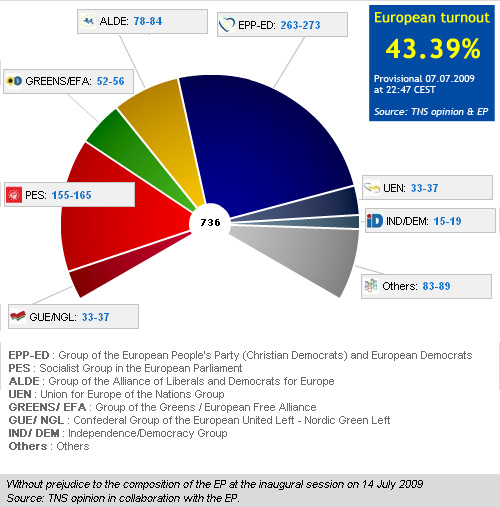 I begin my New Atlanticist roundup essay “European Parliament Moves Right” with, “The weekend’s European Parliament produced good news for the center-right parties, bad news for the center-left, and good news for radical parties of all stripes.”
I plan other posts today on the implications for the major governments and smaller states in Europe. This post, though, focuses on the general picture for the EU, notably the odd fact that the Right won at a time when they seemed ripe for rebuke and the fact that turnout has declined in every successive election for the European Parliament.
My close:
While I agree with Yglesias that the EU’s failure to capture the public imagination by now is problematic, it goes to far to say that they are”the world’s most significant economic actor.” It’s true that the EU and USA vie for the title of world’s largest economy and that, epending on the day’s euro-dollar exchange rate, the EU is sometimes out in front. But the fact of the matter is that, while they’ve made a lot of progress, the EU is not a single economy, let alone a unified political entity. And they’re further away from that goal today than they were a week ago.
It’s also worth noting that, while “the right” were the big winners in these elections, “the right” is even less a coherent entity in EU politics than it is in the United States at the moment. While Sarzoky is bullish on consolidating gains and making the EU more powerful (naturally, with France/Sarkozy guiding the way) the center-right parties elected in the UK and elsewhere are decidedly not interested in that agenda.
Much more at the link.
Graphic: Euractiv

This seems like a good point at which to point out that the ideas of right, left, and center don’t translate well between different countries. In France the center-right is a lot more like John Kerry than it is like, say, Newt Gingrich.
Judging by the pie chart it looks like social democrats won relative to socialists and Greens and the European Right (which doesn’t have a close equivalent here in the U. S.) is still pretty marginalized.
And that’s saying something.
I suppose rather than a support of the right, it’s a rejection of the left we are seeing.
That graphs seems deeply misleading: Why are all of the “other” MEPs assumed to ultra-hard-right? Shouldn’t, on average, that gray wedge be in the middle?
For example, the Swedish Pirate Party is an “other”, but will likely ally with the Green block.
The explanation that goes with the graph describes “other” as follows:
It would be interesting to see a more detailed breakdown, but this, plus the position of the right in European politics, suggests most of them would end up on the right. The European Right tends towards nationalistic positions that are unique to each country’s history, while the Left is naturally international.