L.A. Billboard Ban Upheld
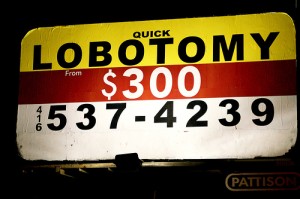
This billboard sign was mocking the $300 Divorce signs that have littered Toronto the past year or two
The 9th Circuit has upheld Los Angeles bans on billboards, saying no 1st Amendment issues were at stake.
Outdoor advertising company Metro Lights LLC had argued that the city could not prohibit new “off-site” signs — images that advertise products not sold on the immediate property — while at the same time selling advertising space on city-owned bus benches and kiosks. Metro Lights had accused the city of auctioning off “1st Amendment rights to the highest bidder.”
“This is strong, if rather sloganeering, language, but after reviewing the case law on which Metro Lights relies, we believe it to be little more than a canard,” the court wrote.
Howard Bashman has a good write-up on the case.
While my instincts are generally libertarian and to be dubious of anything coming out of the 9th Circuit, this strikes me as a no-brainer. Decades of case law make clear that localities can impose time, place, and manner restrictions on speech in order to achieve public policy goals incidental to said speech. Clearly, the city’s purpose here was a reasonable limitation in order to improve the aesthetic quality of the community rather than a backdoor attempt to regulate speech.
Metro Lights LLC is no doubt harmed by the law, since they’re in the outdoor advertising business. But the harm isn’t to their free speech rights but rather to their commercial interests. And they’re no more harmed than, say, newspapers and magazines denied the right to publish advertisements from tobacco and liquor companies.
That the city is selling outdoor advertising while prohibiting others from doing likewise is perhaps unfair but it’s hardly unusual. For example, many states restrict the sale of alcoholic beverages to state-run ABC stores and many also have state-run lotteries while prohibiting private ones. In any case, it’s not a free speech issue.
Photo by Flickr user Word Freak under Creative Commons license.

not to mention that the 1st amendment is largely about political speech. Commercial advertisement has no protection whatsoever under the 1st.
I don’t recall reading the word “non-commercial” in the First Amendment.
$300 for a lobotomy! Expensive!
I’d rather have a bottle in front of me than a frontal lobotomy!
I thought the 1st amendment was about protecting nekkid dancers? A crucifix in urine? Illinois Nazis?