Petraeus Senate Testimony Cites ‘Significant but Uneven’ Progress
General David Petraeus’ testimony before the Senate Foreign Relations Committee today was cautious and somewhat predictable.
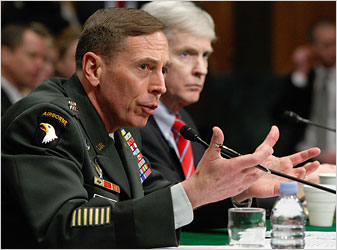
Key quotes follow with bold emphasis mine in all cases:
Since Ambassador Crocker and I appeared before you seven months ago there has been significant but uneven security progress in Iraq. Since September, levels of violence and civilian deaths have been reduced substantially, Al Qaida-Iraq and a number of other extremist elements have been dealt serious blows, the capabilities of Iraqi security force elements have grown, and there has been noteworthy involvement of local Iraqis in local security.
Nonetheless, the situation in certain areas is still unsatisfactory and innumerable challenges remain. Moreover, as events in the past two weeks have reminded us and as I have repeatedly cautioned, the progress made since last spring is fragile and reversible.
[…]
Another important factor has been the attitudinal shift among certain elements of the Iraqi population. Since the first Sunni Awakening in late 2006, Sunni communities in Iraq increasingly have rejected Al Qaida-Iraq’s indiscriminate violence and extremist ideology. These communities also recognize that they could not share in Iraq’s bounty if they didn’t participate in the political arena. Over time, Awakenings have prompted tens of thousands of Iraqis, some former insurgents, to contribute to local security as so-called Sons of Iraq. With their assistance and with relentless pursuit of Al Qaida- Iraq, the threat posed by AQI, while still lethal and substantial, has been reduced significantly.
[…]
In September, I described the fundamental nature of the conflict in Iraq as a competition among ethnic and sectarian communities for power and resources. This completion continues, influenced heavily by outside actors. And its resolution remains the key to producing long- term stability in Iraq.
[…]
Finally, insufficient Iraqi government capacity, lingering sectarian mistrust and corruption add to Iraq’s problems.
[…]
Given the importance of the Sons of Iraq, we’re working closely with the Iraqi government to transition them into the Iraqi security forces or other forms of employment. And over 21,000 have already been accepted into the police or army or other government jobs. [Sons of Iraq = Former Baathist Dead-Enders -ed.]
[…]
Iraqi forces have grown significantly since September, and over 540,000 individuals now serve in the Iraqi security forces. The number of combat battalions capable of taking the lead in operations, albeit with some coalition support, has grown to well over 100. These units are bearing an increasing share of the burden, as evidenced by the fact that Iraqi security losses have recently been three times our own.
[…]
In the coming months, Iraq leaders must strengthen governmental capacity, execute budgets, pass additional legislation, conduct provincial elections, carry out a census, determine the status of disputed territories, and resettle internally displaced persons and refugees. These tasks would challenge any government, much less a still-developing government tested by war.
[…]
It clearly is in our national interests to help Iraq prevent the resurgence of Al Qaida in the heart of the Arab world, to help Iraq resist Iranian encroachment on its sovereignty, to avoid renewed ethno-sectarian violence that could spill over Iraq’s borders and make the existing refugee crisis even worse, and to enable Iraq to expand its role in the regional and global economies.
Andrew Sullivan‘s assessment strikes me as about right:
Petraeus and Crocker strike me as making every effort to be intellectually honest, and their credibility is all the greater for it. They certainly appear more circumspect about Iraq than some of their Republican interlocutors (Inhofe, predictably, is a parody of knee-jerkism and Lindsey Graham seems much more insistent on the surge’s success than Petraeus). He’s candid about turning Baghdad into a warren of sectarian mini-ghettoes guarded by massive internal walls, about Iran’s large gains in influence whatever happens, about a recent spike in violence.
I haven’t had a chance to see the testimony or the Q&A yet; I’ll likely comment further once I have.
Early big media coverage:
- “General Resists Timetable for Withdrawal of Troops in Iraq,” Thom Shanker and Steven Lee Myers, NYT
- “Petraeus: Iraq Security Improved, but ‘Fragile and Reversible’,” William Branigin, WaPo
- “Petraeus Says Iraq Too `Fragile’ for Removing Troops,” Nicholas Johnston and Ken Fireman, AP
