Urban Density
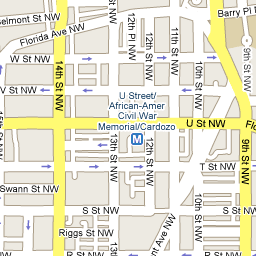 Tim Lee does Google maps for three neighborhoods he’s lived in and one he’s thinking of moving to and notes the incredible range of compactness (as visually demonstrated from many more streets showing up in comparable map grids).
It’s amazing how many people you can pack into a small area. It’s also interesting to note that that St. Louis neighborhood, the Central West End, is among the densest in the St. Louis metro area. There aren’t any parts of St. Louis that are like the heart of DC, to say nothing of Philadelphia.
Then again, if there were, it wouldn’t be St. Louis.
I very much enjoy visiting Manhattan or Chicago or some of DC’s more densely packed neighborhoods. There’s something to be said for having a huge variety of restaurants, bars, shops — even museums — within walking distance. For some, they find it so enjoyable that they want to live that way all the time, even though it means paying much more for rent and/or living in a much smaller place than they’d otherwise have. For others of us, not so much.
Personally, I’m glad that the variety exists and we don’t all have to live in densely packed neighborhoods or sprawling suburbs but rather get to choose.

It’s hard to draw comparisons. In St. Louis the city proper has “de-densified” over the period of the last hundred years or so. In 1900 St. Louis was the fourth largest city in the U. S. after New York, Chicago, and Philadelphia and had a commensurate footprint and density.
Streets that used to exist no longer do. Old streets have been widened. And so on.
BTW Tim’s map is walking distance from where I went to high school and just a wee stretch of the legs from where I spent my early years.
Tim’s map also seems to show his St. Louis neighborhood was only a few blocks away from what might be one of the largest urban parks in the country — its certinly much larger than NYC’s Central Park.
Maybe the classic (modern) statement of the dichotomy is Jacque Tati’s Mon Oncle–check it out.
The choice isn’t really free – urban residents massively subsidize suburban residents, and most developeable and developed land in this country carries restrictions which force suburban development on it.
Here’s a record of the changes in St. Louis’s population over the years. As you can see the city’s current population is less than half what it was at its peak in 1950. St. Louis is a case of hollowing-out.
Switching to satellite view belies the deliberately misleading comparison between the Central West End and the DC and Philly neighborhoods cited here. The buildings on the block shown include hospitals, hotels, and large high rise apartment buildings, which necessarily have a larger footprint and will appear to have a lower “density” if your only critera for density is “number of roads shown on google maps.”
A more apt comparison would have been Soulard or Tower Grove, both of which feature a more analogous building style as the other neighborhoods featured. They are indeed less dense than DC or Philly, but not so much as it would appear from the linked post.
BTW when my great-great-great-grandfather first came to St. Louis in the 1830’s the city ended at 4th St. That’s where the Arch is.
It certainly is a lifestyle choice with pluses and minuses. Having lived in a number of “dense packed” neighborhoods in Chicago, and now living in classic suburbia I can tell people all about those pluses and minuses.
Bottom line: if you have kids, even if they go to private schools, its tough in the city. But when the nest is empty……..Old Town? Gold Coast? Or maybe south of Grant Park….
heh.
Next time I’m aked to pay more property tax to support an urgan transportation system I’ll never use… but the urbanites do, I’ll remember this.
Bithead, the amount of money spent on mass transit is a drop in the bucket compared to the gas taxes collected on urban drivers but diverted to suburban highways. And that’s just one of the subsidies.
But wait; WHy would they need gas? Isn’t everything within walking distance?
Suburban drivers drive father thereby paying far greater tax. Your numbers don’t add up.
Bithead, most urban areas in this country still require a lot of driving – and most of those cities maintain a much higher percentage of their major arterial network than do their corresponding suburban areas.
IE, for every 10 miles I drive on major roadways, 8 are on roads on which I pay gas tax but the city has to build/maintain. For every 10 miles you drive, only 1 is on a major roadway that doesn’t get gas taxes.