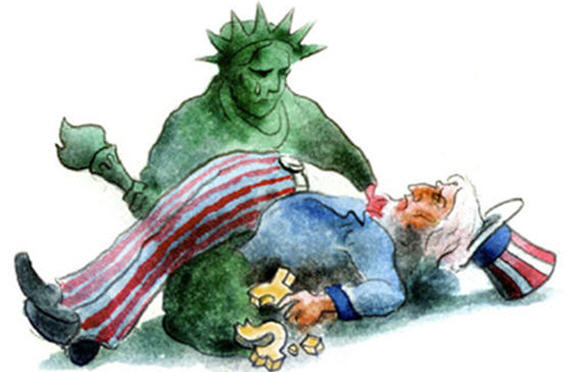

Watching the news and reading the op-eds makes it clear: America is doomed.
Tom Friedman says it’s our own damned fault.
In the wake of the hugely disappointing budget deal and the S.& P.’s debt downgrade, maybe we need to hang a new sign in the immigration arrival halls at all U.S. ports and airports. It could simply read: “Welcome. You are entering the United States of America. Past performance is not necessarily indicative of future returns.”
[…]
Our slow decline is a product of two inter-related problems. First, we’ve let our five basic pillars of growth erode since the end of the cold war — education, infrastructure, immigration of high-I.Q. innovators and entrepreneurs, rules to incentivize risk-taking and start-ups, and government-funded research to spur science and technology.
We mistakenly treated the end of the cold war as a victory that allowed us to put our feet up — when it was actually the onset of one of the greatest challenges we’ve ever faced. We helped to unleash two billion people just like us — in China, India and Eastern Europe. For us to effectively compete and collaborate with them — to maintain the American dream — required studying harder, investing wiser, innovating faster, upgrading our infrastructure quicker and working smarter.
But Friedman is, at heart, an optimist. He thinks we can right the ship if we just work together and make the right choices. John Harwood, not so much.
[S]tep back from events this month, this year or even this decade, and a more ominous portrait comes into focus. It shows an American economy under ever-increasing competitive pressure, demographic trends making those pressures more acute and a voting public facing repeated disappointment as it yearns for better times.
[…]
Any American economy would suffer compared with the one that emerged as a dominant force after World War II. In 1960, according to the World Bank, the United States accounted for 39 percent of global economic output. Millions of soldiers came home to attend college under the G.I. Bill, lifting worker productivity and expanding the suburban middle class. Annual economic growth topped 5 percent four times each in the 1950s, ’60s and ’70s.
Those trend lines eventually turned down. But changes in American society helped mask the effects. While international competition shrank the American share of the global economy, women poured into the work force and gave more and more families two breadwinners instead of one. While men’s median income declined slightly between 1970 and 1990, the median income for women rose nearly 50 percent. So household income rose.
While overall growth slowed — the economy expanded at least 5 percent in a year just once in the 1980s, and not since — so did the rate at which Americans had children. Smaller families stretched family incomes further.
And as increases in education and the number of women in the work force reached a plateau, cheap and easy credit encouraged Americans to consume more. So did the “wealth effect” from the Internet-fueled stock market of the 1990s, and the real estate boom after that. From 1980 to 2005, personal savings as a proportion of disposable income shrank to 1.5 percent from 9.8 percent. All the while, politicians and voters grew accustomed to more government services than they were willing to pay for.
“The 2007-2009 collapse brought this era to an end,” Mr. Reischauer said. In the new one, ordinary Americans “are going to be very frustrated, because the political system can’t deliver the rising economic performance and living standards they’ve come to expect.”
Blake Hounshell summarized Harwood’s column, “Sorry Americans, the good times are over.” Naturally, this immediately evoked Merle Haggard:
I wish a buck was still silver.
It was back when the country was strong.
Back before Elvis; before the Vietnam war came along.
Before The Beatles and “Yesterday”,
When a man could still work, and still would.
Is the best of the free life behind us now?
Are the good times really over for good?
Are we rolling down hill like a snowball headed for hell?
With no kind of chance for the Flag or the Liberty bell.
Wish a Ford and a Chevy,
Could still last ten years, like they should.
Is the best of the free life behind us now?
Are the good times really over for good?I wish coke was still cola,
And a joint was a bad place to be.
And it was back before Nixon lied to us all on TV.
Before microwave ovens,
When a girl could still cook and still would.
Is the best of the free life behind us now?
Are the good times really over for good?Are we rolling down hill like a snowball headed for hell?
With no kind of chance for the Flag or the Liberty bell.
Wish a Ford and a Chevy,
Could still last ten years, like they should.
Is the best of the free life behind us now?
Are the good times really over for good?Stop rolling down hill like a snowball headed for hell.
Stand up for the Flag and let’s all ring the Liberty bell.
Let’s make a Ford and a Chevy,
Still last ten years, like they should.
The best of the free life is still yet to come,
The good times ain’t over for good.
Released in May 1982, it reached #2 on the Billboard Country Singles chart. In my mind, it’s the best of a series of similar songs that came out in the late 1970s and early 1980s. (The Kinks’ “Catch Me Now I’m Falling” [1979] and Hank Williams Jr’s “Mr. Lincoln” [1984] are other archetypes.) The country had suffered defeat in war, several shocks in the political system, and the economy was in the crapper.
Within a couple of years, it was Morning in America.
Things are really, really bad right now. But I’m not sure they’re any worse than they were then. While GM has had its troubles, a Chevy actually will run ten years (like it should). And at least a podunk country hasn’t held our embassy hostage for 444 days.
They’re almost certainly not as bad as they were during the turmoil of the late 1960s and early 1970s, with Vietnam, the civil rights struggle, Watergate, and the oil shocks ripping the country apart. And, regardless of whether we’re undergoing a Great Recession, a Great Contraction, or a Mediocre Depression, they’re sure as hell not as bad as they were from 1929 to 1944.
I haven’t the slightest clue how we’re going to pull out of the nose dive that we’re in. Maybe we won’t; there’s a first time for everything. But I’d bet the other way.