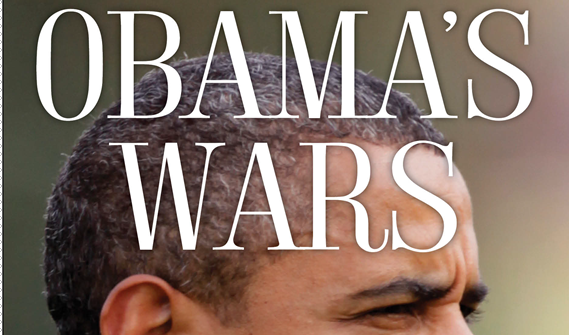

Dan Drezner asks, “Has Bob Woodward jumped the shark?”
My snarky response is that he did that in Bob Casey’s hospital room. But Dan’s making a different point:
What used to be his bread and butter — the political and bureaucratic machinations of presidential administrations — is no longer his exclusive province. Beyond the Washington Post and New York Times, media outlets as varied as Politico, Vanity Fair, Huffington Post, and the New Yorker now generate monthly weekly hourly revelations that Woodward used to be able to hoard for his books. As my old dissertation advisor used to say, “is there anything new here?”
The major “revelation” of Woodward’s latest tome, Obama’s Wars, is apparently that there was substantial dissent on the White House team on the matter of Afghanistan. Did anyone not already know that?
But Blake Hounshell makes a pretty strong case that the details matter.
Get a load of some of these nuggets:
- Neither Richard Holbrooke, the special advisor for Afghanistan and Pakistan, nor retired Lt. Gen. Doug Lute, the White House “war czar,” believe in the current U.S. war strategy. Woodward quotes Holbrooke saying flatly “it can’t work”; Lute apparently said that the Afghan strategy review didn’t “add up” to the course the president ultimately chose. For his part, Vice President Joe Biden is quoted calling Holbrooke “the most egotistical bastard I’ve ever met.”
- Afghan President Hamid Karzai has apparently been diagnosed with manic depression and is treating his condition with drugs (though perhaps not opium, as suggested some months back by the ousted U.N. diplomat Peter Galbraith). Woodward quotes Karl Eikenberry, the U.S. ambassador, as saying, “He’s on his meds, he’s off his meds.” That’ll go over well in Kabul.
- Axelrod apparently asked Obama, “How could you trust Hillary?” when Clinton was being considered to be secretary of state.
- In comments that fall into the category of “true but not a good idea to say,” Obama tells Woodward, “We can absorb a terrorist attack. We’ll do everything we can to prevent it, but even a 9/11, even the biggest attack ever . . . we absorbed it and we are stronger.”
- Plenty of people have the knives out for national security advisor Jim Jones, who in turn rips unnamed presidential aides as “the water bugs,” “the Politburo,” “the Mafia,” and “the campaign set.” I’m not sure what he means by this or to whom he’s referring, but I have some educated guesses.
- Defense Secretary Bob Gates apparently doesn’t like Jones’s deputy, Tom Donilon, and thinks he would be a “disaster” as national security advisor. Gates was offended by a remark Donilon made about a general who isn’t named in the book. Meanwhile, Joint Chiefs Chairman Adm. Mike Mullen and Vice Chairman Gen. James Cartwright don’t trust one other — Cartwright worked closely with Biden on a proposal for a smaller Afghan surge force than was ultimately chosen.
- Gen. David Petraeus, the man now charged with saving Obama’s ass in Afghanistan, thinks White House advisor David Axelrod is “a complete spin doctor.” Petraeus also told his aides in May that the administration was “[expletive] with the wrong guy,” though it’s not clear what the context was.
None of this shocks me. Holbrooke is an exceedingly controversial figure. Jim Jones has been the subject of stab-in-the-back leaks since the earliest days of the administration. And the military, generally, doesn’t have much use for politicos.
But, then, I’m a cynical political scientist who follows this stuff on a routine basis. Revelations of how the sausage gets made are always embarrassing.