
Mass protests, sometimes violent, in France are wildly popular and gaining steam.
NYT (“‘Yellow Vests’ Descend on Paris as Police Arrest Hundreds and Fire Tear Gas“):
Thousands of demonstrators descended on Paris early Saturday, as residents braced for more mayhem and the police turned out in force, blocking access to main arteries and monuments that had been the focus last week of France’s worst urban violence in decades.
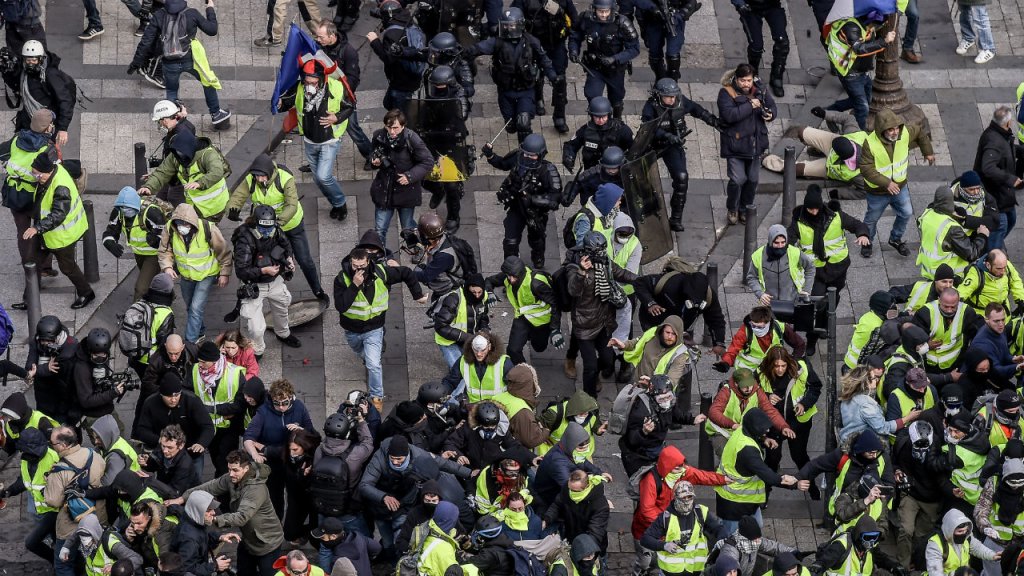
About an hour into a tense but otherwise peaceful demonstration, the police fired an initial tear-gas volley, as the so-called Yellow Vests protesters attempted to charge a cordon blocking a side street off the Champs-Élysées, where other protesters milled about.
The scenes were punctuated by shouts of “Macron Resign!” — a reference to President Emmanuel Macron, who has become a focus of anger — impromptu bursts of the French national anthem, “The Marseillaise,” and curses spat at the police and members of the news media.
The police quickly swept up and arrested nearly 500 demonstrators.
A line of eight police vehicles blocked access to the Arc de Triomphe, a quasi-sacred national symbol and that was defaced last weekend. The police also hemmed in demonstrators at the other end of the Champs-Élysées, near the seat of the French presidency and the Place de la Concorde.
Police detachments were set up at all major central Paris intersections. Shops on the Champs-Élysées were shuttered, and most monuments and museums were closed, even those far from the protest areas, including the Eiffel Tower, the Louvre and the Musée d’Orsay. Residents of many wealthier neighborhoods left the city as a precaution.
The government has been warning of a potential increase in violence from the vandals or casseurs, literally “breakers,” who habitually attach themselves to French streets protests.
There was great fear on Saturday that those more hard-core and violent elements would hijack the Yellow Vests demonstrations, whose ranks were initially filled by members of the working poor from rural areas dismayed by a planned increase in a gasoline tax. Their demonstrations were named for the fluorescent yellow hazard vests adopted by the protesters as a sign of their distress.
The French government eventually suspended the planned gas tax increase before canceling it outright. But that did not quell the outrage, which has morphed into much broader anger at Mr. Macron’s economic and social policies, and France’s declining living standards.
The motivations of the protesters have not changed from previous weekends, nor has their determination.
“We drove all night,” said Julien Lezer, an electrician from the Var region, on the Mediterranean. “We don’t agree with the current system anymore; it doesn’t represent us. It’s not in the regions that things change; it’s in Paris. It’s when the people from the regions go to Paris that the politicians listen.”
Reuters (“French police clash with ‘yellow vest’ protesters on Champs Elysees“):
French riot police fired tear gas canisters at “yellow vest” protesters in central Paris on Saturday at the start of a planned demonstration against the high cost of living under President Emmanuel Macron.
A police spokeswoman told reporters there were about 1,500 protesters on the Champs Elysees boulevard and authorities said 211 people had been arrested after police found weapons such as hammers, baseball bats and metal petanque balls on them.
Hundreds of protesters were milling around the Arc de Triomphe monument, which was defaced with graffiti last Saturday, when rioters also torched cars and looted shops.
“We will do all we can so that today can be a day without violence, so that the dialogue that we started this week can continue in the best possible circumstances,” Prime Minister Edouard Philippe said on French television.
On Tuesday Philippe announced the government was suspending planned increases to fuel taxes for at least six months to help defuse weeks of protests, the first U-turn by Macron since he came to power 18 months ago.
About 89,000 police were deployed across France on Saturday, some 8,000 of them in Paris.
“We have prepared a robust response,” Interior Minister Christophe Castaner told online news site Brut. He called on peaceful protesters not to get mixed up with “hooligans”.
“The troublemakers can only be effective when they disguise themselves as yellow vests. Violence is never a good way to get what you want. Now is the time for discussion,” he said.
“If you are not aggressive, we will not be aggressive, a masked policeman said as a protester stuck yellow plastic flowers onto policemen.
Much of Paris looked like a ghost town on Saturday, with museums, department stores closed on what should have been a festive pre-Christmas shopping day.
Tourists were few and residents were advised to stay at home if at all possible. Dozens of streets were closed to traffic, while the Eiffel Tower and world-famous museums such as the Musee d’Orsay, the Centre Pompidou and the Louvre were shut.
Many shops were boarded up to avoid looting and street furniture and construction site materials have been removed to prevent them from being used as projectiles.
NBC (“Paris braced for new riots as ‘Yellow Jacket’ protests sweep France“):
The French capital was shut down on Saturday as the city braced itself for what many fear will be the most violent protests in weeks of forceful anti-government demonstrations that have swept the country.
Protests that began last month against planned tax hikes on gas have since morphed into a wider rebuke of Emmanuel Macron’s presidency and an expression of anger at his attempts to reform France’s long-ailing economy.
Almost eight in ten people in France support the protests, according to a poll published last week.
Paris was largely deserted on Saturday morning as riot police waited on street corners and the first streams of protesters walked toward the Champs-Elysees, chanting the country’s iconic national anthem and waving the tricolor flag as they passed the presidential palace.
Store fronts along the world-famous street — the scene of last week’s clashes between demonstrators and police — were barricaded behind plywood sheets in preparation for yet more violence.
[…]
Paris’s glittering museums and galleries — including the Louvre and the Eiffel Tower — said they would not open their doors to the usual troop of holiday season tourists.
Soccer matches have also been called off across the country.
As Parisians prepared for what looked to be another weekend of destruction, the vast majority who spoke to NBC News on Friday said they supported the grievances of the so-called Yellow Jackets.
While many said they were perturbed by the protests’ escalating violence, they also said they shared the demonstrators’ frustrations. Namely, the high-cost of living in France and Macron’s appetite for reform.
“There is great anger in France at the moment,” said André Rubinot, a retired baker whose old boulangerie stands in the shadow of the Eiffel Tower.
“The president has too many reforms and he is going about them too quickly without asking anyone — quick, quick, quick,” he said.
Like others, Rubinot lamented that life had become too expensive as he ticked off different household goods that had gone up in price. “A baguette is now one euro 20 cents,” ($1.36) said the 68-year-old in disbelief.
The French have a tendency for fiercely opposing reform and quickly falling out of love with their presidents.
Macron, a former investment banker who swept to power on a reformist agenda, was supposed to be different.
The young centrist pledged to overhaul the country’s generous welfare state, which redistributes wealth across society with high taxes for the rich.
France has high levels of social security and workers’ rights, making it difficult to enact business-friendly reforms in spite of persistent unemployment.
But while he’s enjoyed a high profile on the global stage, he has struggled to pass legislation at the heart of his domestic agenda.
Joseph Downing, an expert in French politics at the London School of Economics, agreed that the protests were about “much more” than taxes on gas.
“It’s this entire idea of the squeezed middle or the squeezed upper working-class person who feels an entitlement to an ever-increasing standard of living but is something that no politician can deliver,” he said.
“This is where we’ve seen disenfranchisement with Sarkozy, with Hollande and now with Macron.”
The self-organized approach of the protest, which sprung up from the depths of social media, is also a relatively new phenomenon in France where people have historically relied on the powerful unions to organize discontent.
Several people who spoke to NBC News said the strength of the “Yellow Jackets” lies in the fact that the protest isn’t specifically linked to any political party or union and has therefore united swathes of the population.
“The politicians are afraid because they don’t know how to stop it,” said Julian Guillo, a 23-year-old property student. “It’s not one organization, it’s the people.”
There’s no small irony in a movement complaining about the high cost of living shutting down the economy during the peak season. But what most strikes me is the notion that a democratically-elected government ought be held hostage by rioters and engage them in “conversation.” But, having already capitulated to some of their demands, there’s no incentive for the mobs to quit now.
Of course, as an unsigned France 24 report (“Aux barricades! France’s long history of revolt“) notes, this is hardly unprecedented.
During the 1789 Revolution that began with the storming of the Bastille, French workers rioted over taxes, economic inequality and perceptions that the country’s rulers were out of touch.
And it seems President Emmanuel Macron has ignited this same spark, rekindling the French citizenry’s rebellious tendencies. While democracy has replaced the monarchy in France, the tradition of the masses taking their anger against perceived inequality onto the streets of Paris remains much the same.
Last weekend Yellow Vest protesters were responsible for Paris’s worst rioting in decades, looting and torching cars in plush neighbourhoods near the Champs-Élysées and graffitiing “Macron=Louis 16” and “King Macron”. Four people have been killed and hundreds have been injured in the protests.
Macron, a former Rothschild banker whom critics have long accused of being a “friend of the rich”, stoked popular anger for doing away with a wealth tax last year and proposing a rise in fuel taxes that campaigners say will hurt the poorest.
“We have all kinds of different social categories that have united under what we call ‘The People’, which has deep roots in French history,” sociologist Michel Fize told FRANCE 24 on the eve of new protests. “It’s become a very inclusive movement.”
He noted that unions representing students, farmers and truck drivers have recently joined the struggle.
“There’s reason to believe that other groups will join in too, because all social categories are affected by modern-day social injustice,” Fize said.
And the Yellow Vests have widespread backing. In a survey conducted by the Elabe institute for broadcaster BFMTV earlier this week, 46 percent of the French say they “support” them while 26 percent “sympathise” with their cause.
On Wednesday the French president caved. Macron abandoned the fuel-tax hike, but not before his image as an unshakeable leader was severely damaged.
“If people compare Macron to Louis XVI, it’s a warning that he has hasn’t learned the lesson of history,” sociologist Michel Wieviorka told the Associated Press. “They don’t literally want his head, but it’s a strong message that they don’t feel listened to.”
The concessions haven’t appeased the protesters, who said it was too little too late. With wages stagnant, unemployment above 9 percent and growing frustration at France’s taxes, which are among the highest in Europe, some Yellow Vests now want to topple the government.
Protest may be such a recurrent part of French history simply because it has often succeeded.
[…]
Fifty years ago, students at Sorbonne University erected barricades in a challenge to the status quo. The violence that authorities used to suppress the protesters brought French workers onto the streets, and the swelling 1968 movement that eventually numbered 9 million people brought France to its knees.
The uprising led to a 35 percent rise in the minimum wage and salary increases of 10 percent. But it undermined the legitimacy of president Charles de Gaulle, who stood down the following year.
Mass demonstrations also forced the French government to ditch plans to reform the university selection process in 1986, the reform of public transport workers’ pensions in 1995 and the introduction of a lower wage scale for recent university graduates in 2006.
“There is indeed a stronger culture of taking to the streets to protest in France than in many other countries. It’s due to our political history,” French Sociologist Laurent Mucchielli told FRANCE 24.
“It’s the counterparty to the way we are governed,” he continued. “In the past we were ruled by an absolute monarchy and today by a presidential regime. When there is no citizen participation, or citizens aren’t consulted [on important decisions], with someone always making decisions for them, you come to the point where the only way to react is to protest.”
While one understands general frustration across Western democracies with the failure of the system to continually provide ever-better living standards, the specific grievances fueling these protests mystify me.
That a newly-elected government would seek to quickly enact the agenda on which it ran is hardly shocking. Indeed, one would think the opposite would spark outrage.
The fuel tax, which Macron rescinded to appease the rioters, was indeed regressive. The intent, however, wasn’t so much revenue-generation as an attempt to reduce pollution to meet agreed-to standards to combat climate change. It’s not clear what Plan B will be.
It’s true that the French governing system is less responsive than many Western democracies, giving enormous power to the President and comparatively little to the parliament and premier. But that comes with more accountability. In the American system, a President can blame a recalcitrant Congress and Congress can blame the President. Not so much in France.
While the office is quite powerful, it’s not clear to me what it is that Macron is supposed to do about a baguette costing $1.38. That doesn’t seem particularly high to me; indeed, that’s about what they go for at my local supermarket.
One would think that having the country’s biggest and most important city shut down for weeks on end by a mob would grow tiresome. But, thus far, the movement, such as it is, seems to be gaining in popularity.