
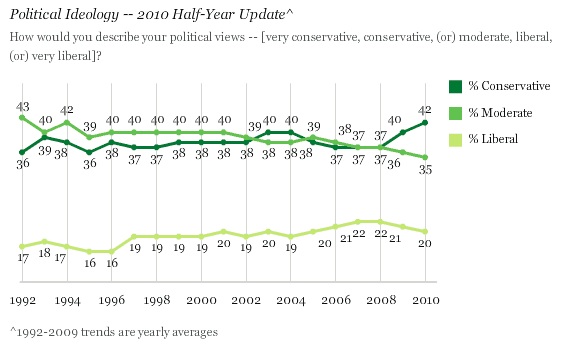
 Via Gallup: In 2010, Conservatives Still Outnumber Moderates, Liberals
Conservatives have maintained their leading position among U.S. ideological groups in the first half of 2010. Gallup finds 42% of Americans describing themselves as either very conservative or conservative. This is up slightly from the 40% seen for all of 2009 and contrasts with the 20% calling themselves liberal or very liberal.
[…]
The ideological orientation of Americans seen thus far in 2010 would represent a record-high level of conservatism (since at least 1992) if it is maintained for the full year.
The question is, however: what does this mean? I am not sure it means all that much, save for a measure of general dissatisfaction with the direction of the country, especially the economy, at the moment. The basic range of variation is not that great over time. The averages are as follows:
%con: 38.21%
%mod: 39.00%
%lib: 19.16%
The place a variation over time is within whether people identify as “conservative’” or “moderate,” as the “liberal” numbers vary very little over the time of the chart and are especially stable since 1997.
Some thoughts:
First, these terms are pretty vague, in truth. We have imprecise ideas of what they mean and certainly individuals have their own personal definitions.
Second, it is more an issue of marketing than anything else. It has long been the case that being a “liberal” has had a negative connotation in the general public. One of the knock on MIchael Dukakis in the 1988 elections was that he was a self-identified “liberal.” Indeed, part of what the Democratic Leadership Council tried to do after that election was to redefine the Democratic Party in a way that they were not so readily identified as liberal, and that shaped the campaign of Bill Clinton in 1992.
Third, even with the recent uptick in self-identified conservatives, if we look at the chart and consider the actual electoral outcomes, during this period we have had both a two-term Democratic presidency and a two-term Republican presidency. As predictors of such things, these numbers aren’t too helpful. Consider, for example, as low-water mark for being liberal (17% in 1992), we elected a Democrat. To specify what I am talking about here: our general ideological self-identification has remained within a fairly narrow range for almost twenty years, and yet there have been significant changes at the polls in terms of partisan victories and losses. As such, ideological self-identification does not appears to be an especially good proxy for understanding likely voting patterns.
Fourth, the likelihood is that the numbers reflect general dissatisfaction with the way the country is going at the moment—the current president is on the liberal side of the ledger and the economy and other issues are problematic, and so there is a reaction. That could explain as well, the 1992 36% number for conservatives—a recession had made the occupant of the White House at the time unpopular.
The bottom line is that while I suspect some conservative commentators will make a big deal out of these numbers, we are talking about a vague metric, ultimately, and one that really isn’t showing that much of a variation.








