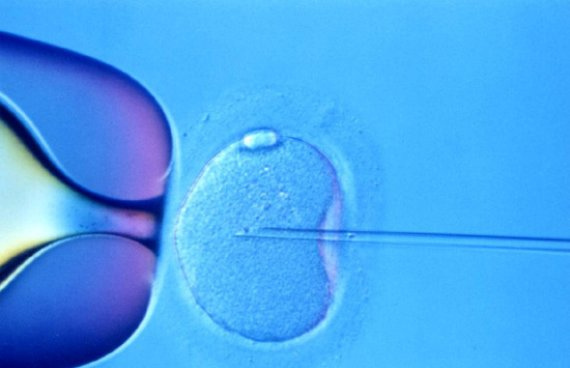

One of the two men who pioneered a procedure that once seemed like science fiction has won this years Nobel Prize In Medicine:
The Nobel Prize in physiology or medicine has been awarded this year to Robert G. Edwards, an English biologist who, with a physician colleague, Patrick Steptoe, developed the in vitro fertilization procedure for treating human infertility.
Since the birth of the first test tube baby, Louise Brown, on July 25, 1978, some four million babies worldwide have been conceived by mixing eggs and sperm outside the body and returning the embryo to the womb to resume development. The procedure overcomes many previously untreatable causes of infertility.
Dr. Edwards, a physiologist who spent much of his career at Cambridge University in England, spent more than 20 years solving a series of problems in getting eggs and sperm to mature and successfully unite outside the body. His colleague, Dr. Steptoe, was a gynecologist and pioneer of laparoscopic surgery, the method used to extract eggs from the prospective mother.
Dr. Steptoe, who presumably would otherwise have shared the prize, died in 1988. Dr. Edwards, who born in 1925, has now retired as head of research from the Bourn Hall Clinic in Cambridge, which he and Dr. Steptoe founded as the world’s first center for in vitro fertilization.
Though in vitro fertilization is now widely accepted, the birth of the first test tube baby was greeted with intense concern that the moral order was subverted by unnatural intervention in the mysterious process of creating a human being. Dr. Edwards was well aware of the ethical issues raised by his research and took the lead in addressing them.
The objections gradually died away, except on the part of the Roman Catholic Church, as it became clear that the babies born by in vitro fertilization were healthy and that their parents were overjoyed to be able to start a family. Long-term follow-ups have confirmed the essential safety of the technique.
It’s been thirty-two years since Louise Brown, the world’s first human conceived outside the womb, was born and it’s unclear why the Nobel Committee waited this long to award Edwards — and Steptoe — for what was clearly a ground-breaking and, for many people, life-changing procedure.
Those of you who were around in 1978 when Brown was born will remember the breathless ethical debates that the story generated in the media — debates that probably would’ve been even more heated if cable news and the internet had existed back then — but, in the end, IVF has become rather commonplace, even among Catholics who continue to be instructed by their Church that the procedure is improper.