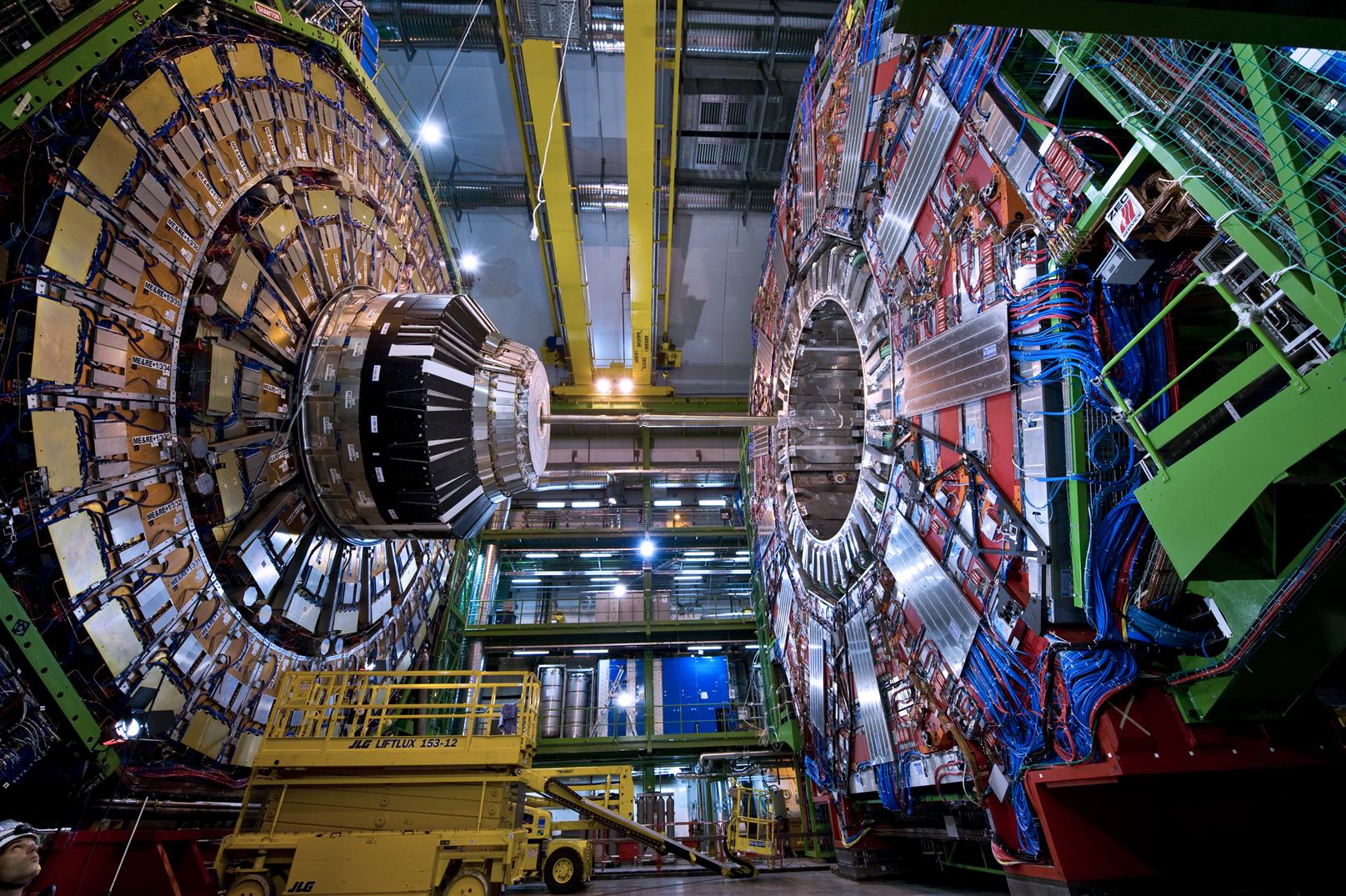

Scientists at the Large Hadron Collider in Europe think they might be close to confirming the existence of the most elusive particle in theoretical physics:
High noon is approaching for the biggest manhunt in the history of physics. At 8 a.m. Eastern time on Tuesday morning, scientists from CERN, the European Center for Nuclear Research, are scheduled to give a progress report on the search for the Higgs boson — infamously known as the “God particle” — whose discovery would vindicate the modern theory of how elementary particles get mass.
The report comes amid rumors that the two competing armies of scientists sifting debris from hundreds of trillions of proton collisions in CERN’s Large Hadron Collider, or L.H.C., outside Geneva, have both finally seen hints of what might turn out be the elusive particle when more data is gathered next year.
Alternatively, the experimentalists say that a year from now they should have enough data to rule out the existence of the most popular version of the Higgs boson, sending theorists back to their blackboards in search of another explanation of why particles have mass.
So the whole world will be watching.
For those of us who aren’t named Stephen Hawking here’s an explanation of what they’re looking for:
Q. What is the Higgs and why is it important?
A. The name Higgs refers to at least four things. First of all, there is a Higgs mechanism, which is ultimately responsible for elementary particles’ masses. This is certainly one of the trickier aspects of particle physics to explain, but essentially something like a charge — not an electric charge — permeates the vacuum, the state with no particles.
These “charges” are associated with a Higgs field. As particles pass through this field they interact with the “charges,” and this interaction makes them act as if they had mass. Heavier particles do so more, and lighter particles do so less. The Higgs mechanism is essential to the masses of elementary particles.
The Higgs particle, or Higgs boson, is the vestige of the simplest proposed model of what created the Higgs field in the first place. Contrary to popular understanding, the Higgs field gives mass — not the Higgs boson. But a discovery of the Higgs boson would tell us that the Higgs mechanism is right and help us pin down the theory that underlies both the Higgs mechanism and the Standard Model.
In the simplest implementation of the Higgs mechanism, the experimental consequence is the Higgs boson. It is the particle that the experimentalists are now searching for.
The BBC explains it a little more:
The way the Higgs field works has been likened to the way photographers and reporters congregate around a celebrity. The cluster of people are strongly attracted to the celebrity and create resistance to his or her movement across a room. In other words, they give the celebrity “mass”.
“The thing about the Higgs is that we always say we need it to explain mass. But the real importance of it is that we need it to make sense of the Universe,” said Dr Tara Shears, a particle physicist at Liverpool University.
She told BBC News: “Discovering the Higgs confirms that the approach we have been taking to understand the Universe is correct.”
The story of how the Higgs Boson has come to be known as the “God Particle” is amusing:
The Higgs boson is often referred to as “the God particle” by the media,[48] after the title of Leon Lederman‘s book, The God Particle: If the Universe Is the Answer, What Is the Question?[49] Lederman initially wanted to call it the “goddamn particle,” but his editor would not let him.[50] While use of this term may have contributed to increased media interest in particle physics and the Large Hadron Collider,[49] many scientists dislike it, since it overstates the particle’s importance, not least since its discovery would still leave unanswered questions about the unification of QCD, the electroweak interaction and gravity, and the ultimate origin of the universe.[48] A renaming competition conducted by the science correspondent for the British Guardian newspaper chose the name “the champagne bottle boson” as the best from among their submissions: “The bottom of a champagne bottle is in the shape of the Higgs potential and is often used as an illustration in physics lectures. So it’s not an embarrassingly grandiose name, it is memorable, and [it] has some physics connection too.”[51]
But “God Particle” it is, even though it doesn’t come close to describing the importance of confirming the existence of this particle.