
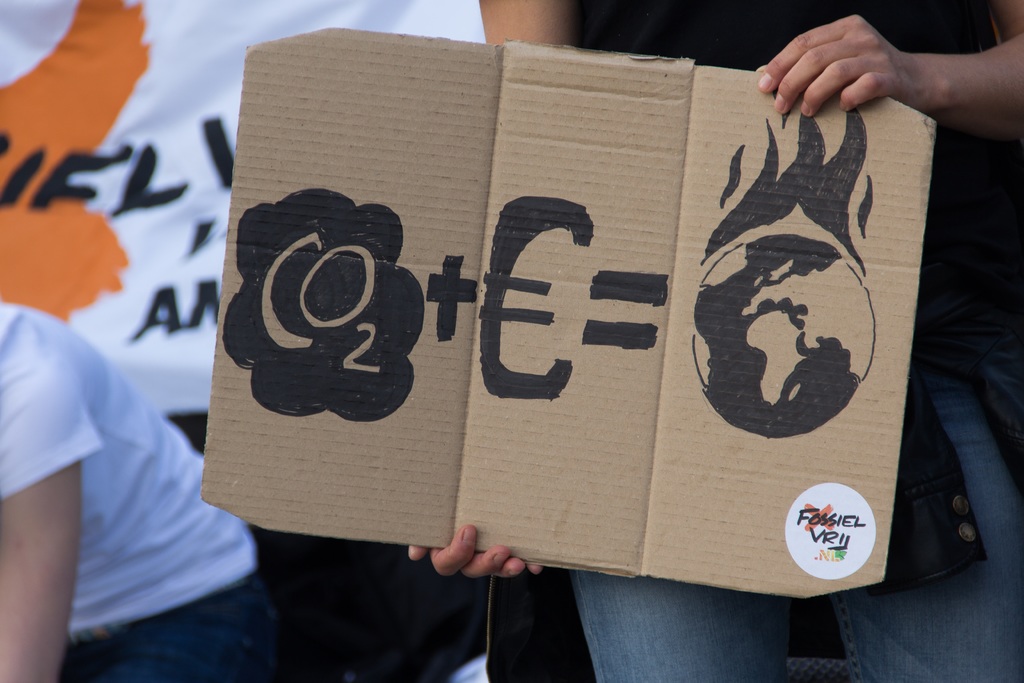

Yesterday, a roughly two week conference in Paris attended by representatives from nearly 195 nations came to an end with the announcement of an agreement intended to reduce carbon emissions and, the representatives hope, the long term impact of a changing climate:
With the sudden bang of a gavel Saturday night, representatives of 195 nations reached a landmark accord that will, for the first time, commit nearly every country to lowering planet-warming greenhouse gas emissions to help stave off the most drastic effects of climate change.
The deal, which was met with an eruption of cheers and ovations from thousands of delegates gathered from around the world, represents a historic breakthrough on an issue that has foiled decades of international efforts to address climate change.
Traditionally, such pacts have required developed economies like the United States to take action to lower greenhouse gas emissions, but they have exempted developing countries like China and India from such obligations.
The accord, which United Nations diplomats have been working toward for nine years, changes that dynamic by requiring action in some form from every country, rich or poor.
“This is truly a historic moment,” the United Nations secretary general, Ban Ki-moon, said in an interview. “For the first time, we have a truly universal agreement on climate change, one of the most crucial problems on earth.”
President Obama, who regards tackling climate change as a central element of his legacy, spoke of the deal in a televised address from the White House. “This agreement sends a powerful signal that the world is fully committed to a low-carbon future,” he said. “We’ve shown that the world has both the will and the ability to take on this challenge.”
Scientists and leaders said the talks here represented the world’s last, best hope of striking a deal that would begin to avert the most devastating effects of a warming planet.
Mr. Ban said there was “no Plan B” if the deal fell apart. The Eiffel Tower was illuminated with that phrase Friday night.
The new deal will not, on its own, solve global warming. At best, scientists who have analyzed it say, it will cut global greenhouse gas emissions by about half enough as is necessary to stave off an increase in atmospheric temperatures of 2 degrees Celsius or 3.6 degrees Fahrenheit. That is the point at which, scientific studies have concluded, the world will be locked into a future of devastating consequences, including rising sea levels, severe droughts and flooding, widespread food and water shortages and more destructive storms.
But the Paris deal could represent the moment at which, because of a shift in global economic policy, the inexorable rise in planet-warming carbon emissions that started during the Industrial Revolution began to level out and eventually decline.
At the same time, the deal could be viewed as a signal to global financial and energy markets, triggering a fundamental shift away from investment in coal, oil and gas as primary energy sources toward zero-carbon energy sources like wind, solar and nuclear power.
(…)
In a remarkable shift from their previous standoffs over the issue, senior officials from both the United States and China praised the Paris accord on Saturday night.
Secretary of State John Kerry, who has spent the past year negotiating behind the scenes with his Chinese and Indian counterparts in order to help broker the deal, said, “The world has come together around an agreement that will empower us to chart a new path for our planet.”
Xie Zhenhua, the senior Chinese climate change negotiator, said, “The agreement is not perfect, and there are some areas in need of improvement.” But he added, “This does not prevent us from marching forward with this historic step.” Mr. Xie called the deal “fair and just, comprehensive and balanced, highly ambitious, enduring and effective.”
Negotiators from many countries have said that a crucial moment in the path to the Paris accord came last year in the United States, when Mr. Obama enacted the nation’s first climate change policy — a set of stringent new Environmental Protection Agency regulations designed to slash greenhouse gas pollution from the nation’s coal-fired power plants. Meanwhile, in China, the growing internal criticism over air pollution from coal-fired power plants led President Xi Jinping to pursue domestic policies to cut coal use.
In November 2014 in Beijing, Mr. Obama and Mr. Xi announced that they would jointly pursue plans to cut domestic greenhouse gas emissions. That breakthrough announcement was seen as paving the way to the Paris deal, in which nearly all the world’s nations have jointly announced similar plans.
The final language did not fully satisfy everyone. Representatives of some developing nations expressed consternation. Poorer countries had pushed for a legally binding provision requiring that rich countries appropriate a minimum of at least $100 billion a year to help them mitigate and adapt to the ravages of climate change. In the final deal, that $100 billion figure appears only in a preamble, not in the legally binding portion of the agreement.
As always, the devil is in the details, and in addition to the question of whether or not the measures that are contained in the agreement will actually make any real progress in achieving the stated goal of the conference, there are questions about whether or not compliance can actually be assured and what the economic impact of the measures that nations might try to implement will actually be, a point that could become more important in the event economic conditions turns south for relations related or unrelated to the agreement itself. Moreover, there’s really no guarantee that the nations of the world will comply with the agreement at all, and no real method to enforce compliance:
Despite the historic nature of the Paris climate accord, its success still depends heavily on two factors outside the parameter of the deal: global peer pressure and the actions of future governments.
The core of the Paris deal is a requirement that every nation take part. Ahead of the Paris talks, governments of 186 nations put forth public plans detailing how they would cut carbon emissions through 2025 or 2030.
Those plans alone, once enacted, will cut emissions by half the levels required to stave off the worst effects of global warming. The national plans vary vastly in scope and ambition — while every country is required to put forward a plan, there is no legal requirement dictating how, or how much, countries should cut emissions.
Thus, the Paris pact has built in a series of legally binding requirements that countries ratchet up the stringency of their climate change policies in the future. Countries will be required to reconvene every five years, starting in 2020, with updated plans that would tighten their emissions cuts.
Countries will also be legally required to reconvene every five years starting in 2023 to publicly report on how they are doing in cutting emissions compared to their plans. They will be legally required to monitor and report on their emissions levels and reductions, using a universal accounting system.
That hybrid legal structure was explicitly designed in response to the political reality in the United States. A deal that would have assigned legal requirements for countries to cut emissions at specific levels would need to go before the United States Senate for ratification. That language would have been dead on arrival in the Republican-controlled Senate, where many members question the established science of human-caused climate change, and still more wish to thwart Mr. Obama’s climate change agenda.
So the individual countries’ plans are voluntary, but the legal requirements that they publicly monitor, verify and report what they are doing, as well as publicly put forth updated plans, are designed to create a “name-and-shame” system of global peer pressure, in hopes that countries will not want to be seen as international laggards.
That system depends heavily on the views of the future world leaders who will carry out those policies. In the United States, every Republican candidate running for president in 2016 has publicly questioned or denied the science of climate change, and has voiced opposition to Mr. Obama’s climate change policies.
In the Senate, Mitch McConnell, the Republican leader, who has led the charge against Mr. Obama’s climate change agenda, said, “Before his international partners pop the champagne, they should remember that this is an unattainable deal based on a domestic energy plan that is likely illegal, that half the states have sued to halt, and that Congress has already voted to reject.”
Outside the United States, there’s also no real guarantee that leaders in developing and growing nations such as China, India, and the nations of Southeast Asia, or nations that are heavily dependent on gas, coal, and oil for hard currency such as Russia and many of the nations of the Middle East will be willing to comply with the more stringent requirements of the agreement notwithstanding their agreement in Paris this weekend. In the developing nations in particular, the demands of a growing middle class for the benefits of an industrial economy will continue to put pressure even on authoritarian leaders in nations like China who have long shown concern about a restive middle class that wants to share in the benefits of the global economy in the same way the rest of us have, as well as a lower class that simply wants to get to the point where even thinking about being “middle class” is a viable option. In the end, after all, it’s hard to argue with someone still living in the slums of New Dehli or Rio de Janerio that they have to wait for a better life because of “climate change” when the rest of the world didn’t do that during their development stages. In any case, this is just one of the factors that is likely to make actually implementing the agreement much more difficult than the delegates in Paris seem to think it is going to be, no matter how optimistic their rhetoric.
Predictably, of course, the reaction to the agreement is largely filled with hyperbole that tends to exaggerate what’s actually been accomplished, and underplay what the future is likely going to be like. The New York Times news analysis calls it a “healing step,” while at the same time admitting that it would not really achieve its goals even if fully and perfectly implemented, which of course it won’t be. The Washington Post’s Steven Mufson calls the agreement a “big win” for President Obama, which seems counterintuitive given the fact that it is clear that the President will not be able to get Congress to sign on to the deal, especially not in a Presidential election year, and most likely not during any time before he leaves office in 2017. French President Francois Hollande called it a “major leap for mankind.” Think Progress paints it, rather optimistically, as an historic deal that will leave most fossil fuels unburned, while The Guardian goes even further by calling it the “end of the fossil fuel era.” Walter Russell Mead, meanwhile, is more sanguine and, in the end, more realistic in his view of the agreement:
The agreement is a far cry from the binding international treaty eco-activists envisioned in the run-up to the summit. Instead, it is the codification of national pledges called Intended Nationally Determined Contributions (INDCs) made by UN members. These pledges trickled in in advance of the conference and, according to the treaty (which you can read here), countries “shall communicate a nationally determined contribution every five years.” Instead of the UN’s setting targets for individual countries to adhere to, nations are charged with creating their own plans themselves, and updating those plans every five years going forward.
(…)
Overall what came out of Paris was the diplomatic equivalent of a New Year’s resolution to go on a strict weight loss regime involving no more than six chocolate eclairs between meals. But the negotiators did pay some attention to one green concern: The goal has been lowered. Instead of pretending to take actions that will hold the total temperature increase down to 2 degrees Celsius, we will now, in the words of the document, solemnly pretend to “[pursue] efforts to limit the temperature increase to 1.5 °C.” There was, however, no mechanism specified to reach this target; nobody volunteered to adopt more aggressive decarbonization policies to implement this change in the real world. In other words, the world announced that it intends to lose weight on the same six eclair diet as before.
There was little hope for any other outcome. World leaders can spin this however they like, but the real meaning of the Paris agreement is that the world is as far from adopting the kind of climate strategies greens want as ever. The world’s governments (with a handful of exceptions) are determined to go their own way on climate policy, whether that makes greens happy or not.
That, in the end, is the reality of the situation, and it’s largely a reflection of the fact that, as I note above, the nations of the world quite simply don’t have the same interests or concerns as the greens, or even among themselves, Nations like the United States, the nations of Europe, and Japan, can arguably afford to talk about taking “radical” steps to reduce carbon emissions largely because, well, they can afford to do so because they’ve already reached a level of economic growth that makes such discussions realistic. That isn’t true of much of the rest of the planet and, even with this agreement, those nations are going to follow the policies that are in their best interests regardless of what the rest of the world thinks. Additionally, the idea that we are anywhere close to the the “end of the fossil fuel era” is utter silliness. Yes, progress is being made on alternative energies slowly but surely but the idea that we’ll see the end of the use of fossil fuels on a widespread basis even in the most advanced nations within the lifetime of most of the people on the planet right now is quite simply utopian nonsense. Instead of fanciful dreams about the end of fossil fuels, or some breakthrough on fusion reactors that may or may not even be possible, we ought to be working more on technology that will make burning those fuels, or capturing their carbon emissions, easier. Any world agreement that sets its end goal as the “end of fossil fuels,” then, is nothing more than hyperbole.









