Profound Changes in U.S. Foreign Policy?
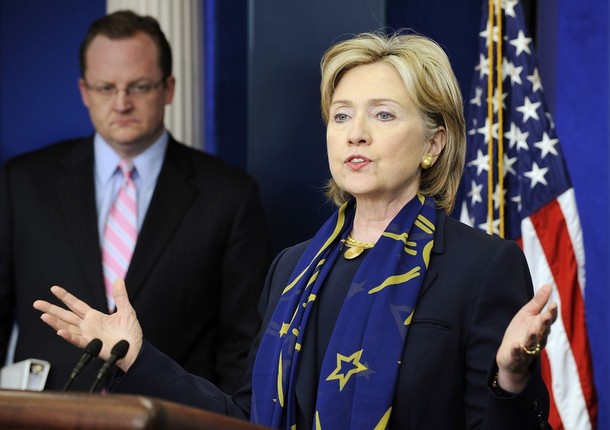 Author David Rothkopf (who served as a deputy undersecretary of commerce under Bill Clinton) argues in the Sunday Washington Post that, while the commentariet is distracted by Hillary Clinton’s celebrity, the new secretary of state is “overseeing what may be the most profound changes in U.S. foreign policy in two decades — a transformation that may render the presidencies of Bill Clinton and George W. Bush mere side notes in a long transition to a meaningful post-Cold War worldview.”
In a rebuttal essay at New Atlanticist, “Hillary Clinton’s Quiet Revolution,” I argue that this is “hyperbolic in the extreme” and that my “Bush’s Third Term” viewpoint is still more plausible.
Photo: Reuters Pictures.

No, not a third term. We are slowly, implicitly, unwinding too many positions for that. War sentiment is calm because voters assume an end.
Wait, did you mean that in the last year of his term GWB began the Obama plan?
Now THAT might be, but it was hardly Bush-Cheney
@odograph>: Actually, the change began well before that. Wolfie, Feith, and other prominent neocons were gone by 2005 and Rummy by the end of 2006. Even Cheney is now admitting that he was on the outside looking in in the second term.
Condi Rice was taking the State Department’s policy to the White House instead of enforcing Bush’e policies on the State Department.
I guess I was expecting something else of a “Bush’s Third Term” in terms of continuity.
The break in the middle was the failure of the neocon dream? Perhaps, though I think its fair to say Bush held the line a bit. He tailed off most precipitously after the financial crisis hit in full.
If a prolonged Iraq, without a victory of the initial vision, was the first strike against (neo) cons. The market failure, and Republican-led call for bailout, was a strike against (all the) cons. At that point all you’ve got is the gays.
Yeah, calling that “continuity” might be missing a lot.
@odograph: The argument is that it’s a continuity of Bush’s foreign policy. I agree that the domestic agenda is quite different.
What I’ve heard from some commentators is that Bush spent his last term pretty much trying to untie the foreign policy knots created in his first term by Cheney & Co. (Might explain why he refused to pardon Libby.) If that is true, it will reinforce my belief that George Bush is a basically decent guy who got in over his head and let himself be bamboozled by the real cowboys in his first-term administration.
@sam: Beyond that, I think Bush fell, as did a whole lot of people who do foreign policy for a living, for the whole “9/11 changed everything meme. He overcorrected our security policy to deal with terrorism and then moved it back to something more resembling normal after three years or so.
Hmm, would be interested in hearing your opinion on whether he would have completed this transition absent the 2006 election results. I think that he was already on the way to kicking out the neocons, but the 2006 results cemented it for him.
Steve
War sentiment is calm because voters assume an end.
No, war sentiment is calm because there is no Republican President to demonize. It was never about the war itself.
I’m not sure you can split a “Republican President” from his war of choice. Particularly when it was sold hard, “smoking guns in the form of mushroom clouds” etc.
I mean, that’s the thing that still puts black marks against a “Democrat President” (Johnson) in my book.
James wrote:
I’m not sure that kind of arc really works under the title of “continuity”, or “a third Bush term”
We’re still counting on Obama to walk back warrantless wiretapes, etc, right?