The Attorney General has released a redacted version of the “full” Mueller investigation, which is well over 400 pages. I have only skimmed it at this point and am mostly reacting to reports from teams of journalists from major outlets who have been racing to find interesting nuggets to report.
Thus far, there are no real surprises.
Rather than new revelations, we’re mostly getting a lot of color and nuance.
The New York Times offers the following topline summary:
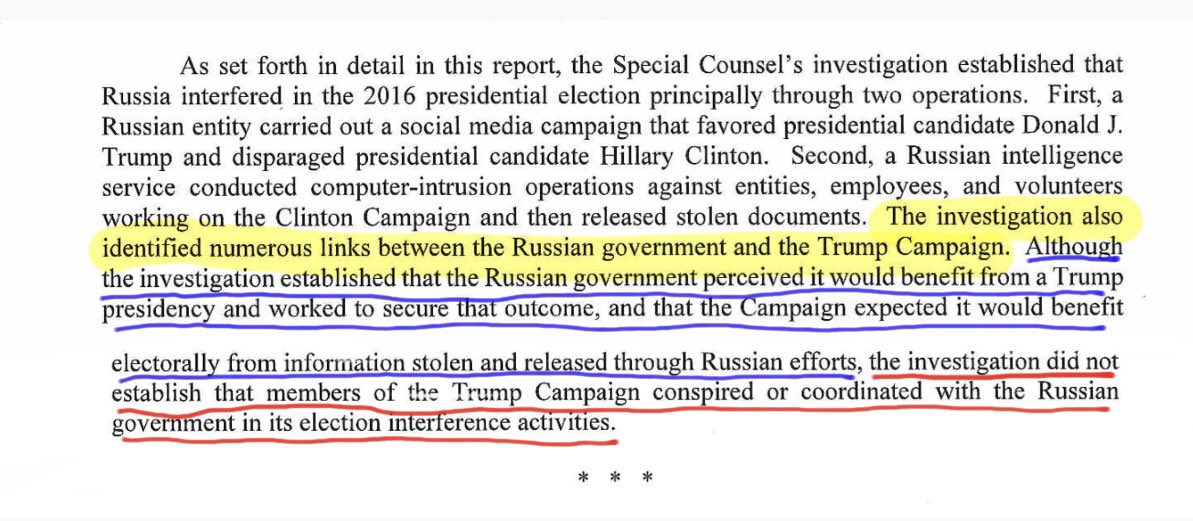
- After a sweeping, 22-month investigation, Robert S. Mueller III found there was insufficient evidence to establish that Mr. Trump or his associates engaged in a criminal conspiracy with Russia to disrupt the 2016 election.
- Investigators identified numerous contacts between campaign advisers and Russians affiliated with the government during the campaign and after the election. But the special counsel did not establish that the contacts added up to an illegal conspiracy.
- The report detailed Mr. Trump’s efforts to thwart the investigation, and the Mueller team debated whether the episodes amounted to criminal obstruction of justice. The report said that, by virtue of his position as president, he had the authority to carry out several of the acts in question — including firing James B. Comey as F.B.I. director
All of that is exactly what most of us thought this morning.
The same report—which is being updated with some frequency, with new information/sections at the top—offers these other bullets. I’m quoting them directly from subheaders but eliding substantial amounts of quoted material from the redacted report.
- Trump’s lawyers massaged Michael Cohen’s testimony, but there is no evidence Trump told him to lie.
- Mueller suggests a pattern of behavior by Trump to harm the investigation.
- Mueller says obstruction laws apply to presidents who use their executive powers corruptly.
- The report explicitly states that the investigation did not clear the president [of obstruction of justice–jhj].
- The report indicates that Michael D. Cohen never traveled to Prague to meet with Russians.
- Barr heavily redacted evidence about the Trump campaign’s outreach to WikiLeaks.
- The special counsel found evidence of plenty of other crimes and made 14 referrals.
- Trump ordered the White House counsel to claim that stories about the president wanting to fire Mueller were false.
- After Michael T. Flynn’s lawyer refused to share information about what he was telling the special counsel’s team, Mr. Trump’s personal lawyer said the president would be informed of Flynn’s ‘hostility.’
- Trump called the appointment of Mueller the ‘end of my presidency.’
- Mueller found several prominent Trump-Russia contacts — and a Republican platform change — were innocuous.
- Mueller identified ‘numerous’ Trump campaign-Russia contacts, but the evidence did not rise to the level of a crime.
- George Papadopoulos suggested that Russia wanted to coordinate with Trump campaign.
- Trump called McGahn at home and ordered him to dismiss Mueller, but McGahn balked.
- To find evidence of coordination, both Russia and the Trump campaign would have had to agree to act.
- Mr. Trump likely fired James B. Comey for refusing to clear the president’s name.
I’ve put in boldface the bullets I find most interesting, in that they at least provide some context that I didn’t know or hadn’t considered.
In reverse order:
To find evidence of coordination, both Russia and the Trump campaign would have had to agree to act.
This is huge. “Coordination” is an incredibly high bar. Trump and his organization almost certainly engaged in repeatedly coordination with Russian officials in the ordinary sense of that word. That they stopped short of committing actual crimes is meaningful, of course, but it’s hardly the end of the story. Still, it’s worth noting that Mueller found many of the connections—notably the much-ballyhooed change to the GOP platform—had innocent explanations.
Trump called the appointment of Mueller the ‘end of my presidency.’
The president immediately recognized the threat of the investigation. When he learned of Mr. Mueller’s appointment, he slumped in his chair and said, “Oh my God. This is terrible. This is the end of my presidency. I’m fucked.”
He also lashed out at the attorney general for what Mr. Trump viewed as a failure to protect him. This would ultimately become a key consideration for the special counsel in debating whether the president obstructed justice, or sought to. — Maggie Haberman
Trump’s immediate reaction tells us nothing about his criminal culpability. It does, of course, suggest that he understood that an independent investigation into his dealings would, at the very least, be extremely embarrassing.
That said, Trump followed Matt Yglesias’ first rule for surviving scandals: don’t resign. While many Trump cronies and associates have been imprisoned and others ruined, Trump himself has survived the ordeal. Whether the various investigations going on in New York with do further damage remains to be seen.
Trump ordered the White House counsel to claim that stories about the president wanting to fire Mueller were false.
This is one of the most damning episodes listed in the report, despite having already been reported by The New York Times. It demonstrated an active effort by the president to paint a false narrative about his conduct, both in the news media and with the special counsel.
— Maggie Haberman
Yes.
As is often the case with long-running investigations, specifics start to fade into obscurity and eyes glaze over at the steady stream of revelations. Simply publishing so much of what we already knew into a comprehensive reports is impactful by consolidating the narrative.
The special counsel found evidence of plenty of other crimes and made 14 referrals.
Twelve of those referrals remain secret. Two others have been made public, including prosecutions involving Mr. Trump’s former personal lawyer, Michael D. Cohen, and Gregory B. Craig, a White House counsel in the Obama administration. — Adam Goldman
Just another reminder that Mueller’s report marks the end of his team’s investigation into a specific set of criminal allegations but not the end of the federal government’s investigations or, as previously mentioned, those in New York.
Barr heavily redacted evidence about the Trump campaign’s outreach to WikiLeaks.
[REDACTED] Manafort also [REDACTED] wanted to be kept apprised of any developments with WikiLeaks and separately told Gates to keep in touch [REDACTED] about future WikiLeaks releases. According to Gates, by the late summer of 2016, the Trump Campaign was planning a press strategy, a communications campaign, and messaging based on the possible release of Clinton emails by WikiLeaks. [REDACTED] while Trump and Gates were driving to LaGuardia Airport. [REDACTED], shortly after the call candidate Trump told Gates that more releases of damaging information would be coming. [REDACTED]
Mr. Barr said this type of material must be kept secret because it was relevant to a continuing criminal matter. That is probably, at a minimum, the indictment of the former Trump adviser Roger Stone Jr., who is charged with lying about his participation in such efforts. But this raises a larger question: whether the hidden evidence shows that the Trump campaign conspired with WikiLeaks. At his news conference on Thursday morning, Mr. Barr said any campaign collusion with WikiLeaks could not amount to a criminal conspiracy because WikiLeaks’ publication of the emails was not a crime so long as it did not help Russia hacking them. —Charlie Savage
I’m filing this under the Damned if You Do, Damned if You Don’t category absent further revelations. Given how central this issue was to the original investigation, the public rightly wants to know more. Given that there are likely to be prosecutions in the WikiLeaks matter, though, it’s likely reasonable to redact this information.
Overall, I’m not seeing anything that materially alters my view of Trump, Barr, Mueller, or the outcome of the 2020 elections.