 Whenever I post on the flaws of the electoral college (such as I did recently here and here), one of the attempted counter-arguments is often that the electoral college forces the candidates to pay attention to the small states and that this is something that they would not do if we elected the president via a national popular vote.
This sounds good, I suppose, as we are usually taught in basic civics class that the reason we have the EC in the first place is to make sure that the small states were not ignored. And since we are taught that this was the intention of the Framers, we often do a good job of ex post facto reasoning to make all the pieces fit together.
However, if we look at where the attention is going, it is not to small states, it is to swing states. For example, see the NYT: Cash Flood Fuels Fight to the End in Leaning States (not that one really needs a news piece to draw attention to where the candidates are focusing their money and energies at the moment).
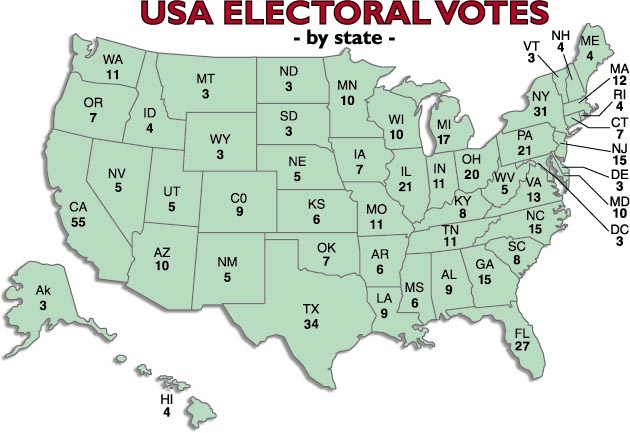
The only “small state” (as defined by population) that is truly of significance at the moment is New Hampshire and its four electoral votes. It is not its size that makes NH relevant to the campaigns, but rather it is their swing state status.
Consider the following smallest of “small states” (i.e., those with three electoral votes): Alaska, Montana, Wyoming, North Dakota, South Dakota, Vermont, and Delaware. None of these are of consequence at the moment because they are not swing states. Or, consider, those with four EVs: Hawaii, Idaho, Maine, New Hampshire, and Rhode Island. As noted, the only one of those of potential significance at the moment is NH.
So, let’s not pretend that the electoral college enhances the attention that small states receive. All it does is make swing states (regardless of population size) significant every four years and treats the rest of the country as decided.
Look back, for example, on where commercials were aired in 2008 (click): note the focus was not on where voters were, but on where swing voters were.
And, by the way, the notion that the small states see the electoral college as being so in their advantage that they would never accept reforming it, it is worth noting that several small state have passed legislation in support of the national popular vote initiative that would result in states casting their electoral votes for the candidate who won the national vote. It is law in Hawaii and Vermont and it has passed both houses in Rhode Island. It has passed one house in Delaware. This would indicate that the small states do not necessarily see the electoral college as vital to their political interests (see here). As I noted at the beginning of this post, we often see the small/large state discussion in regards to the electoral college in the context of the basic presentation of the compromises made in Philadelphia not in the context of contemporary politics. (And, of course, as I constantly stress, the EC does not function as the Framers’ designed and, therefore, appeals to original intent are grounded in historical fallacy—see here and here)).
So, regardless of anything else, the notion that “small states” benefit from the electoral college in terms of attention is simply not correct. They do benefit from being over-represented in the process of electing the president, so if one is going to defend the college, one can to defend it on the grounds that voters in Wyoming ought to count more than voters in California, Texas, New York, etc.