Taegan Goddard highlights this quote from Mitt Romney that repeats a line I’ve heard from several Presidential candidates, and many, many conservatives, over the past several months:
Surveying the crowd in Sioux City, Romney launched into an almost soaring speech about the virtues of the nation he says he wants to restore, not remake.
“The next election isn’t about just picking the next president,” he said. “It’s about the soul of the country.”
This isn’t something new, of course. The idea that whatever election happens to be taking place at a given time is “The Most Important Election In History” is something you hear from partisans on both sides of the aisle almost every four years. In reality, of course, there have been very few Presidential elections that have been of truly monumental importance. The Election of 1800 certainly qualifies for that, as do the contests in 1860, 1932, and, perhaps, 1980. That’s not to say that all the other elections have been unimportant, of course, but it’s simply not the case that every election has had the same impact on the direction of the nation as others have, and the odds are more likely than not that a given Presidential election will be far less trans-formative than people think. Change in American politics is typically marginal, not revolutionary.
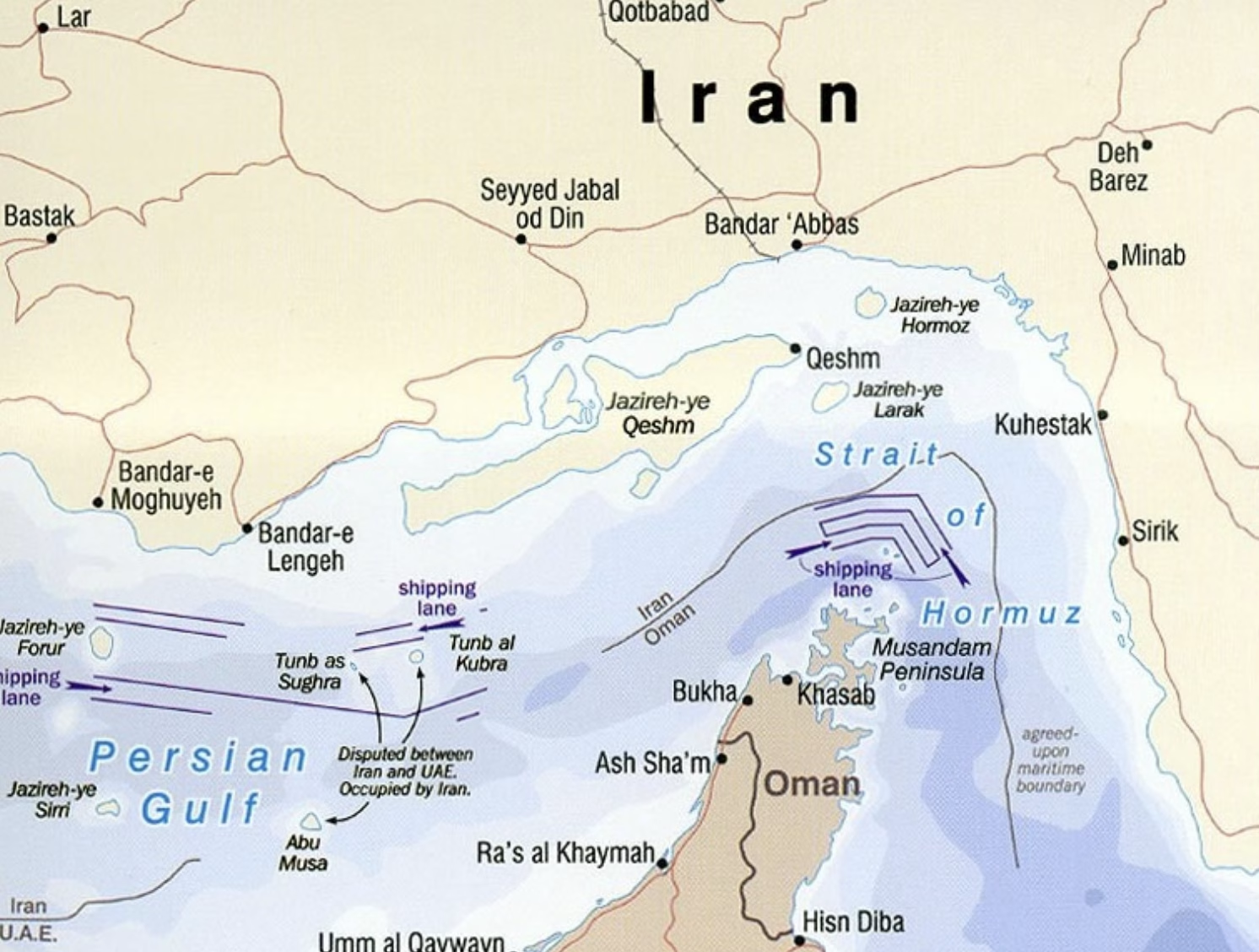
The three years of the Obama Administration have not been nearly as radical a departure from the norm in American politics as many on the right would suggest. In foreign policy, for example, the President has largely maintained the policies of his predecessor, even when it comes to controversial subjects like Drone Warfare, the prisoners at Guantanamo Bay, and the bypassing of traditional legal procedures when dealing with terrorist suspects. Similarly, and again contrary to the President’s critics, our policies toward Israel have not changed in any significant degree from what they were under the Bush Administration, and the United States under Barack Obama has treated the prospect of an Iranian nuclear weapon. Domestically, the President’s 2009 stimulus program followed in the footsteps of two stimulus packages passed under the Bush Administration, the fact that it arguably didn’t work says more about the failures of Keynesian stimulus in a deflationary recession than the radicalism of Barack Obama. Even the President’s signature domestic achievement, the Patient Protection And Affordable Care Act, was based on ideas that had been advocated by conservative organizations and politicians for a decade prior to Barack Obama’s election. The truly radical solution on health care reform would have been a Public Option, which the Administration made no effort to advance in Congress after it was clear there was no way it would pass both Chambers.
So, the idea that Barack Obama has been some kind of trans-formative radical simply doesn’t stand up to reality.
The other idea we hear from partisans around election time is the idea that the nation is doomed unless a certain person is elected President. This is is one we’ve heard before, and it’s almost always not true. There are only a few examples in history of what you might the “essential man,” the man without whom history would have turned out for the worse, or at least far differently from how it did. Abraham Lincoln, Winston Churchill, Franklin Roosevelt, Ronald Reagan. These are, arguably, names that belong on that list. Does anyone truly believe that any of the people running for President in 2012 would end up on that list? Of course not, and yet that is what we hear from the rabid supporters of candidates (Ron Paul) and non-candidates (Sarah Palin) alike.
A variation on the myth of the Essential Man, of course, is the idea that the re-election of Barack Obama means that America is doomed. This is perhaps an even more dangerous idea, about any candidate, than its companion myth. Except perhaps for Aaron Burr and John Breckinridge (the candidate who came in second in the Election of 1860), I can’t think of a single major party nominee in our history who it could be fairly said would have been a grave danger to the Republic had they won the election. The only purpose that engaging in such rhetoric serves is to rile up the partisan masses, and while that’s a grand old American tradition (just look at the politics of the 1820s or late 19th Century for proof of that) it seems as though we’ve entered an era where the partisan nature of campaigning has made governing itself impossible. If you believe your opponent is not just wrong, but evil and a threat to the nation, then compromise is impossible. The fact that it isn’t true doesn’t really matter.
Re-electing Barack Obama won’t mean the end of America. In fact, if recent history is any guide it’s quite likely that a second Obama Term will be even more of a let down for his supporters than the first one has been, as James Joyner noted in another context back in October:
A re-elected Obama would be, like most second term presidents, a placeholder. His Big Ideas are all either enacted or failed and he’s unlikely to have much support in Congress.
Like most two-term Presidents, Obama would likely look overseas to establish his legacy, either in a renewed push for Middle East peace or something even more quixotic. By 2014, his fellow Democrats will already have begun maneuvering to replace him and the next generation of Republican candidates will be well on their way toward attempting to make sure there isn’t a third Democratic term in 2016. In other words, America will muddle through and our destiny will largely be controlled by events far beyond the control the President regardless of who he, or she, might be.