As expected, last yesterday afternoon South Carolina Governor Nikki Haley, flanked by a phalanx of South Carolina political leaders, called for the removal of the Confederate Battle Flag from the grounds of the State Capitol in Columbia:
COLUMBIA, S.C. — Gov. Nikki R. Haley called on Monday for South Carolina to do what just a week ago seemed politically impossible — remove the Confederate battle flag from its perch in front of the State House building here. She argued that a symbol long revered by many Southerners was for some, after the church massacre in Charleston, a “deeply offensive symbol of a brutally offensive past.”
“The events of this week call upon us to look at this in a different way,” said Ms. Haley, an Indian-American, who is the first member of an ethnic minority to serve as governor of the state as well as the first woman.
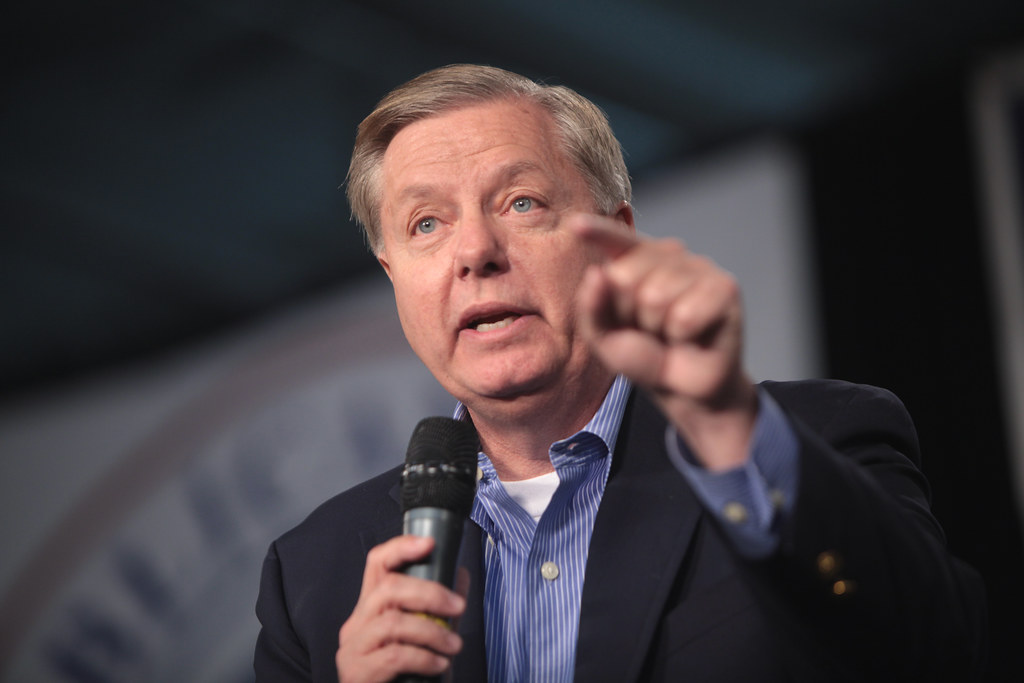
She spoke at an afternoon news conference, surrounded by Democratic and Republican lawmakers including both of the state’s United States senators, Lindsey Graham and Tim Scott, an African-American. “Today we are here in a moment of unity in our state, without ill will, to say it’s time to move the flag from the capitol grounds,” she said.
It was a dramatic turnabout for Ms. Haley, a second-term Republican governor who over her five years in the job has displayed little interest in addressing the intensely divisive issue of the flag. But her new position demonstrated the powerful shock that last Wednesday’s killings at Emanuel A.M.E. Church have delivered to the political status quo, mobilizing leaders at the highest levels.
On Monday, the White House announced that President Obama will travel to Charleston on Friday and deliver the eulogy for the Rev. Clementa C. Pinckney, the slain pastor of the Emanuel Church and a state senator. The political aftershocks from the shootings were also felt in Mississippi, where the House speaker, a Republican, unexpectedly declared in a statement Monday night that the Mississippi state flag, which includes the Confederate banner, “has become a point of offense that needs to be removed.”
Interviews suggested that Ms. Haley’s rapidly evolving position on the flag was shaped by several factors: the horror of seeing the unsmiling gunman posing with it in photos; her conversations with congregants at the church; intensifying pressure from South Carolina business leaders to remove a controversial vestige of the state’s past; and calls from leaders of her own party, including its leading presidential contenders, urging her to take it down once and for all.
The result on Monday was a moment of political and racial drama, and a signature moment for Ms. Haley, who blended the traditional values of the South — faith, family, empathy — into a powerful call for taking down the flag as a gesture of unity, healing and renewal.
(…)
In the days since the shooting, the Republican presidential hopefuls Jeb Bush and Senator Marco Rubio of Florida have issued vague or equivocal statements, perhaps wary of losing support in the crucial South Carolina primary. (Mr. Bush, who ordered the removal of the flag from the Florida statehouse while governor, said he was confident that South Carolina would “do the right thing,” while Mr. Rubio said the state would “make the right choice for the people of South Carolina.”)
But inside the governor’s office, Ms. Haley’s phone line lit up with messages from national Republican officials offering words of condolence, among them Mr. Bush, Gov. Chris Christie of New Jersey, Gov. Bobby Jindal of Louisiana and Mitt Romney, all current, likely or former candidates for president, and Reince Priebus, the chairman of the Republican National Committee. In some cases, there was also something else: subtle encouragement to dispatch the flag.
Mr. Romney, a financial backer of Ms. Haley’s campaigns, was explicit, according to an adviser: The flag, he believed, had to come down, a message he delivered Saturday morning on Twitter to an extraordinary response. Thousands of people, including Mr. Obama, retweeted the message, many of them heralding his stand.
Mr. Romney was taken aback by the reaction and told an aide he was glad he had spoken out. Ms. Haley, a rising star in the Republican Party, had her own political future to consider. The flag would inevitably complicate her selection as a cabinet member or even vice-presidential nominee, if she wanted either.
Over the weekend, Ms. Haley and her staff reached out to top officials like Representative James E. Clyburn, the ranking African-American member of Congress, sounding them out on the issue, and on Monday, she summoned officials to her office and told them of her decision: It was time for the Confederate flag to stop flying over the historic building’s grounds. Every leading South Carolina politician — stunned by the massacre, moved by the church’s demonstration of grace and fearful of the repercussions from inaction — agreed.
“If you want to credit anybody here, credit the families of the victims and the church members who displayed Christianity and love,” Mr. Graham said. “The politicians followed their moral authority.”
Not surprisingly, shortly after Haley made her announcement, which included a warning to the state legislature that if they don’t deal with the flag issue during the special session that starts today, or during the veto session that starts shortly thereafter, she will use her authority as Governor to call them back into session for a special session to deal exclusively with the flag issue so that it is resolved before the summer ends, Republican candidates for President who had previously equivocated on the issue, started to line up behind the Governor:
Tongue-tied over the issue for nearly a week, senior Republicans jumped on the bandwagon Monday and called for folding up the Confederate battle flagafter Gov. Nikki Haley of South Carolina said the Civil War symbol should be removed from the state Capitol.
Senator Mitch McConnell of Kentucky, the majority leader, acknowledged that while the flag meant different things to different people, it was time to take it down.
“The fact that it continues to be a painful reminder of racial oppression to many suggests, to me at least, that it’s time to move beyond it, and that the time for a state to fly it has long since passed,” Mr. McConnell said.
Reince Priebus, chairman of the Republican National Committee, echoed that sentiment, calling the flag too hurtful for Americans.
“For South Carolina, taking down this Confederate flag is a step in mending those divisions,” Mr. Priebus said.
Republican presidential candidates were also quick to praise Ms. Haley.
Gov. Scott Walker of Wisconsin, who is considering a White House bid, said he supported her decision.
And former Gov. Rick Perry of Texas, who has announced his presidential campaign, called it an important step in mourning the killings of the nine churchgoers in Charleston.
“Removing the flag is an act of healing and unity that allows us to find a shared purpose based on the values that unify us,” Mr. Perry said.
While some Republicans still seem to be sitting on the sidelines on this issue, Politico notes that the reasons behind the quick shift are obvious. Basically, while there are still elements on the Republican Party that will be upset by this move, it became rather obvious rather quickly that national opinion on the issue was moving in the other direction and that Republicans are going to face far more bad press for clinging to positions of the past than they will if they go with the tide. For the candidates especially, this issue is one of the “moral tests” that frequently pop up in the middle of a Presidential campaign that say much more about a particular candidate than they do about an issue itself.
As a practical matter, it is still up to the ledlature to take the steps necessary to repeal the law that was passed in 2000 placing the flag in its current location after it had been flying atop the State Capitol Building itself along with the American and South Carolina flags since the early 1960s. In that regard, while there have been both Republican and Democratic state legislators who have said they would back an initiative to remove the flag even as early as the special budget session that begins today, more than half of the members of the legislature have not yet weighed in on the issue, the general consensus seems to be that this is effectively the end of the flag’s presence on state grounds in Columbia. Additionally, yesterday’s developments make clear that the momentum oPn this issue is moving fairly quickly, as evidenced by how quickly Governor Haley, along with Senators Graham and Scott and other South Carolina political leaders, came forward yesterday after having previously stated, at most, that this is something that the state should deal with in the future. In no small part, of course, this is due to media attention that the issue has garnered in the wake of the tragedy in Charleston and the sentiment expressed by many of the colleagues of one of the victims, State Senator Clementa Pinckney that the flag be down before Pinckney’s funeral on Friday. That motive may prove to be powerful enough to spur action on this matter as early as today and, indeed, it would be theoretically possible for the legislation that needs to be passed to be on Haley’s desk by Thurssday.
South Carolina, though, seems to be just the beginning of this story, as there are signs that public opinion is causing many other institution to re-examine the ways in which they are preserving legacies of the Confederacy. For example, after South Carolina, the state with perhaps the most obvious tie to Confederate symbols is Mississippi, which is presently the last state in the nation that has a representation of Confederate flag in its state flag. One might expect that, given its deeply conservative roots, the Magnolia State would be slow to bow to pressure on this issue, but you’d be wrong. Over the weekend, a petition began circulating to remove the battle flag emblem from the flag, and it quickly gained the support of one of the most powerful politicians in the state, although it’s unclear whether anything will happen in the state any time soon:
Mississippi House Speaker Philip Gunn said Monday night that the Confederate emblem in the state’s official flag has to go.
“We must always remember our past, but that does not mean we must let it define us,” Gunn, a Clinton Republican, said in a statement. “As a Christian, I believe our state’s flag has become a point of offense that needs to be removed. We need to begin having conversations about changing Mississippi’s flag.”
It’s the first time a Mississippi Republican elected official has publicly called for the removal of the emblem that served as the battle flag flown by the Confederate army during the Civil War. Later, it was adopted by anti-Civil Rights groups.
Gov. Phil Bryant said Monday morning that he didn’t expect the Legislature to “supersede the will of the people on this issue.”
He was referring to the 2001 ballot measure in which 64 percent of those who voted made the flag with the Confederate emblem the state’s official banner. Bryant spokeswoman Nicole Webb said the governor voted with the majority.
A spokeswoman for Bryant said Monday night he was traveling and unavailable for comment on Gunn’s position. A spokesperson for Lt. Gov. Tate Reeves had not responded to questions sent Monday morning, and again Monday night.
The debate whether to remove the Confederate battle flag from South Carolina’s state capitol, touched off by last week’s Charleston church shooting, arrived
Mississippi isn’t the only state in the South that has a state flag with at least some tie to one of the flags of the Confederacy or its military. As Christopher Ingraham notes, the flags of six other states contain at least some elements that harken back to the Confederacy in some way, with the most obvious being Georgia and North Carolina, which both resemble the “Stars And Bars” of the actual National Flag of the Confederate States during the Civil War. Arkansas and Tennessee have flags that have abstract designs that arguably contain elements of those flags. Of those listed by Ingraham, though, Florida and Alabama‘s placement in the category seems the most dubious since both flags resemble the St. Andrew’s Cross and the Flag of England more than anything else. In any case, depending on the momentum this issue has, we may see some of those state reexamine the symbolism depicted by their flags at some point soon. Beyond the political world, Walmart announced yesterday that it would no longer sell Confederate flag merchandise at its stores, and Sears announced that, while it does not sell any such merchandise at its Sears or K-Mart stores, it would remove such merchandise sold by third parties via its online portal.
What’s clearly happening here is that parties in both the political and business worlds are moving to disassociate themselves from a flag that, thanks largely to the tragedy in Charleston, has come to be associated with something odious. While one can argue that many of these people are only acting now that the light of public attention is upon them, at least they are acting, and re-acting to public opinion in a way that might not have been possible otherwise. As I said yesterday, ending the ubiquitous glorification of the Confederate flag in all its varieties will not end racism in this country. As President Obama noted in his podcast interview over the weekend, we should not deceive ourselves into believing that removing public displays or racial animus is a solution to all of our problems. These are, however, good first steps and perhaps a sign that, now that we’ve passed four years of observing the Sesquicentennial of the American Civil War, we are finally moving into a new phase of the legacy of that conflict where, even in the South, people are more honest about what that war was really about and what it its legacy has been.