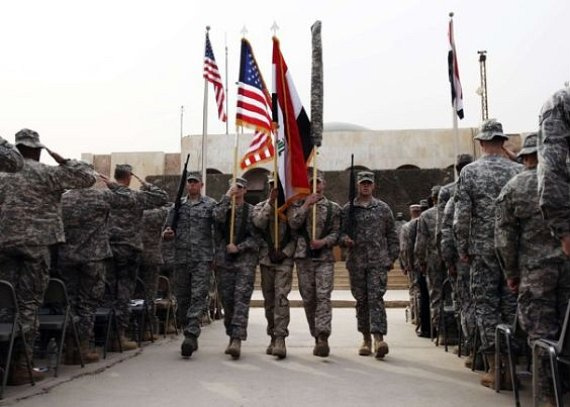

The most contentious foreign military action since Vietnam and, depending on how you measure these things, either the second or third longest war in American history, came to a muted end today in a ceremony at Baghdad International Airport:
BAGHDAD — The United States military officially declared an end to its mission in Iraq on Thursday even as violence continues to plague the country and the Muslim world remains distrustful of American power.
In a fortified concrete courtyard at the airport in Baghdad, Defense Secretary Leon E. Panetta thanked the more than one million American service members who have served in Iraq for “the remarkable progress” made over the past nine years but acknowledged the severe challenges that face the struggling democracy.
“Let me be clear: Iraq will be tested in the days ahead — by terrorism, and by those who would seek to divide, by economic and social issues, by the demands of democracy itself,” Mr. Panetta said. “Challenges remain, but the U.S. will be there to stand by the Iraqi people as they navigate those challenges to build a stronger and more prosperous nation.”
The muted ceremony stood in contrast to the start of the war in 2003 when an America both frightened and emboldened by the attacks of Sept. 11, 2001, sent columns of tanks north from Kuwait to overthrow Saddam Hussein.
As of last Friday, the war in Iraq had claimed 4,487 American lives, with another 32,226 Americans wounded in action, according to Pentagon statistics.
The tenor of the 45-minute farewell ceremony, officially called “Casing the Colors,” was likely to sound an uncertain trumpet for a war that was started to rid Iraq of weapons of mass destruction it did not have. It now ends without the sizable, enduring American military presence for which many officers had hoped.
The Washington Post notes the comments that Secretary Panetta made during today’s ceremony:
BAGHDAD — Defense Secretary Leon E. Panetta paid solemn tribute on Thursday to an “independent, free and sovereign Iraq” and declared the official end to the Iraq war, formally wrapping up the U.S. military’s mission in the country after almost nine years.
“After a lot of blood spilled by Iraqis and Americans, the mission of an Iraq that could govern and secure itself has become real,” Panetta said at a ceremony held under tight security at Baghdad’s international airport. “To be sure, the cost was high — in blood and treasure for the United States, and for the Iraqi people. Those lives were not lost in vain.”
The 1:15 p.m. ceremony (5:15 a.m. in Washington) effectively ended the war two weeks earlier than was necessary under the terms of the security agreement signed by the U.S. and Iraqi governments in 2008, which stipulated that the troops must be gone by Dec. 31.
But commanders decided there was no need to keep troops in Iraq through the Christmas holidays given that talks on maintaining a U.S. presence beyond the deadline had failed. The date of the final ceremony had been kept secret for weeks, so as not to give insurgents or militias an opportunity to stage attacks.
Dignitaries and a small crowd of military personnel in fatigues gathered at a terminal in the Baghdad airport, which until now had been operated by the U.S. military. In the future, it will be overseen by the State Department, which is assuming responsibility for a massive, $6 billion civilian effort to sustain American influence in Iraq beyond the troops’ departure.
The white flag of United States Force-Iraq was carefully folded and put away, and Panetta took the podium.
“No words, no ceremony can provide full tribute to the sacrifices which have brought this day to pass,” the defense secretary said. “I’m reminded of what President Lincoln said in Gettysburg, about a different war, in a different time. His words echo through the years as we pay tribute to the fallen in this war: ‘The world will little note, nor long remember, what we say here, but it can never forget what they did here.’ ”
In his speech, Panetta singled out U.S. Ambassador James Jeffrey and Army Gen. Lloyd Austin, the commander of U.S. forces in Iraq, for overseeing the rapid withdrawal of 50,000 troops in recent months and the closure of dozens of bases.
But he paid special tribute to the more than 1 million U.S. troops who have served war duty in Iraq since 2003, including about 4,487 who were killed and some 30,000 who were wounded.
“You have done everything your nation has asked you to do and more,” he said. “You came to this ‘Land Between the Rivers’ again and again and again.You did not know whether you’d return to your loved ones.
“You will leave with great pride, lasting pride, secure in knowing that your sacrifice has helped the Iraqi people begin a new chapter in history free from tyranny and full of hope for prosperity and peace.”
Panetta also paid homage to military families who, “through deployment after deployment after deployment … withstood the strain, the sacrifice and the heartbreak of watching their loved ones go off to war.”
“Together with the Iraqi people,” he added, “the United States welcomes the next stage in U.S.-Iraqi relations.”
How one feels about the official end of the U.S. mission in Iraq depends, in large part, on how one felt about the mission to begin with. For opponents of the war, who won the war for American public opinion in the end, this is a welcome development and a not-soon-enough end to a war that should not have lasted this long to begin with. For supporters of the war, mostly hardline conservative Republicans at this point, are likely to see this as a defeat of some kind. Ever since the President announced that American troops would be leaving Iraq by the end of this year, there’s been a recurring meme on the right claiming that the President failed by not convincing the Iraqis to agree to an extension of the current Status of Forces Agreement, which was negotiated by the Bush Administration, which required that American troops be out of the country by December 31, 2011. When it comes to the public opinion side of the argument, it’s fairly clear that the President and the opponents of the war have the better argument:
[A] new poll shows that three in four Americans support the withdrawal of U.S. troops from Iraq.
Seventy-seven percent of Americas approve of President Barack Obama’s decision to withdraw troops by the end of the year, according to a new CBS News poll, including 63 percent of Republicans.
Just 17 percent of Americans disapprove.
The poll follows on a Gallup poll earlier this month, which similarly found that three-quarters of Americans support the decision to withdraw troops.
In that poll, 96 percent of Democrats, 77 percent of independents, and 43 percent of Republicans supported Obama’s decision.
Additionally, a newly released NBC News/Wall Street Journal poll shows that bringing all the troops home from Iraq ranks just behind killing Osama bin Laden when voters are asked to rank President Obama’s greatest achievements of his First Term. Clearly, the public is glad that a war they had grown weary off long ago has come to an end, and the images we’ve seen over the past several days of soldiers being reunited with their families at bases across the country is a welcome sight, especially as we approach the Holidays.
It’s likely to be many years before the full impact of the Iraq War on American domestic politics, not to mention the politics of the Middle East, can be fully measured. Earlier this year, many on the right attempted to make the claim that it was the toppling of Saddam Hussein in 2003 that set in motion the events that led to the Arab Spring of 2011. We haven’t heard this argument very much since protests turned violent and the political future of nations like Egypt has become more uncertain, of course, but even if that had not occurred it strikes me that any link between Iraq and the 2011 uprisings is tenuous at best. Moreover, even if it were true, that hardly stands as justification for a massive war that cost hundreds of billions of dollars and thousands of American lives.
In the end, I think history will judge the Bush Administration harshly for both the run-up to the Iraq War and its initial execution. In the wake of the September 11th attacks, which had no connection at all to the regime of Saddam Hussein, they exploited the nations fear of terror from the Middle East to ramp up war fever against a nation that we had gone to war against ten years before, and whom we’d been staring at, and striking, across a no-fly zone ever since. Saddam was developing a secret chemical and biological weapons program, we were told, even though the United Nations weapons inspectors never found any evidence of the same. There were whispers about a secret nuclear weapons program, which turned out to be entirely unfounded. Rumors were spread about secret meetings between Mohammed Atta and the head of Iraqi Intelligence, which also turned out to be false. Yes, it was true that every major intelligence service in the world believed that Saddam had a WMD program, but what nobody seemed to realize was that the intelligence was based on unreliable witnesses and, apparently, an effort by Saddam himself to make the world think he had WMDs so as make Iraq seem stronger than it actually was. So, we went to war.
The execution of the war also seemed flawed from the start. Even before a shot was fired, there were dissenting voices saying that we were not committing enough troops to deal with the consequences of the inevitable downfall of the regime and the possibility of guerilla warfare. Administration officials such as Donald Rumsfeld dismissed these concerns, and some of them actually seemed to have the fanciful idea that American troops invading Iraq would be greeted as liberators by the Iraqi people. When Turkey refused permission for U.S. troops to use the nation as the launching point for the northern half of a two-pronged thrust into the country, the effectiveness of the U.S. forces in gaining the type of victory needed for a quick and lasting victory seemed to have been further reduced. There’s no denying that the initial invasion was a massive success, notwithstanding the fact that it took most of the rest of 2003 to finally catch up with Saddam Hussein. However, by July of that year the insurgency had begun and the situation began to spin out of control. The surge in 2007 did stabilize the situation, and Iraq is possibly on its way to some kind of stability, but the future is far from certain. One thing is certain, though, with Saddam Hussein gone, Iraq is now most likely to fall into the Iranian sphere of influence, and I can’t see how one can consider that to be a positive development in the long run.
I was never a supporter of the Iraq War. Even with the evidence the Administration was putting forward in 2002, I was not convinced that the case had been made that Iraq posed such a grave threat to American national security that invasion and regime change were the only options. I wasn’t among the protesters, mostly because it’s just not my style, but I mostly agreed with their message, at least until groups like MoveOn and Answer got involved and the whole thing took a decidedly left-wing, anti-American tilt. When the war started in March, though, I hoped that at least our troops would be able to achieve a quick, decisive victory with minimal casualties. Alas, it had become clear by the summer that this wasn’t going to happen and, as the insurgency grew, the ability of the United States to simply walk away from Iraq became much more difficult. As Colin Powell had said in meetings with the President in the summer of 2002, if we broke Iraq, we would be responsible for it, the Pottery Barn Rule it was called. And, boy, had we broken Iraq into a million pieces. It took four years to put the country back together, and perhaps we could’ve gotten out at some point in that process but it strikes me that leaving a broken country in the Middle East would have been as unwise and foolish as invading it was in the first place.
In any case, though, the war is over, the troops are coming home, and the future of Iraq is in the hands of the Iraqi people. Was it worth it at all? Frankly, I cannot find a single redeeming thing to point to that justifies the costs we incurred for a war we never should have been fighting to begin with.