
Frequent commenter and part time contributor to Outside the Beltway Bernard Finel is disputing claims that there are serious fiscal imbalances facing the United States.
Yesterday I posted an analysis that refuted the notion, common among conservatives, that the federal budget is out of control and growing a rapid rate. Instead, I demonstrated that government spending as a percentage of GDP maxed out in the early 1980s and has been declining slowly on average ever since.
Today, I will address a variant of this argument that focuses on spending on social program, including Medicaid, Medicare, and Social Security. My argument is simple: We don’t have a crisis of entitlements or social programs, we have, very narrowly, a health care crisis. Non health-related social spending — entitlements, Social Security, welfare, etc — is actually declining as a percentage of GDP since 1980.
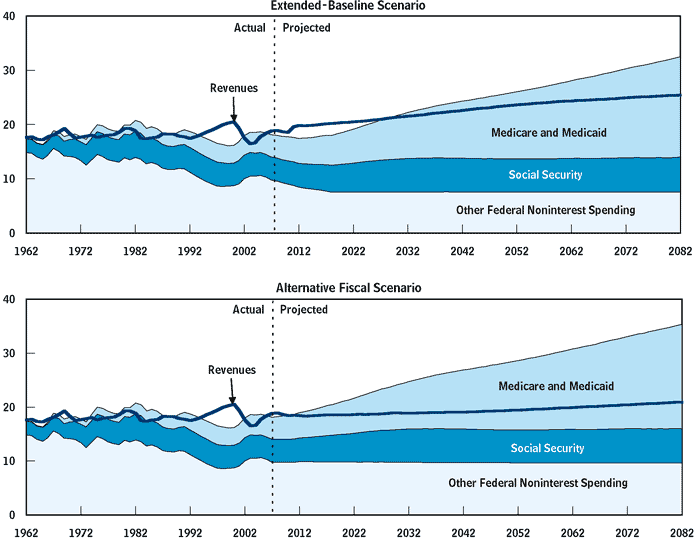
This is a common theme with liberals like Bernard. We don’t have any crisis in Medicare or Social Security don’t touch them. Problem is we do. We can see the problem when looking at this picture from the CBO,

And note that the above graph does not include interest on the debt.
Now what Bernard has done is look at historical budget data as a percentage of GDP and has concluded our problem is health care. In this I agree with him. Health care expenditures in general are growing anywhere from 2 to 2.5 percentage points faster than GDP. Eventually it will cause a problem in terms of budgets, taxes and debt.
Where I disagree with Bernard is where is states this conclusion,
We face a health care crisis today, not a crisis in social programs or in federal spending overall. Our problems are almost wholly a function of exploding health care costs.
But our social spending is very much determined by health care costs. Medicare and Medicaid are a problem precisely for this very reason. Bernard is almost arguing, health care spending isn’t a problem except for health care spending. Well…yeah.
What is particularly annoying is that I’ve pretty much acknowledged this in past posts and comments. We have a medium to long term fiscal problem. That problem can be traced to two sources (for the most part). The first is demographics–the baby boomers are going to start retiring in larger and larger numbers in the next decade or so. By itself this aspect of the problem wouldn’t be that large of a problem, in my view. If we simply had more people retiring than normal we could likely handle it with marginal changes to Medicare, Social Security and Medicaid and possible a few other programs.
However, there is a second cause. Health care costs have been rising at an unsustainable rate. Here is a simple exercise to show the problem. Suppose today you are spending $1 on health care and that you have $2 in income. Further you income grows at 3% per year and health care expenditures grow at 5% per year. How long until you can no longer afford health care? At about the 37 year mark your expenditures on health care is just about equal to your income. In short you’ll have no more money for food, housing, transportation, and entertainment. Clearly that is not sustainable. In reality, something would “give” well before you got to that point.
I also agree that we need to address the problem with the growth rate of health care expenditures. If we act now it might be quite a bit less painful than if we don’t do anything and let nature take its course (so to speak). After all unsustainable trends are not sustained. Eventually the situation will correct itself. Problem is if we wait for that moment it might make our current economic crisis look like a trip to Disneyland.
My overall position is that since health care is a complex and contentious issue, we should “plan for the worst”. We should look at all of the federal budget for places where cuts can be made, taxes can be increased, programs reformed and so forth. As such Social Security should not be “off the table”. By the same token Social Security should not be viewed as the only means by which to solve the health care expenditure problem. Precisely because Social Security is not the cause of that problem. Increasing the tax base, increasing the age for eligibility, indexing the age of eligibility to life expectancy, and adjusting things like COLA adjustments are marginal changes that wouldn’t impact current beneficiaries. Future beneficiaries will be impacted, but quite frankly I think many of them would welcome these changes.
As I noted unsustainable trends are not sustained and if nothing is done regarding health care is it possible that Social Security is gutted to fund Medicare? Maybe. If by making marginal changes to Medicare and Social Security we reduce the fiscal imbalance it might very well be the case we’d help ensure that both programs continue to exist.
And to be clear, the changes I noted for Social Security should be made to Medicare as well. After all, I think it is fair to say that one reason why health care expenditures have increased so much is in part due to Medicare. For example, this NBER Digest points to the research of Amy Finkelstein on the impact of Medicare in regards to health care.
At an annual cost of $260 billion, Medicare is one of the largest health insurance programs in the world. Providing nearly universal health insurance to the elderly as well as many disabled, Medicare accounts for about 17 percent of U.S. health expenditures, one-eighth of the federal budget, and 2 percent of gross domestic production. Medicare’s introduction in 1965 was, and remains to date, the single largest change in health insurance coverage in U.S. history.
Finkelstein estimates that the introduction of Medicare was associated with a 23 percent increase in total hospital expenditures (for all ages) between 1965 and 1970, with even larger effects if her analysis is extended through 1975.
[…]
Finkelstein suggests that the reason for the apparent discrepancy is that market-wide changes in health insurance – such as the introduction of Medicare – may alter the nature and practice of medical care in ways that experiments affecting the health insurance of isolated individuals will not. As a result, the impact on health spending of market-wide changes in health insurance may be disproportionately larger than what the estimates from individuals’ changes in health insurance would suggest. For example, unlike an isolated individual’s change in health insurance, market wide changes in health insurance may increase market demand for health care enough to make it worthwhile for hospitals to incur the fixed cost of adopting a new technology. Consistent with this, Finkelstein presents suggestive evidence that the introduction of Medicare was associated with faster adoption of then-new cardiac technologies.
[…]
Such evidence of the considerable impact of Medicare on the health care sector naturally raises the question of what benefits Medicare produced for health care consumers. Finkelstein and McKnight investigate this question, noting. two potential benefits that public health insurance might provide to the elderly:: better health and risk- reduction.
Things like new and better technologies and better health and risk reduction are all good things, but they obviously have come at a cost. A cost we cannot keep incurring. So reducing the future expenditures of Medicare by simply doing things like changing age of eligibility may have some sort of feedback effect and reduce the growth rate of health care costs providing an ancillary reduction in Medicare costs.
To recap, while personally I think Social Security is a badly designed program I’m not advocating getting rid of it. I’m not advocating gutting it. Any claims to the contrary are simply not an accurate reflection of my position. I am arguing that Social Security should be one area we look to to shore up our fiscal situation for the medium and long term. It shouldn’t be the top priority. The top priority should be growth rate of health care costs.
Note: The graph above is from 2007 and does not reflect the current economic situation, as such it is probably overly optimisitc in terms of revenues.








