
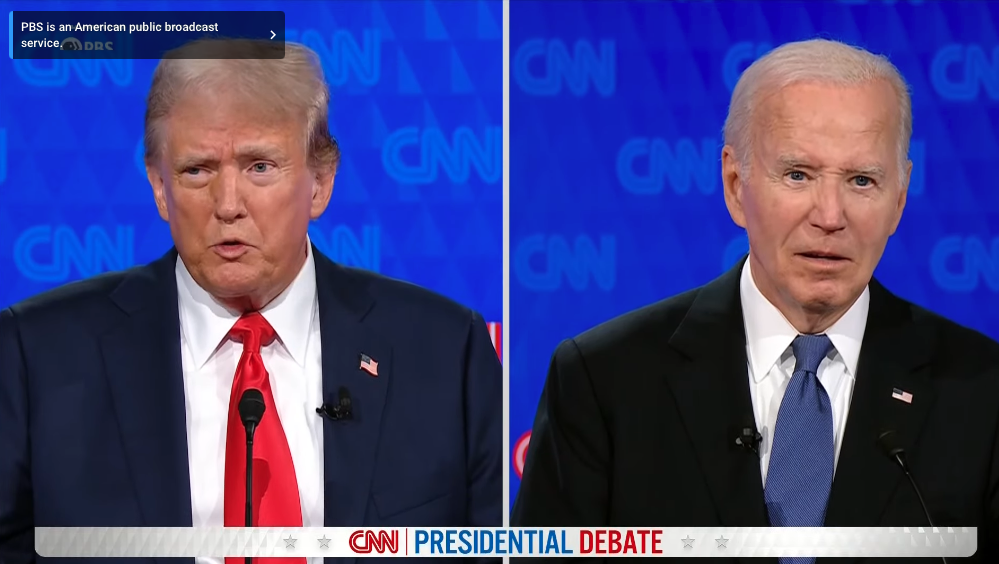

Watching last night’s debate, I had almost exactly the same reaction as my colleague Steven Taylor: President Biden seemed to be a befuddled old man. It was easily the worst showing in one of these events since Admiral James Stockdale’s “Who am I? Why am I here?” in the 1992 vice presidential debate.
We were not alone.
The POLITICO Playbook gang previewed the stakes thusly:
“Hardly anyone is paying attention to this race or to the stakes of this race — and this is our best chance to change that,” said a senior Biden official granted anonymity to speak candidly about internal discussions. “We’re pushing a lot of our chips to the center of the table.”
No one in Biden’s orbit would go so far as to say that a bad night on Thursday would effectively doom the president’s chances of a second term. Five officials in Wilmington and the West Wing believe that there would be time to recover if the debate goes poorly.
But they also aren’t sugarcoating just how difficult a bad night would be. A major mistake by Biden — like a bad verbal gaffe or freeze-up — could linger in the eyes of the public with few remaining opportunities to correct it. The convention is not until August, and the only other debate currently on the books is not until September.
They also know that Biden is being judged on a different scale than his predecessors were, owing to the questions that swirl continuously around Biden’s age. The senior official and three other officials not authorized to speak publicly about private conversations said it was critical that the president use the evening to prove to some skeptics in the national audience that he is able to handle another four years in the Oval Office.
If he were to bomb, the panic from other Democrats could overwhelm the president’s campaign.
The flip side of risk, in this case, is opportunity. And the president’s team sees the debate as presenting that as well. It’s not just that they believe the 81-year-old Biden could dispel doubts that he is too old for the job by having another strong showing akin to his March State of the Union address. They believe he can rattle and land serious blows against Trump.
Alas, bomb he did.
The POLITICO gang (“Dems freak out over Biden’s debate performance: ‘Biden is toast’“) in the immediate aftermath:
All Joe Biden needed to do was deliver a repeat performance of his State of the Union address.
Instead, he stammered. He stumbled. And, with fewer than five months to November, he played straight into Democrats’ worst fears — that he’s fumbling away this election to Donald Trump.
The alarm bells for Democrats started ringing the second Biden started speaking in a haltingly hoarse voice. Minutes into the debate, he struggled to mount an effective defense of the economy on his watch and flubbed the description of key health initiatives he’s made central to his reelection bid, saying “we finally beat Medicare” and incorrectly stating how much his administration lowered the price of insulin. He talked himself into a corner on Afghanistan, bringing up his administration’s botched withdrawal unprompted. He repeatedly mixed up “billion” and “million,” and found himself stuck for long stretches of the 90-minute debate playing defense.
And when he wasn’t speaking, he stood frozen behind his podium, mouth agape, his eyes wide and unblinking for long stretches of time.
Peter Baker, chief White House correspondent for the NYT (“A Fumbling Performance, and a Panicking Party“):
President Biden hoped to build fresh momentum for his re-election bid by agreeing to debate nearly two months before he is to be formally nominated. Instead, his halting and disjointed performance on Thursday night prompted a wave of panic among Democrats and reopened discussion of whether he should be the nominee at all.
Over the course of 90 minutes, a raspy-voiced Mr. Biden struggled to deliver his lines and counter a sharp though deeply dishonest former President Donald J. Trump, raising doubts about the incumbent president’s ability to wage a vigorous and competitive campaign four months before the election. Rather than dispel concerns about his age, Mr. Biden, 81, made it the central issue.
Democrats who have defended the president for months against his doubters — including members of his own administration — traded frenzied phone calls and text messages within minutes of the start of the debate as it became clear that Mr. Biden was not at his sharpest. Practically in despair, some took to social media to express shock, while others privately discussed among themselves whether it was too late to persuade the president to step aside in favor of a younger candidate.
“Biden is about to face a crescendo of calls to step aside,” said a veteran Democratic strategist who has staunchly backed Mr. Biden publicly. “Joe had a deep well of affection among Democrats. It has run dry.”
“Parties exist to win,” this Democrat continued. “The man on the stage with Trump cannot win. The fear of Trump stifled criticism of Biden. Now that same fear is going to fuel calls for him to step down.”
A group of House Democrats said they were watching the debate together, and one, who spoke on the condition of anonymity, acknowledged that it was a “disaster” for Mr. Biden. The person said the group was discussing the need for a new presidential nominee.
Mark Buell, a prominent donor for Mr. Biden and the Democratic Party, said after the debate that the president had to strongly consider whether he is the best person to be the nominee. “Do we have time to put somebody else in there?” Mr. Buell said.
He added that he was not yet calling for Mr. Biden to withdraw but that “Democratic leadership has a responsibility to go to the White House and clearly show what America’s thinking, because democracy is at stake here and we’re all nervous.”
Mr. Biden’s goal in accepting a general election debate earlier than ever held in presidential history was to recalibrate the contest as a choice between himself and a felon who tried to overturn an election and would in his view destroy American democracy if given the power of the presidency again. Mr. Biden left the CNN studio in Atlanta instead facing a referendum on himself and his capacity that will reverberate for days if not longer.
Mr. Trump, 78, appeared to coast through the debate with little trouble, rattling off one falsehood after another without being effectively challenged. He appeared confident while avoiding the excessively overbearing demeanor that had damaged him during his first debate with Mr. Biden in 2020, seemingly content to let his opponent stew in his own difficulties.
While Mr. Trump at times rambled and offered statements that were convoluted, hard to follow and flatly untrue, he did so with energy and volume that covered up his misstatements, managing to stay on offense even on issues of vulnerability for him like the Jan. 6, 2021, attack and abortion.
Mr. Biden appeared on defense much of the time and either did not use lines teed up for him by his campaign’s predebate advertising or mumbled them in passing in such a way that they barely registered.
Karen Tumulty, WaPo editor and columnist (“The Great Democratic Freakout is upon us“):
Get ready for the Great Democratic Freakout.
It will be difficult for even the most creative spinners in President Biden’s camp to manufacture a victory narrative out of his dreadful performance at Thursday night’s debate against his predecessor, Donald Trump.
Which means the anxieties that Democrats have had all along about Biden’s decision to run for a second term will come to the fore, along with far-fetched scenarios in which he might be compelled to step aside. There will no doubt be talk of throwing open the Democratic convention in Chicago in August to pick a new nominee.
But the turmoil that would create would be catastrophic. Biden and Trump are the candidates that each party has cast its lot with — a choice that polls consistently show is the most distasteful one that Americans have faced in modern history.
All along, Biden’s age has been the biggest concern that voters have about him. At 81, he is the oldest sitting president in history; he would be 86 by the end of a second term.
The president’s performance on Thursday will have done nothing to allay their worries. He lost the debate from the first moments. His voice was weak and hoarse, shockingly so. At times, he struggled for words and appeared to lose his train of thought. It was a drastic contrast from the vigorous Biden who delivered a robust State of the Union speech in March.
Though Trump, at 78, is only three years younger than Biden, he dominated throughout.
The lowest moment for Biden — the one likely to be remembered the most, and replayed many times in coming days — came early in the debate, at the end of a rambling answer in which Biden concluded: “We finally beat Medicare.”
Trump, predictably, pounced: “Well, he’s right. He did beat Medicare. He beat it to death.”
[…]
Even when it came to the question he should have most expected — one from CNN’s Dana Bash about his “capability to handle the toughest job in the world well into your 80s” — Biden was rambling and incoherent, first talking about how he spent much of his career as the youngest person in politics and then launching into a disquisition about computer chips.
Biden has tried to turn this election into a referendum on his opponent, which is always a hard thing for an incumbent to do — and particularly so for him. Biden’s job approval in a new Gallup poll is a dismal 38 percent, which is about where it has been for months and about 10 points below the threshold that all reelected incumbent presidents in the modern era have cleared by Election Day.
The same survey found Republicans were nearly twice as likely as Democrats to say they are pleased with their nominee, though fewer than half of those polled viewed either candidate favorably.
In calling for this debate, which was the earliest ever in a general election campaign, Biden was taking a big gamble, and hoping that it would shake the dynamic of a race that is excruciatingly close. He was right, but not in the way he hoped.
Jose Pagliery and Jake Lahut, reporters for The Daily Beast (“Joe Biden Mumbles and Stumbles the Democrats Into Crisis“):
With the future of American democracy at stake, the first presidential debate of 2024 was an embarrassing trip to the nursing home. One old man struggled to answer questions and finish his sentences. The other defied logic and spewed relentless lies.
“We had great H20,” former President Donald Trump said, inexplicably.
“We finally beat Medicare,” President Joe Biden touted, mistakenly.
The string of gaffes threatened to eclipse the most frightening aspect of the night: the fact that the only thing standing between Trump’s increasingly brazen authoritarianism and the White House is a wheezy octogenarian.
In an Atlantic column titled “Trump Should Never Have Had This Platform,” the one-time Republican speechwriter David Frum rightly argues that the very setup was problematic:
The octogenarian president delivered a fiasco of a performance on the Atlanta debate stage. But the fiasco was not his alone.
Everything about the event was designed to blur the choice before Americans. Both candidates—the serving president and the convicted felon—were addressed as “president.” The questions treated an attempted coup d’état as one issue out of many. The candidates were left to police or fail to police the truth of each other’s statements; it was nobody else’s business.
It may be no coincidence that the modern television presidential debate was born at a time of national political consensus. In 1960, John F. Kennedy and Richard Nixon presented a choice very familiar to viewers in the days of three big channels and a limited number of mass-market products: You could choose Crest or Colgate, two very similar products to meet a similar need. One might be a little mintier, the other a little spicier, but both did the job. Now we live in a very different world, a world in which the choice is much more existential—and yet we retain the Crest vs. Colgate format.
How could it be otherwise? We live in a political culture in which some of us think the supreme issue of our time was an attempted violent overthrow of the Constitution, while other Americans think it was Hunter Biden’s laptop. There are means and institutions to arbitrate those differences. That’s what elections do. But television debates cannot do it, because television debates don’t happen unless they get buy-in from “both sides.” Therefore, television debates are designed necessarily to ratify the concept of “both sides.”
Alas, this is the system we have. Americans are presented with two realistic options, the survivors of the nominating process of our two major political parties.
Biden could have declared that he would not sully the grand office of the presidency by debating a man found to have sexually assaulted a woman by one jury and convicted of 34 felony counts by another. Instead, he rejected the structure of the Commission on Presidential Debates and issued a bold challenge to debate early. Then he fell on his face.
Some Democratic commentators are blaming moderators Jake Tapper and Dana Bash for not checking Trump’s lies and exaggerations themselves, rather than leaving it to the helpless old man across the stage. Maybe that would have changed the narrative. But it may well have backfired, making it look like three against one and highlighting Biden’s impotence.
It’s worth noting that being quick on one’s feet is not a prerequisite for the presidency. By most accounts, Biden remains quite functional behind the scenes and, certainly, has handled the job much more competently than his predecessor and would-be successor. But voters don’t get to see Biden run cabinet meetings or National Security Council sessions.
There will be plenty of opportunities for Biden to recover from this performance over the next four months. But he blew a big one last night.









