
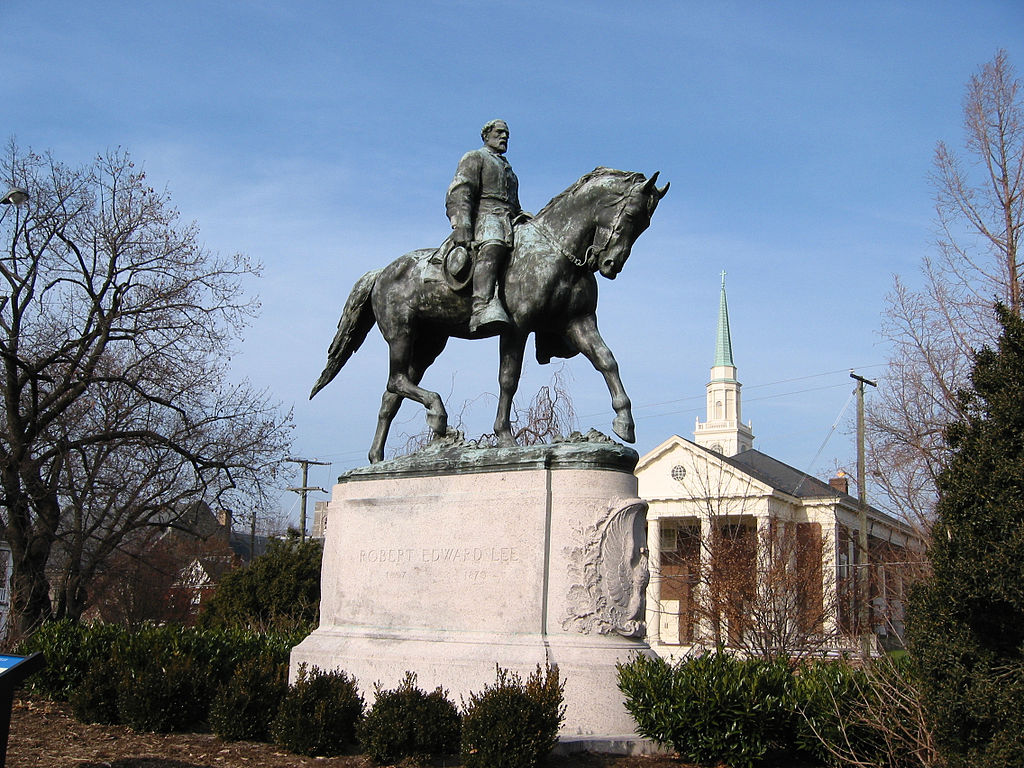

Two of the most controversial monuments to Confederate generals met their demise yesterday. One was a triumph for decency. The other, I’m less sure.
The unambiguous case was reported by Nashville’s NewsChannel 5 (“Nathan Bedford Forrest statue along I-65 removed after more than 2 decades”):
For years, he peered down from a hillside overlooking the interstate — hard for anyone to miss. But now, the controversial statue of Nathan Bedford Forrest along I-65 just south of Nashville is gone.
The controversial statue came down Tuesday morning, and the decision came after the death of the property owner. The late Jack Kershaw sculpted the 25-foot statue and put in on private land owned by his friend, Bill Dorris, overlooking I-65 back in 1998.
Dorris knew thousands of people driving by would see it every single day.
There was controversy with Nathan Bedford Forrest considering his past as a Confederate General and the first grand wizard of the Ku Klux Klan.
Over the years, Dorris refused to move the statue, despite pleas from those who viewed it as a symbol of racism. The statue was repeatedly vandalized — at one point splashed with pink paint.
The thing is ugly in every sense:

By 1998, when this monstrosity was constructed, there was no romanticism around Forrest. While Robert E. Lee, Stonewall Jackson, and a handful of others continue to be held up by many as examples of bold generalship and exemplars of old-style Southern gentlemen, Forrest had long since been a pariah. While he was a brilliant cavalryman, the 1864 massacre at Fort Pillow was one of the most barbaric incidents in the war. And even those who still privately supported white supremacy mostly rejected the Klan.
This statue, then, was a giant middle finger to anyone who drove by it on I-65, which I did many times over the years. Because it was on private land, there was nothing anyone could do about it and Kershaw and Dorris revelled in that.
Alas, death comes for us all. He left the sculpture to the Battle of Nashville Trust and they issued a statement:
Mr. Dorris had no prior affiliation with the Battle of Nashville Trust, Inc. and the Trust had no idea it was a beneficiary of his will until well after Mr. Dorris passed.
The Dorris will leaves the Hogan Road property to the Battle of Nashville Trust , Inc. There are some restrictions and we will let the court decide all of this.
Preservation of history is critical. The Nashville battlefield was one of the largest in the Civil War and the least protected. It spans from the Cumberland River near Charlotte Pike east to the other side of Nolensville Road and South from the hills just south of town all the way to Brentwood. The core battlefield covers most of Green Hills all the way east to I-65. The citizens of Nashville tried to protect some of the site as early as the 1920s but were unsuccessful. Development and time have made the battlefield virtually unrecognizable. However, the Trust, in conjunction with its partners including Metro Nashville, have been able to save some of the sites for all Americans. The interest in the Civil War and the battle here is huge. We have had over a million visitors to our website from all over the country and the world. People want to know where their great great great grandfather fought and his roots in time and history. We are proud of what we have accomplished. Our sites are hidden gems in the community-protected forever-for all to enjoy.
The battle here was perhaps the most decisive victory for the United States during the war and it ended major fighting in the western campaign. The largest attack of the war by African Americans -the USCT-occurred here on Franklin Pike near Battery Lane and their casualties were enormous. History is important. It tends to repeat itself. And it is all in our backyards. The Battle of Nashville was a pivotal moment in our nations bloodiest conflict. The Hogan Road property is not core battlefield land. It is a sliver of the retreat. Putting aside a debate about Forrest as a person and commander and all of the related controversy, the position of the Trust on this statue is:
1. Forrest was not present at the Battle of Nashville
2. The property has no historical significance related to the battle other than a spring house and ice house that was part of a large estate where CSA Brig. General Claudius Sears was taken for a leg amputation-the home has long since been destroyed by Interstate 65
3. The statue is ugly
4. Even Forrest would think it is ugly
5. It hinders our mission and what we are trying to accomplish.
The Trust is grateful for the gift by Mr. Dorris.
While I’m sure there are those who lament that they will no longer see this statue, its loss is an unalloyed good.
The Washington Post reports (“Charlottesville’s Robert E. Lee statue will be melted down by city’s African American history museum“) on the other case.
The statue of Confederate Gen. Robert E. Lee that once provoked a deadly weekend of violence in Charlottesville will be melted down and turned into a new piece of public artwork, following a vote by city lawmakers early Tuesday morning.
The city had for months been searching for a new owner for the 1,100-pound monument, which served as the focal point of the white-supremacist Unite the Right rally in 2017. After the city took the statue down over the summer, six proposals on what to do with it were submitted by arts groups, historical societies or individuals, some offering to pay the city as much as $50,000 for the bronze sculpture.
But the Charlottesville City Council voted 4 to 0 to hand it over to the only local bidder: the Jefferson School African American Heritage Center, a Black-led museum that proposed repurposing the metal entirely.
Called “Swords Into Plowshares,” the project “will allow Charlottesville to contend with its racist past,” Andrea Douglas, the museum’s executive director, said in an interview Tuesday afternoon. “It really is about taking something that had been harmful and transforming it into something that is representative of the city’s values today.”
The museum will consult Charlottesville residents in the coming months, including in open forums early next year, to determine guidelines for the art piece, and then convene a jury to select one idea, Douglas said. The end result will be gifted back to the city to display on public land by 2024.
So, on the one hand, the fact that this statue is gone from public display is almost certainly the right outcome. Aside from having a giant monument to the cause of slavery offend so many Black citizens, it had become a rallying point for white supremacists. But that removal was achieved six months ago.
Unlike the Bedford monument, this statue was a legitimate work of art. And it has a century-long history, having been s commissioned in 1917 and dedicated in 1924. Confederate veterans were still alive at that point—indeed, it was roughly as close to the end of the Civil War then as the end of the Vietnam War is now. It was listed on the National Register of Historic Places in 1997, the year before the Forrest statue went up in Nashville. It really belongs in a museum somewhere, where it can be part of an exhibit that puts it into context.
Having it melted down—and by an African-American organization, no less—may well have some cathartic value as poetic justice. But it’ll also reinforce the impulses that spawned the Charlottesville rally to begin with.








