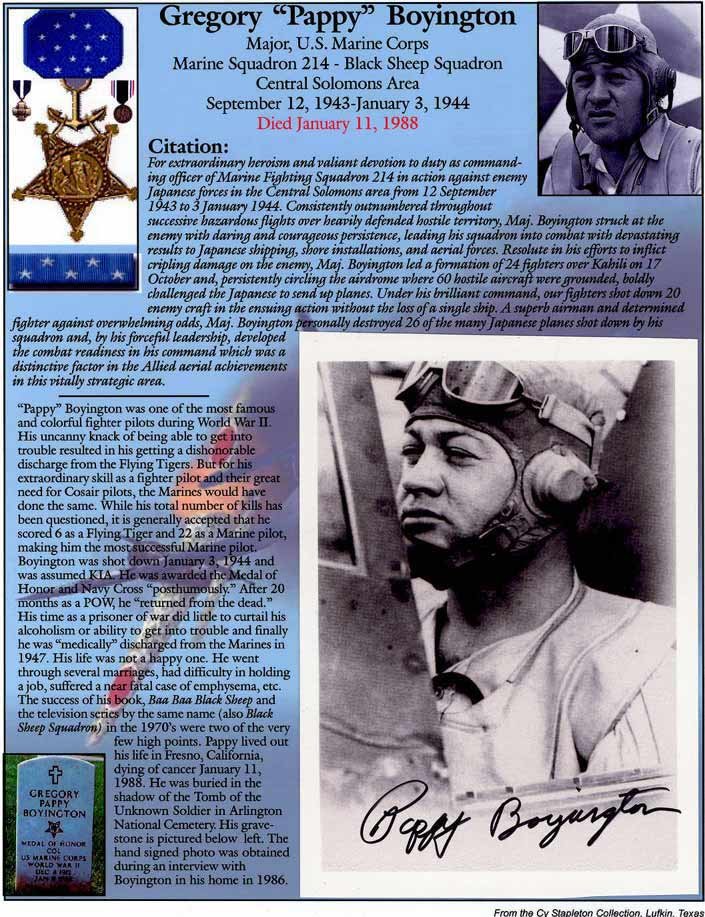
The University of Washington student senate narrowly rejected putting up a memorial to alumnus Gregory “Pappy” Boyington, Medal of Honor recipient and leader of the legendary Black Sheep Squadron.
WorldNetDaily reports:
The University of Washington’s student senate rejected a memorial for alumnus Gregory “Pappy” Boyington of “Black Sheep Squadron” fame amid concerns a military hero who shot down enemy planes was not the right kind of person to represent the school. Student senator Jill Edwards, according to minutes of the student government’s meeting last week, said she “didn’t believe a member of the Marine Corps was an example of the sort of person UW wanted to produce.” Ashley Miller, another senator, argued “many monuments at UW already commemorate rich white men.”
Senate member Karl Smith amended the resolution to eliminate a clause that said Boyington “was credited with destroying 26 enemy aircraft, tying the record for most aircraft destroyed by a pilot in American Uniform,” for which he was awarded the Navy Cross. Smith, according to the minutes, said “the resolution should commend Colonel Boyington’s service, not his killing of others.”
The senate’s decision was reported first by Seattle radio talk-host Kirby Wilbur of KVI, whose listeners were “absolutely incensed,” according to producer Matt Haver. Brent Ludeman, president of the university’s College Republicans, told WND in an e-mail the decision “reflects poorly on the university.”
Bravo Romeo Delta, writing at the Jawa Report, corresponded with Lee Dunbar, the president of the senate, and got the encouraging news that the resolution only “failed by one vote, and a good majority of those who voted against it wanted more inclusion of other alumni who were combat veterans who earned the Medal of Honor. This week a new resolution to that effect is being drafted and introduced.”
Ace and Michelle Malkin are also on the story.
Ironically, on the same day this news broke, the Providence Journal featured an op-ed from Jim Donaldson entitled, “Let’s save the worship for true heroes of the world.”
It’s an Olympic scene networks love to show. And newspapers, too. Even more than dramatic pictures of skiers falling, snowboarders backflipping, and beautiful pairs skating, the shots that everybody loves to see are those of American athletes draped in the flag. Or waving the flag. Or up on the medal stand, gold medal hanging around the neck, a smile on the face — even as a tear rolls gently down a cheek, perhaps mouthing the words of “The Star-Spangled Banner” as the revered red, white and blue is run up the flagpole.
It’s gives the folks back home in the good ol’ U.S. of A. that warm-and-fuzzy, feel-good, isn’t-he-or-she-great, aren’t-we-great, isn’t-America-great, sports-as-combination-Kodak Moment-Hallmark Card, Mom-and-apple pie feeling. But just when did winning the halfpipe make someone a hero? What’s so patriotic about skating, or skiing, faster than the next guy? Does winning a medal in ice hockey make America a better, safer place?
The pictures I’d like to see, but we seldom, if ever do, are of a teenaged sentry standing along the DMZ, between North and South Korea, or beside the barbed wire at Guantanamo Bay, Cuba. I’d like to see video of the officer of the deck during the midwatch from midnight to 4 a.m. as he keeps his destroyer on course in the Indian Ocean while most of his shipmates sleep, or of the non-commissioned officer as keeps a watchful eye on his men during a patrol through the streets of Tikrit.
[…]
Those achievements are not insignificant. Those stories are worth telling. But, when the Olympics are over, will those same networks tell us nightly stories of the young Marine serving a tour of duty in Afghanistan, a guy with a young wife back home, and perhaps a child who was born shortly after he shipped out that he’s never seen, doing his duty each day — proud to do it — while at the same time counting each day until he can return? Will they superimpose a flag behind him while extolling his virtues and telling us what a hero he is? And how about the female Army officer serving in Iraq, where women are treated as second-class citizens? Will we hear about her? Don’t count on it.
We all have heard stories about heroes of past wars — men like Alvin York and Audie Murphy, Eddie Rickenbacker and “Pappy” Boyington. But who are the heroes of the Gulf War? Of the current conflicts in Afghanistan and Iraq? Combat heroes no longer are glorified in America, where, if battles occur, we like to think they can be fought without anyone getting hurt.
So true.