

If you were an incumbent member of the House or the Senate running for re-election in 2012, the odds are pretty good you made you pretty well:
Nine in 10 members of the U.S. House and Senate who sought new terms in office this year were successful, improving their record for re-election even as public approval of Congress sank to all-time lows.
The BGOV Barometer shows that 90 percent of House members and 91 percent of senators who sought re-election in 2012 were successful, exceeding the incumbent re-election rates of 2010, when 85 percent of House members and 84 percent of senators seeking re-election were successful. For senators, this year’s re-election percentage was the highest since 2004.
Voters were more likely to return their own representatives to office even though the public had a dim view of the legislative branch as a whole. Congress had a 21 percent approval rating on Oct. 15-16 after reaching all-time lows of 10 percent in February and August, according to Gallup polls. Just 10 percent of Americans said that members of Congress have high or very high honesty and ethical standards, according to Gallup data for Nov. 26-29.
“It wasn’t a ‘throw the bums out’ election, it was a ‘throw the bums in’ election,” John J. Pitney Jr., a professor at Claremont McKenna College in Claremont, California, said in an interview.
This contrasts with the 2010 elections, when 87% of the incumbents running in House elections were re-elected, and 84% of the incumbent Senators running for re-election were re-election. As noted, it’s also a higher re-election rate than we’ve seen in eight years, although the historical re-election rates of Members of Congress going back nearly 50 years have been fairly high except in unusual circumstances.
Here, for example, is a chart of the House re-election percentages going back to 1964 and updated through 2010:
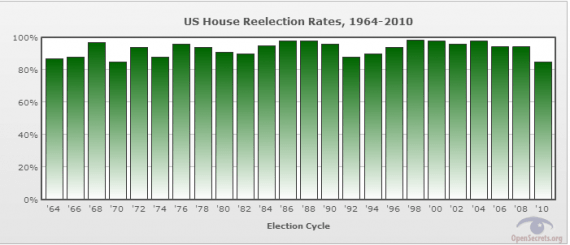
Even in years where there were massive swings in control of the House, such as 1994, 2006, and 2010, you find that more than 85% of the incumbents running get re-elected. The reasons for this are well know. Incumbents have always had inherent advantages over challenges thanks to name recognition, and this is especially true in House Districts where representatives tend to be very “hands on” such that the voters are well aware who they are. Additionally, there’s the money advantage that incumbents naturally get both by virtue of interest groups who wish to curry favor with elected officials as well as the fundraising network they’ve built up from previous elections. Finally, there’s redistricting and the fact that vast numbers of incumbent Congressmen find themselves in districts that are so heavily tilted in the direction of one party that defeating them in a General Election is often next to impossible.
The chart for Senators looks a little bit different:

In past years, Senators have been in fairly precarious positions, such as in 1980 when only 55% of the Senators running for re-election were successful. In more recent years, though, re-election rates for Senators have historically been 75% or better and, except for a period from 1976 to 1980, there’s never been a time in the last 50 years when it was below 70%. So, even though Senators don’t have the same job security that Congressmen do, in no small part because they don’t have the advantage of gerrymandering, it’s still a pretty secure job even in times in political upheaval.
The broader point is that being a Member of either House of Congress is a pretty secure job. I’m not sure we should want it to be that way, though.
Charts via Open Secrets








