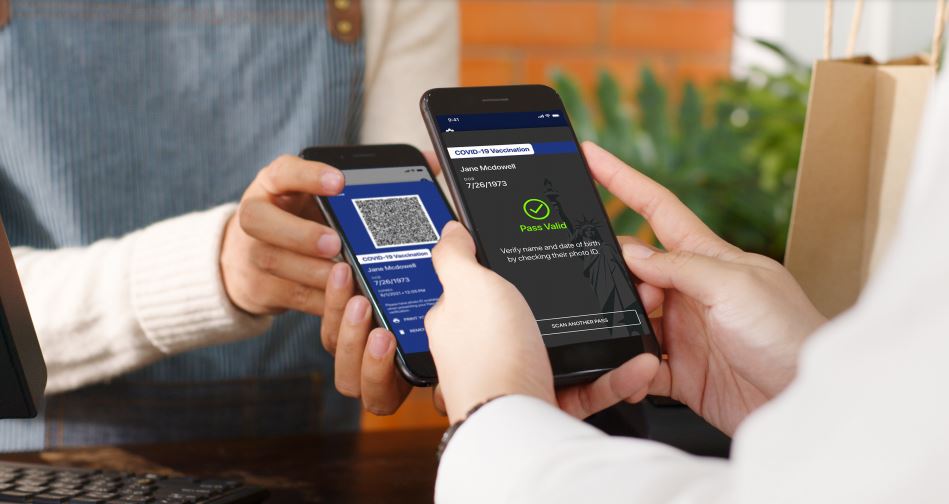

As of Friday, residents of New York state can display an Excelsior Pass to prove they’re vaccinated or have recently passed a COVID test. Fears of a two-tier society are naturally emerging.
USA Today (“New York launches nation’s first ‘vaccine passports.’ Others are working on similar ideas, but many details must be worked out.“):
Starting Friday, New Yorkers will be able to pull up a code on their cell phone or a printout to prove they’ve been vaccinated against COVID-19 or recently tested negative for the virus that causes it.
The first-in-the-nation certification, called the Excelsior Pass, will be useful first at large-scale venues like Madison Square Garden, but next week will be accepted at dozens of event, arts and entertainment venues statewide. It already enables people to increase the size of a wedding party, or other catered event.
The app, championed by Gov. Andrew Cuomo to support the recovery of industries most affected by the pandemic, is funded by the state and available for free to businesses and anyone with vaccination records or test results in New York.
Like an airline boarding pass, people will be able to prove their health status with a digital QR code – or “quick response” machine-readable label. They’ll need to download the Excelsior Pass app, enter their name, date of birth, zip code and answer a series of personal questions to confirm their identity. The data will come from the state’s vaccine registry and also will be linked to testing data from a number of pre-approved testing companies.
The state’s official announcement argues that this will “fast-track” re-opening of businesses that have been closed or operating under reduced capacity owing to COVID restrictions. It is currently voluntary and personal data safeguarded using blockchain technology:
While some businesses have been able to operate by reducing capacity or by having their employees work from home, many others, like performing arts and sporting events with fans, which involve large, dense gatherings, have only just been able to re-open under strict health and safety guidelines. As more New Yorkers are being vaccinated, these activities will be permitted to resume in accordance with new public health guidelines, and this new mobile app can help to further fast-track the reopening of these venues.
As part of major stadium and arena reopening guidelines announced by the Governor on February 10, venues must ensure that all staff and spectators receive a negative COVID-19 PCR test within 72 hours of the event. During this pilot program, a subset of predetermined participants will be able to use the pass to confirm their recent negative COVID-19 test and gain entry to these events at Barclays Center and Madison Square Garden.
Robust privacy protections are woven throughout the digital health pass solution, giving individuals a secure, verifiable and trusted way to maintain control of their personal health information using an encrypted digital smartphone wallet or printed credential. Each participant will be able to determine if they would like to use it -and if so, what passes they wish to use for which purpose -all without sharing their underlying personal data. User data is always kept completely confidential, and participation is voluntary. The QR code only informs the venue if a pass is valid or invalid.
There are still quite a few technical issues to be worked out but the larger concerns are social. Back to the USA Today report:
Amy Fairchild, dean of Ohio State University and a historian and ethicist, said the biggest challenges with such certifications will be cultural not technological.
[…]
But whether American consumers and businesses will accept the idea of providing proof before entry is not so obvious, she said. Just as many Americans have resisted wearing masks during the pandemic, some will reject the idea of showing a certificate to get into a ballgame or night club.
Requiring vaccination “is not something we have done before within this country outside of school systems and hospitals,” said Fairchild, adding it would incredibly useful from a public health standpoint and could eventually be expanded to cover flu and measles shots – if public opinion would allow it.
“To the extent that it could be used to help build up our public health infrastructure, that would be fabulous,” she said.
But such efforts have typically fallen apart because of cultural resistance to the idea of being required to do things. “We are ideologically as a culture pretty resistant to the idea of mandates unless it’s kids.”
Jazz Shaw, for one, is not happy.
The first thing to point out here is that New York State has thus far vaccinated roughly half of its eligible citizens. That means that the other half of the state will now be shut out of nearly all nonessential activities unless they can find someplace to be tested and “verified” every few days. And if you think this only applies to things like basketball games, guess again. The state has specifically listed wedding receptions as events that will require a scanner at the door and an immunity passport to gain entrance. As of this morning, CNN is saying that 14.7 percent of adults in the United States are fully vaccinated at this point, so the disparity is vastly greater if a plan like this shows up at the national level.
While it won’t be part of the initial rollout, large retail chains and even grocery stores are reportedly studying how this system could be put into effect at their establishments. You can’t be barred from shopping for food and other essentials entirely, but some stores are considering setting up separate entrances for those with and without the passport or having some shopping hours restricted for only those who pass muster.
I’ve gone through the Post’s “explainer” of how the system operates and I don’t see any exceptions listed for people with comorbidities or other underlying conditions that could lead their doctors to recommend that they avoid the vaccine. So if you either choose not to be vaccinated or are medically disqualified from receiving it, at least in New York, you will officially be a second-class citizen on April 2nd. Without the pass, you will be part of a new class of pariahs who are barred from mingling with the new, upper class of people with immunity, or those who purchase a few days of “normalcy” by showing a negative COVID test result.
As noted in my post “Incentivizing COVID Vaccination,” Israel launched their version of this, the Green Pass, a few weeks ago and is wrestling with these issues. They’re a more compliant society so they’re getting less pushback than will likely be the case here.
But here’s the thing: it’s not that those without the passport are being denied access to activities but that those with it are being allowed to do things they weren’t before. Take the wedding receptions case. Under current guidelines, most states, including New York, have restrictions for large gatherings of people owing to the pandemic. The creation of this pass allows those who wish to do so to bypass these restrictions.
As best I can determine, the only people currently not recommended to get the vaccine are those “with a severe allergic reaction (anaphylaxis) to any component of the COVID-19 vaccine” and children under 16. But the creation of this passport doesn’t change what they’re allowed to do; it merely frees those with it to do things they can’t do now.
As to those who simply refuse to get the vaccine? They have the right to make that choice. But they don’t have a right to get others sick or impose other negative externalities on others. Since vaccinated people are still required to wear a mask, socially distance, and take all manner of other precautions against the virus around people who aren’t vaccinated, that’s a hell of a negative externality. To the extent that makes vaccine-hesitant folks “second-class citizens,” that’s just too damn bad. Choices come with consequences.
The real ethical quandary is that it will be months before we can vaccinate everyone, which means those who are closer to the front of the line are privileged over those in the back. And, of course, a lot of people can’t easily get—or can’t afford—regular COVID tests.
As to when this all ends? Presumably, it’s when we reach herd immunity as a society and can sound the all clear. And incentivizing vaccination against the virus by allowing those who do so to live a more normal life will speed that up for everybody.