
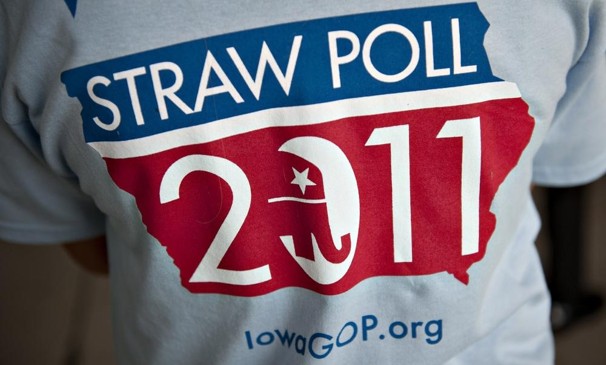

After thirty-six years of what had come to be a very odd history, the Iowa Republican Party has voted to end the quadrennial Iowa Straw Poll:
The Iowa Straw Poll is dead.
The governing board for the Republican Party of Iowa voted unanimously Friday to cancel the straw poll, a milestone on the path to the White House that had passed the strategic tipping point. It was no longer a political risk for presidential campaigns to walk away from the straw poll, and too many of the 2016 contenders had opted to skip it for it to survive.
For GOP activists in Iowa, the summertime political festival was a beloved tradition that dated to 1979, but its fate rested in the hands of the presidential campaigns, who drove attendance by spending resources to haul in their supporters.
Several key contenders — Jeb Bush, Marco Rubio and Mike Huckabee — had decided against dishing out the big bucks it can take to win. Party officials needed at least one legitimate player to participate, but the Iowa frontrunner, Scott Walker, declined to commit.
Ample cover for skipping the straw poll was delivered by Iowa Gov. Terry Branstad, who had declared at the end of the 2012 presidential election that it had “outlived its usefulness.” And a recent Iowa Poll showed that while a slight majority of likely GOP caucusgoers thought it was important for presidential candidates to participate in the straw poll, almost as many dismissed it as unimportant.
In recent weeks, party officials had concluded that the much-criticized party fundraiser could potentially damage Iowa’s first-in-the-nation caucuses.
(…)
The decision comes as the party fundraiser appeared to be on the verge of falling flat because so many presidential contenders were steering clear of it. Some candidates had said they might show up to give a speech, but wouldn’t spend money trying to win the straw poll. That meant the fundraiser would likely have struggled to break even, much less garnered hundreds of thousands for the party as it has in the past.
This result seemed to be inevitable given the fact that Jeb Bush, Mike Huckabee, and Marco Rubio had already announced that they would not be participating in the event, and that Scott Walker was hinting that he might do the same. To a large degree, the fate of the event was set in stone four years ago with the top two showing by Michele Bachmann and Ron Paul, two candidates who everyone knew had no realistic chance of winning either the Iowa Caucuses or the nomination. In the wake of that event, Governor Brandstad had led Iowa Republicans who were arguing that the poll had outlived its usefulness, but even his outsized influence inside the Hawkeye State’s Republican Party wasn’t enough to end the spectacle. Instead, party leaders tried to reimagine the straw poll by moving it away from the Iowa State Fair in Ames to a more rural locale, but that did nothing to address the substantive criticisms that many people outside and inside Iowa had against the event and the way it had come to have far too much influence on the Republican nomination process.
The party will lose from this decision, of course, since the straw poll was one of their biggest fundraisers. At the same time, though, because of the fact that it was leading people to discredit the political process in the state to begin with I think the state GOP was well-founded to conclude that continuing the tradition could have had an adverse impact on the state’s first in the nation status in the Presidential primary process. In all honesty, of course, that status ought to be challenged given the fact that Iowa is hardly representative of the nation as a whole and that caucuses are the worst possibly way to conduct a primary. That battle, though, will have to wait until another day. The end of the straw poll is also arguably a loss for low tier candidates who might have hoped to use a better than expected performance in the event to boost their national profile, something that may have been more likely to happen with nearly all of the top tier candidates skipping the event completely. For the nation as a whole, though, ending this absurd spectacle is nothing but a good thing.









