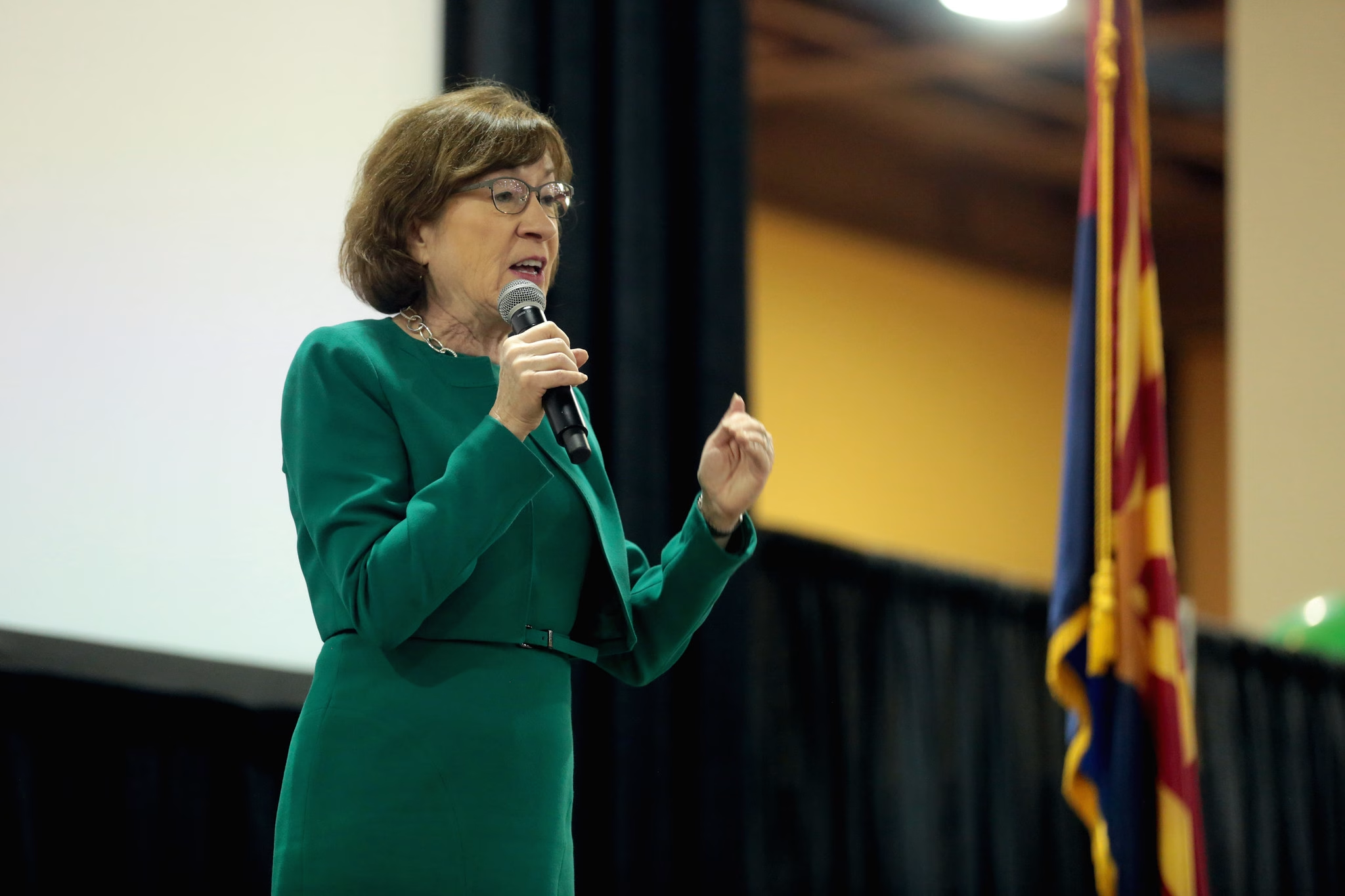
After months of keeping her intentions private, Republican Susan Collins, who has represented Maine in the Senate since first being elected to succeed William Cohen in 1996, has announced that she will seek a fifth term in office in 2020, setting up a re-election bid that could be among the most difficult that she has faced in her political career:
Maine Sen. Susan Collins announced Wednesday she intends to run for reelection, seeking a fifth term in what will likely be the most difficult campaign of her career.
Collins has been raising money and running TV ads as if she was running for reelection for months, but delayed any official announcement, creating widespread speculation about her intentions. In a letter to supporters Wednesday, she made her plans clear.
“The fundamental question I had to ask myself in making my decision was this: in today’s polarized political environment, is there still a role for a centrist who believes in getting things done through compromise, collegiality, and bipartisanship?” Collins said in the letter. “I have concluded that the answer to this question is ‘yes,’ and I will, therefore, seek the honor of continuing to serve as Maine’s United States Senator.”
Maine is a critical state for the GOP’s Senate majority, and Collins’ announcement is a major boost for Republicans. It would have been extremely difficult for the party to hold the seat had Collins decided to retire. Republicans currently have a 53-47 majority.
Democrats argue that Collins has lost her bipartisan credentials in recent years and expect to give her the most difficult challenge of her career. They’re likely to nominate state House Speaker Sara Gideon, who faces a primary but leads the field in fundraising and has been endorsed by the Democratic Senatorial Campaign Committee and a host of Maine Democrats.
More from the Portland Pres-Herald:
U.S. Sen. Susan Collins announced her bid for a fifth term Wednesday morning, officially launching what is expected to be an expensive and closely watched re-election race.
“I promised the people of Maine a decision this fall on whether I would seek reelection,” Collins said in a letter emailed to supporters. “The fundamental question I had to ask myself in making my decision was this: in today’s polarized political environment, is there still a role for a centrist who believes in getting things done through compromise, collegiality, and bipartisanship.
“I have concluded that the answer to this question is ‘yes,’ and I will, therefore, seek the honor of continuing to serve as Maine’s United States Senator.”
The announcement comes the same day the House is expected to vote on articles of impeachment for President Trump.
Collins has not said how she would vote on impeachment if it moves to a Senate trial and did not mention it in the letter, though she did say that “these are difficult and contentious times” and stressed a need for bipartisanship in making her pitch to voters.
The race for Collins’ Senate seat is expected to be the most competitive she has faced to date. In 2014 she received more than 60 percent of the vote to defeat Democratic challenger Shenna Bellows.
“Mainers are excited to elect a new senator, and Maine Democrats have been organizing,” Maine Democratic Party Chair Kathleen Marra said in a statement Wednesday. “With Collins’ support in Maine at an all-time low, we’ve seen volunteer engagement more than double in comparison to the previous off-year and know this excitement will continue to grow.”
Although she is still regarded in Washington as a moderate within an increasingly far-right caucus, Collins has lost support among Maine Democrats and some independents, according to several polls.
Her controversial support of Supreme Court Justice Brett Kavanaugh has been a sticking point for Democrats. Over the summer the non-partisan Cook Political Report named her seat a toss-up.
Collins, who did not support Trump in 2016, also runs the risk of alienating his Republican base by not defending the president on impeachment.
Since first being elected to the Senate to succeed former Senator and Defense Secretary William Cohen in 1996, Collins has won each of her bids for re-election in 2002, 2008, and 2014 easily. In 2018, Collins turned down the opportunity to run for Governor in favor of staying in the Senate. Most recently, she won re-election in 2014 with 68% of the vote, in a state that President Trump lost by 22,000 votes in 2016 (though he did manage to pick up an Electoral Vote by winning the state’s 2nd Congressional District. Ordinarily then, it would be expected that Collins would win re-election easily again in 2020, but some observers suspect that 2020 could prove to be a more difficult year for Collins.
The first reason for this, obviously, is the Trump factor, which is likely to result in a heavy anti-Trump voter turnout. The question for Collins will be how many of those voters end up splitting their vote between the Democratic nominee for President and her, and how many end up voting for the Democratic nominee for Senate. That isn’t necessarily a problem for Collins, though. In 2008, Barack Obama won the state by 126,560 votes and Collins was reelected by 164,790 votes. The second reason revolves around Collins’s decision to vote to confirm Justice Brett Kavanaugh in the face of the sexual assault allegations that were made against him by Dr. Christine Blasey Ford and others during the hearings last year. That vote, which Collins said recently she did not regret, has proven to be controversial among some circles back home and it’s unclear how much of a factor that would be in a race in November 2020.
At this point, it appears that the most likely candidate that Collins will face in November will be Sara Gideon, who has served in the Maine House of Representatives since 2012 and as Speaker of that body since 2016. Gideon’s campaign, which began not long after the vote to approve the appointment of Supreme Court Justice Brett Kavanaugh, is receiving much support from Democrats outside the state who hope to flip Collins’s seat in the fall. Collins, however, has a long history as a political survivor in the shifting winds of Maine politics. Because of that, I would not count her out at all and would for the moment at least place the money on her being re-elected in the fall.
Collins’s announcement likely comes as a relief to Senate Majority Leader Mitch McConnell and other national Republicans concerned about maintaining the party’s majority in the Senate this fall. As it stands, the party’s slim 53-47 majority is at risk in what are likely to be close races in Arizona and Colorado as well as a potentially close re-election bid for Senator Thom Tillis in North Carolina. On the other side of the ledger, Republicans are hoping to take back a seat they should have won easily in Alabama in 2017 but for the fact that they had the worst possible nominee. Had Collins decided not to run, it’s likely that the seat would have gone to the Democrats. With Collins in the race, I would put the state at least in the “Leans Republican” category for the time being unless polling in the future starts calling that into question.