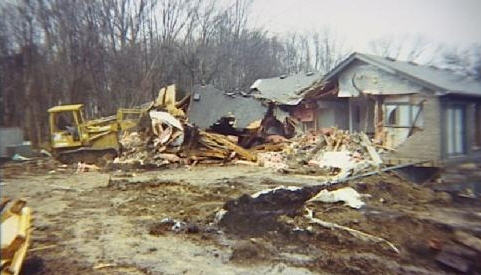
 A Moscow, Ohio man decided to bulldoze his house rather than let the bank take it.
Like many people, Terry Hoskins has had troubles with his bank. But his solution to foreclosure might be unique. Hoskins said he’s been in a struggle with RiverHills Bank over his Clermont County home for nearly a decade, a struggle that was coming to an end as the bank began foreclosure proceedings on his $350,000 home.
“When I see I owe $160,000 on a home valued at $350,000, and someone decides they want to take it — no, I wasn’t going to stand for that, so I took it down,” Hoskins said.
Hoskins said the Internal Revenue Service placed liens on his carpet store and commercial property on state Route 125 after his brother, a one-time business partner, sued him. The bank claimed his home as collateral, Hoskins said, and went after both his residential and commercial properties.
Hoskins said he’d gotten a $170,000 offer from someone to pay off the house, but the bank refused, saying they could get more from selling it in foreclosure.
Hoskins told News 5’s Courtis Fuller that he issued the bank an ultimatum. “I’ll tear it down before I let you take it,” Hoskins told them. And that’s exactly what Hoskins did.
This story makes no sense on a number of levels. For example, it’s just implausible that, if Hoskins only owed $160,000 that the bank would have refused a $170,000 payoff. One, I don’t think they can legally do that. And, two, they’d owe him the difference between what the home brought at auction and what he owed, minus transaction costs.
John Cole, though, doubts that bulldozing assets owned by others ahead of foreclosure will catch on but offers “it would be great if it did.” He doesn’t explain why. But it’s apparently a common sentiment, judging from the comment thread at WLWT5.
Lending institutions provide a tremendous public service, albeit for a hefty profit. Most of us simply could not afford to buy major end items like cars, much less houses, without the availability of banks and mortgage companies to front us the cash. In return for the ability to buy and live in a home we couldn’t otherwise afford, we agree to pay a fully-disclosed monthly payment for a fixed period of time. Further, the lender gets a lien on the asset in question as collateral in the event of nonpayment.
There was a blog meme a couple months back as to whether it’s “immoral” for people whose houses are no longer worth what they paid for them — a phenomenon that’s been dubbed being “under water” in one’s home — to simply walk away, handing the mortgage holder the collateral in return. My sense is that it isn’t: Both sides have a contract and the borrower is exercising his rights under the contract. In accepting the asset as collateral, the bank assumed the risk that its value would decline because of the vagaries of the market. It may or may not be a smart financial decision in a given set of circumstances, but morality doesn’t enter into it.
Here, though, Hoskins’ actions are clearly immoral. He’s committing an act of theft against an institution that lent money in good faith, expecting either payment or return on the asset.
He’s almost certainly committing a crime, too, in so doing.