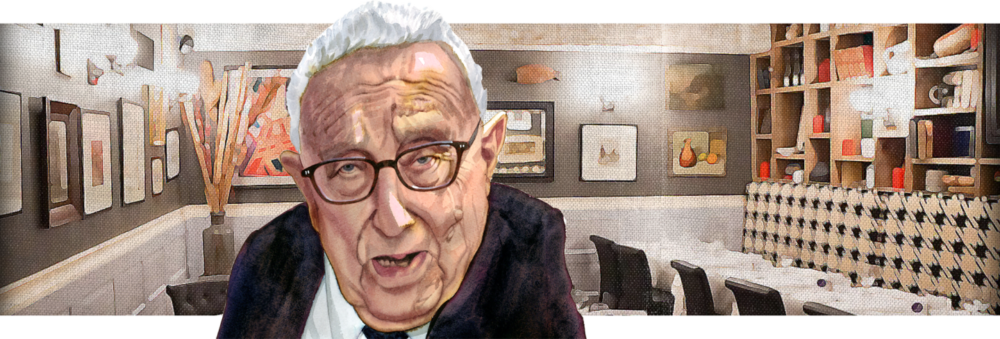

The elder statesman of American statecraft recently sat down with the FT’s Ed Luce to talk about the state of world affairs in the age of Trump. It was not easy getting him to open up. What he did say was quite scary, precisely because he has spent the past four decades saving his candor for his paying customers.
The piece is worth reading in full, partly because of Luce’s clever back-and-forth. But here are some highlights:
He loves to be in the thick of things. Persuading him to say what he actually thinks is another matter. Kissinger is to geopolitical clarity what Alan Greenspan was to monetary communication — an oracle whose insight is matched only by his indecipherability. It is my mission to push him out of his comfort zone.
[…]
As the co-architect of the cold war rapprochement with China and détente with the Soviet Union, Kissinger now surveys a world in which China and Russia are both challenging the US world order, often in concert with each other.
[…]
I sense I am losing my battle to get him on to Trump — or failing to detect his hidden message. Is he saying we are underestimating Trump — that, in fact, Trump may be doing us the unacknowledged service of calming the Russian bear? Again, there is a pause before Kissinger answers.
“I don’t want to talk too much about Trump because at some point I should do it in a more coherent way than this,” Kissinger replies. But you are being coherent, I protest. Please don’t stop. There is another pregnant silence. “I think Trump may be one of those figures in history who appears from time to time to mark the end of an era and to force it to give up its old pretences. It doesn’t necessarily mean that he knows this, or that he is considering any great alternative. It could just be an accident.”
[…]
I cannot shake the feeling that Kissinger is trying to tell me something but that I am too literal to interpret it. Like a blindfolded darts player, I try a number of different throws. What would Germany become if Trump pulled America out of Nato? Kissinger likes that question but declines to give odds as to its likelihood. “In the 1940s, the European leaders had a clear sense of direction,” he says. “Right now they mostly just want to avoid trouble.” They are not doing a very good job of it, I interrupt. “That’s true,” says Kissinger with a cryptic smile. “One eminent German recently told me that he always used to translate tension with America as a way to move away from America but now he finds himself more afraid of a world without America.” So could Trump be shocking the rest of the west to stand on its own feet, I ask. “It would be ironic if that emerged out of the Trump era,” Kissinger replies. “But it is not impossible.”
The alternative, Kissinger adds, is not appealing. A divided Atlantic would turn Europe into “an appendage of Eurasia”, which would be at the mercy of a China that wants to restore its historic role as the Middle Kingdom and be “the principal adviser to all humanity”. It sounds as though Kissinger believes China is on track to achieve its goal. America, meanwhile, would become a geopolitical island, flanked by two giant oceans and without a rules-based order to uphold. Such an America would have to imitate Victorian Britain but without the habit of mind to keep the rest of the world divided — as Britain did with the European continent.
[…]
I decide to take a final stab at the bullseye. We have been talking for almost two hours. If there is one recurring criticism of Kissinger, I tell him, it is that he goes to great lengths to preserve access to people in power at the expense of not speaking plainly in public. Isn’t now — of all moments — the right one to burn a bridge or two? Kissinger looks crestfallen.
“I take that seriously and a lot of people, good friends of mine, have been urging this on me,” he says eventually. “It could happen at some point in time.” There is no time like the present, I say with a nervous laugh.
“It is clear the direction I am going in,” he replies. “Is it clear to you?” Sort of, I reply. You are worried about the future. However, you believe there is a non-trivial chance that Trump could accidentally scare us into reinventing the rules-based order that we used to take for granted. Is that a fair summary?
“I think we are in a very, very grave period for the world,” Kissinger replies. “I have conducted innumerable summit meetings, so they didn’t learn this one [Helsinki] from me.”
It is clear he will not elaborate further. I ask him which period he would liken to today. Kissinger talks about his experience as a freshly minted citizen in US uniform serving in the second world war. He also reminisces about what brought the young German refugee to these shores in the first place. After Germany marched into Austria in 1938, Jews in Kissinger’s home town were told to stay indoors. His parents left for America when they could. “There was a curfew and German soldiers everywhere,” he says. “It was a traumatic experience that has never left me.” His reminiscence is carefully chosen.
Kissinger is not, of course, the first high-powered foreign affairs expert to make these observations. Indeed, many have gone further before now. But, precisely because he is always so exceedingly careful not to burn bridges—he is routinely consulted by US Presidents of both political parties as well as world leaders of all stripes—his saying them should sound alarm bells. That Kissinger is willing to go on the record saying that “we are in a very, very grave period for the world” almost certainly means that he privately thinks that a vast understatement.
The world order generations of American leaders helped build, preserve, and lead for the last seven decades is in danger of collapse. Kissinger’s best hope is that Trump is simply a bumbling idiot rather than an active collaborator with our enemies and that his incompetence will somehow awaken our European allies from their long complacency over their security. I concede that this is possible and wish for it as well. But the notion that Angela Merkel or Emmanual Macron will fill the vacuum is a fantasy. They lack both the will and the means of doing so.
Alas, while our Congress has the means of curtailing this crisis, they also lack the will. And, thus far at least, the Republican electorate seems oblivious to, if not perfectly happy with, the current direction.