The Future of Piracy (Updated)
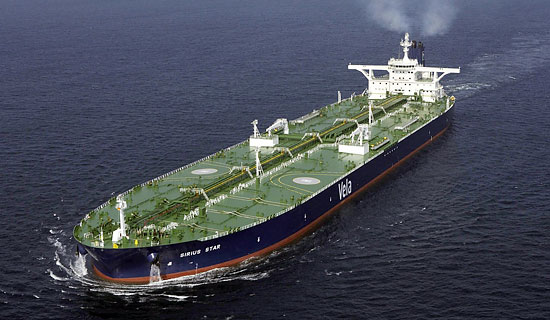 We’re beginning to see the future of piracy unfold in the seas south of the Horn of Africa. Somali pirates have captured an oil tanker belonging to Saudi ARAMCO:
JIDDA, Saudi Arabia: Pirates captured a Saudi-owned supertanker loaded with more than $100 million worth of crude oil off the coast of Kenya, seizing the largest ship ever hijacked, United States Navy officials said Monday.
The hijacking follows a string of increasingly brazen attacks by Somali pirates in recent months, but this appears to be the first time that pirates have seized a full oil tanker.
“This is unprecedented,” Lieutenant Nathan Christensen, a spokesman for the Fifth Fleet, told Reuters. “It’s the largest ship that we’ve seen pirated. It’s three times the size of an aircraft carrier.”
The attack took place despite an increased multinational naval presence off the Somali coast, where most of the recent hijackings have taken place. The pirates are generally heavily armed, and travel in speedboats equipped with satellite phones and GPS equipment.
I’ve been predicting this unwelcome development for some time. I don’t believe that either the oil-exporting or oil-importing nations can allow this to go unchallenged. To date the pirates have mostly been demanding ransoms for captured ships, crews, and cargoes and the ransoms have grown higher as their prizes have become richer. However, that’s not the only possibility.
If the pirates can seize prizes of this size with impunity, I have little doubt that fences will step up to take the oil itself off their hands. It seems to me that could have serious consequences for the world oil trade itself.
Perhaps we’ll be seeing Saudi naval vessels escorting the country’s own ships soon. The Royal Saudi Navy hasn’t had much of a chance to exercise its abilities, compared to the Army and Air Force, so this might be useful.
As I noted before piracy in the Caribbean and Atlantic was only tamped down by the United States and the United Kingdom in the 19th century with a combination of changes in the law and naval might. If the Saudi navy isn’t up to the task, the world’s great navies may be called on once again.
Update
This AP news update would appear to suggest that the tanker remains in the hands of the pirates:
MOGADISHU, Somalia — A Somali official is vowing to rescue a hijacked Saudi oil supertanker “by using force if necessary.”
Abdullkadir Musa is the deputy sea port minister in northern Somalia’s Puntland region, which is a hotspot for piracy. He says that if the ship anchors anywhere near Eyl — where the U.S. says it’s heading — then his forces will rescue it.
The tanker was hijacked over the weekend. Its owners grappled with how to respond Tuesday, as naval forces patrolling the region said they would not intervene to stop or free the captured vessel.
That would seem to contradict earlier reports that the vessel had been freed, a story which I haven’t seen confirmed anywhere.

There’s still piracy in the Malacca Straits and the Gulf of Siam, but that’s lessened of late. Not sure why.
There is also piracy off the coast of Florida, where drug runners take over small boats (usually pleasure boats, yachts, and sport fishing vessels), kill those aboard and then use the boats to enter ports while attracting less attention. I know of several people killed this way over the past few years.
If the Saudi navy isn’t up to the task, the world’s great navies may be called on once again.
Are we not patrolling the area heavily already? This has been going on for a while.
We have 11 carrier groups. Why can’t we prevent this type of thing?
Reuters is reporting that the tanker has been released: Hijacked Saudi Tanker Reported Freed
Jeffrey Baker: The area being patrolled is over one million square miles. The boats involved in the attacks are small, mostly wooden, and don’t show up in either satellite or radar surveillance.
Why can’t we provide some escorts? It’s not like it would take a lot of ships to deter these pirates.
I think the short answer to the question of why we don’t escort vessels in troublesome areas is that we don’t have enough vessels of the right size and type to do so. Our military is largely oriented to near-peer warfare rather than retail law enforcement and peacekeeping.
And as far as the Saudis, Iranians, Quataris, Omanis etc escorting their own shipping with their own navies, none of those navies have significant deep water/out of area capacity. Most of their ships are optimized for relatively protected waters such as the Gulf and the Red Sea and are relatively small. Fast patrol boats and light attack craft can not function effectively in the middle of the Indian Ocean. They don’t have the endurance, sensor reach or the spare parts to stay at sea and be effective long enough to make it worthwhile.
As I recall this was the mandate of the U.S. Navy when they first come into existence. They were there to control piracy on the open seas against U.S. vessels. So we have adapted over the years away from this type of mandate and now we are seeing the consequences. Pirates are just as much as a threat to national security as a terrorist. They both are seeking targets of opportunity and both need to be dealt with accordingly.
“Are we not patrolling the area heavily already? This has been going on for a while.”
Posted by Anderson
IIRC a couple of weeks ago a high-ranking US Navy official made comments which boiled down to “you’re all on your own; the USN doesn’t do piddling sh*t like that”.
As for patrols, this is where one puts armed parties on ships (quietly, in the middle of the ocean), and sinks pirate ships upon their attacks.
This problem is not unlike the u-boat problem. What’s needed is to start convoy operations in that area. A couple of armed escorts and a helo flying cover over a convoy will take care of the pirate threat.
Right now we are hitting a cost/benefit problem — what is the cost of delayed deliveries, increased insurance and ransom versus the costs of convoying such as slower speeds (a convoy moves at the speed of the slowest ship), more idling time as a convoy takes time to assemble and less efficient port utilization as traffic does not enter and leave in a steady stream but instead in spikes so that port facilities are either used at peak capacity OR barely used at all.
During WWII, it was estimated that convoying cost the British roughly 15% to 20% of their annual tonnage import rates. That drop was much smaller than the projected import tonnage losses of not running convoys and letting the U-boats have free reign on unescorted merchies, but convoys are very expensive.