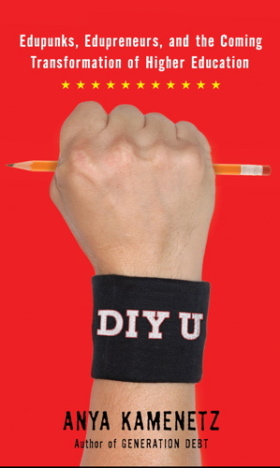
 Anya Kamentz has written a new book titled DIY U: Edupunks, Edupreneurs, and the Coming Transformation of Higher Education. She gives us a taste of the argument in a piece for TAP:
Since 2001, a growing movement — from the Massachusetts Institute of Technology, Stanford, and hundreds of other universities worldwide to insurgent bloggers and entrepreneurs barely out of school themselves — is looking to social media to transform higher education. They’re releasing educational content for free to the world and enlisting computers as tutors. Google has scanned and digitized 7 million books. Wikipedia users have created the world’s largest encyclopedia. YouTube Edu and iTunes U have made video and audio lectures by the best professors in the country available for free.
The face-to-face learning experience, like the live concert experience, remains inimitable. Research shows that, at its best, hybrid learning beats both online-only and classroom-only approaches. Learners can take in and retain more content faster and more easily, form strong mentoring and teamwork relationships, grow into self-directed, creative problem solvers, and publish portfolios of meaningful work that help jobs find them. These innovations hold out the tantalizing possibility of beating the cost disease while meeting the world’s demand for higher education.
[…]
Higher education is not just an industry. Still, from students’ point of view, colleges do provide a bundle of services. You crack a book or go to lecture and learn about the world. You go to labs or write papers and build a skill set. You form relationships with classmates and teachers and learn about yourself. You get a diploma, and the world can learn about you. Content, skills, socialization, and accreditation.
The Web and allied technologies can make each of these services better, cheaper, more accessible, and even free to the student. Content, whether text, video, audio, or game-based, has progressed the furthest along that path. Interactive teaching algorithms can adapt to your learning style on the fly, allowing you to grasp concepts intuitively and at your own pace. And the Internet hasn’t just changed the way we consume information. It has altered the way we interact. Social media can help students and teachers form learning communities. Reputation, assessment, and certification are held jealously as a monopoly by existing institutions, but new tools and models are knocking on that door, too.
[…]
If you go to MIT’s Web site today, you can find the full syllabi, lecture notes, class exercises, tests, and some video and audio for every one of the 1,900 courses MIT offers, from physics to art history. By the end of 2009, some 65 million current students, aspiring students, alumni, professors, and armchair enthusiasts around the world had checked them out.
[…]
These materials have been accumulating for several years now, but most colleges have yet to fully take advantage of them. Students spend an average of $1,000 a year on textbooks, and faculty spend countless hours preparing and updating course materials, which prompts the question: What will it take for colleges to realize the power of free and open resources and use them to cut educational costs?
Ezra Klein argues that physical universities are unlikely to be replaced by virtual ones so long as a degree from the former remains more valuable to employers. But, dispute the Do-It- Yourself title, I gather she’s not arguing otherwise. Rather, she’s saying that the model employed by physical universities will be forced to evolve. And I think that’s right.
Despite the existence of brilliant lectures and materials online, universities and professor-student interaction will remain crucial to the higher education process. An exceedingly small portion of even our brightest 18-year-olds have the self-discipline to teach themselves, even if given a roadmap. Kamanetz seems to not only acknowledge but embrace this. Aside from efficiencies, it’s simply not possible for even “star” professors to teach hundreds, let alone tens of thousands, of students at a time. So that means there will remain a need for the non-star professors. And while it may well be that textbooks could be written in Wiki form or for the sheer vanity of pageviews — which has, after all, managed to draw some amazing talent to the blogosphere — nobody’s going to spend years in graduate school acquiring the expertise if they can’t make a living in some direct fashion.
What I do see happening — indeed, I presume is already happening — is professors taking advantage of the wealth of material provided by their virtual colleagues in helping put together their courses.
When I first started teaching my own courses in 1994, the Internet as we now know it didn’t exist. There was very little content, most of it gated, and delivery speeds were painfully slow. And so most of us developed courses the way our predecessors had for millennia: cribbing from the syllabi others had created, tailoring to our own interests, picking materials that we’d encountered and found useful, and then evolving over time based on trial-and-error and our own subsequent discovery of materials. Now, there are huge troves of online courses from which professors can get ideas. Tons of free videos. More online reading materials than one could possibly use. Social media tools that can be incorporated. And so forth.
This won’t by any means eliminate the university system. But it should certainly make it better. The days of tenured professors teaching from their old, yellowed notes — mostly apocryphal to begin with — are numbered. Students and department heads will simply demand more.