Kenneth Anderson on the Russia-Georgia Conflict
You might want to take a look at law prof Kenneth Anderson’s observations on the Russia-Georgia conflict at Opinio Juris (hat tip: Glenn Reynolds). His observations rest on four legs:
- Russia is undertaking an expansion into its “near abroad” and should be opposed.
- NATO has closed the door on reforms that would have recruited Russia into its membership and will return to being a mutual defense pact.
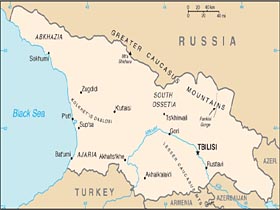
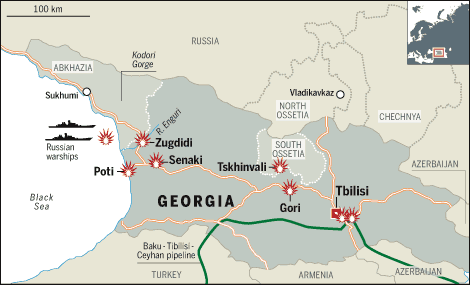
- Georgia will never be able to exert real control over either Abkhazia or South Ossetia.
- While Georgia is worth supporting, it’s no democracy:
US policy must also disentangle “democracy” from what Georgian democracy currently is – which is best characterized not as democracy, but instead as “participatory ethnic nationalism.” The US can be proud of what it has done to help Georgia reach the point of free elections, and to take the first steps toward liberal democracy. But not only does it have a long way to go; much more fundamentally, what we call democracy in Georgia only really works so long as Georgia is pretty much all ethnic Georgian.
While I think this post is worthy of consideration and certainly a valuable contribution to the discussion, I don’t agree with it unreservedly. For example, I don’t think I’d consider what Russia is doing in Abkhazia and South Ossetia as an “imperial expansion in the “near abroad” ” at least not in any novel sense but a continuation of a foreign policy that goes back to the Tsar. Additionally, I have reservations about the degree of enthusiasm with which the United States should be supporting ethnic states as a matter of principle.
One other of Mr. Anderson’s observations really rings true to me:
How long can a free rider club last if its guarantor starts to incur serious costs? I don’t know, but I doubt the answer is forever.
That’s a question I think we’re going to need to come to terms with in the very near future.


Additionally, I have reservations about the degree of enthusiasm with which the United States should be supporting ethnic states as a matter of principle.
I have the same reservations about our Israel policy.
Prof. Anderson’s points ring true, particularly the fear that Georgian attempted control over these breakaway regions will be fiercely contested by the majority of the residents creating a perpetual instability that will prevent democratic and economic development.
Kaplan reported several years ago that the Georgians and Ossetians were no longer speaking Russian, but only their own languages. They could no longer speak to each other or even the larger world.
Amen to that!
“How long can a free rider club last if its guarantor starts to incur serious costs? I don’t know, but I doubt the answer is forever.”
Right on. The European countries have the money and the people. They still depend on us. Why? Time to cut the cord.
Steve