
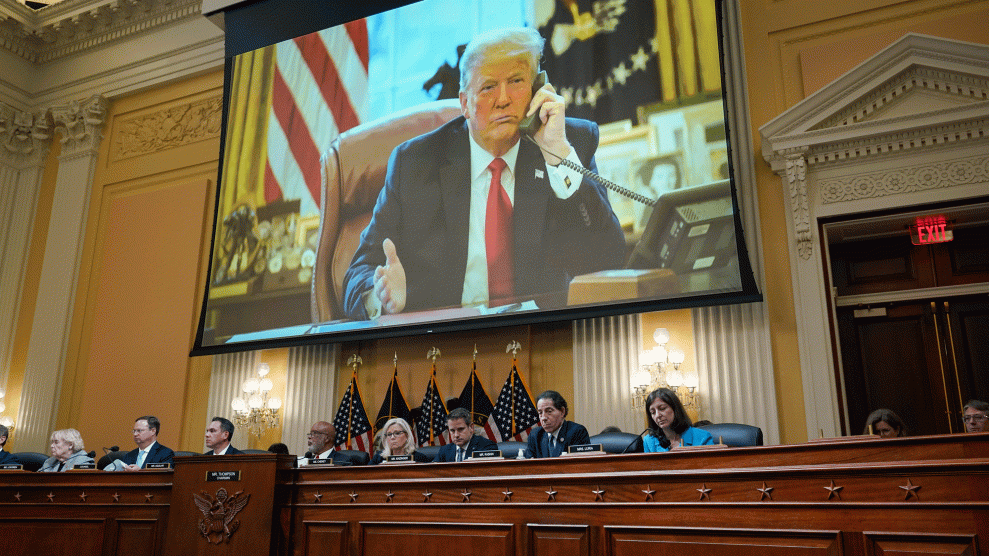

Mother Jones Washington Bureau Chief David Corn warns, “Don’t Fall into the Collusion Trap on Trump and January 6.” Considering that myself and a lot of OTB commenters have done so, it’s useful advice.
Watching the recent coverage of the January 6 investigation, I felt a stab of deja vu. As the House committee probing the insurrectionist riot held a hearing this week that focused on the Oath Keepers and Proud Boys, two militant right-wing groups that led the assault on the Capitol, commentators zeroed in on the question of whether Donald Trump and his White House had forged a direct connection to these extremists prior to their attack on Congress. That is, was there collusion between Trump and these domestic terrorists who have been indicted on charges of sedition? Now where have we heard this before?
This question is an important one, but it is also a trap. Trump and his comrades have been rather deft at developing a tactic to protect him from charges of profound wrongdoing: They raise the bar. If Trump is caught holding a match outside a burning house, Trump and his defenders will say, “Do you have proof he doused the interior with gasoline? That’s fake news. A hoax.”
The question is an important one because it’s likely the bar to criminal prosecution of Trump and a bar on him from holding office in the future. But Corn is right that we already have plenty of evidence that Trump tried to steal an election he damn well knew he’d lost; abused his power in an attempt to influence and intimidate election officials, his Vice President, and several United States Senators; and all manner of other outrages. But, of course, we knew that before the hearings started.
This is what happened with the Russia scandal. There was plenty of confirmed evidence that Trump and his crew acted in a sleazy and improper manner. During the 2016 campaign, his top advisers signaled to Moscow they were fine with the Kremlin’s covert efforts to influence the election to assist Trump. They secretly met with a Russian emissary who they were told was part of this project. And Trump and his team repeatedly denied Vladimir Putin’s regime was attacking the election—even though they were informed Moscow was taking clandestine action to help the Trump campaign—and thus provided cover for Putin, aiding and abetting Russia’s assault on the American political system.
These actions—arguably acts of betrayal—were undeniable and immensely scandalous. Yet Trump and his protectors defined the scandal in different terms: Did he collude with the Kremlin? They made the central question whether he had conspired directly with the Russian operation to hack the Democrats and release pilfered emails and documents through WikiLeaks. Of course, no such direct conspiring was necessary for the operation to succeed. Trump merely encouraged this assault committed by a foreign adversary and denied that it happened. This was enough to land him in Benedict Arnold territory. Yet when special counsel Robert Mueller reported he had not found evidence that Trump criminally conspired with the Russians, Trump and his cult declared he had been cleared—even though Mueller’s final report documented his misdeeds and detailed numerous instances in which Trump possibly obstructed justice.
No collusion equals no culpability—that’s how Trump managed to shape the Russia scandal. And to a large extent the scheme worked. Much of the mainstream media got hooked on the collusion question, and Republicans and the Trumpified conservative press dished out this propaganda unrelentingly. All that helped to deflect attention from the incontrovertible Trump wrongdoing that had transpired. (By the way, a 2020 report issued by the GOP-chaired Senate intelligence committee noted that Paul Manafort, when he was chief executive of the Trump campaign, did indeed collude with a Russian intelligence officer who might have been involved in Moscow’s attack on the election.)
So, again, I’m both in agreement with Corn and not. All of the above is correct. But, again, while my recollection of the Russia scandal had faded a bit given all the other scandals since, I and most of my regular commenters believe Trump’s conduct was scandalous. Even after Bill Barr’s dishonest summary of the Mueller Report was released, roughly half the country believed that Trump colluded with Russia. The problem is that the roughly 40% who are going to believe Trump seemingly no matter what continued to buy into his narrative.
I don’t know what to do about that.
In much the same way, Trump need not be nailed as a colluder with the Oath Keepers or Proud Boys to merit widespread condemnation and possible criminal investigation. It’s been proven that the Trump White House via then-chief of staff Mark Meadows was in communication on January 5 with longtime Trump adviser Roger Stone and disgraced former Trump national security adviser Michael Flynn, who themselves were in contact with the allegedly seditious Oath Keepers and Proud Boys. So it remains a possibility that the White House was in cahoots with the extremists, perhaps egging them on to cause chaos on January 6 that would impede the certification of the electoral vote count—which, at that time, was what Trump desired. (The Proud Boys, at the very least, believed Trump sent them an encouraging message during the 2020 campaign when he told them, “Stand back and stand by.” And in 2016, Trump publicly asked Russian hackers to target Hillary Clinton—and they did.) Yet if these two dots—Trump and the insurrectionist paramiltarists—are not connected, that does not absolve Trump.
So much of Trump’s post-election misconduct is now out in the open. His Big Lie crusade and his incitement of the January 6 mob occurred in full public view. And his behind-the-scenes efforts to overturn the election have been revealed: leaning on state Republican legislators; pressuring election officials in Georgia (“I just want [you] to find 11,780 votes”); scheming to create fake elector slates; pressing the Justice Department to declare the election results corrupt; and muscling Vice President Mike Pence to block the certification of electoral votes. Moreover, the January 6 committee has been revealing evidence showing what was already known about that awful day: While the pro-Trump marauders attacked the Capitol and assaulted law enforcement officers, Trump took no steps to end the riot. The raid proceeded for hours before Trump called on his supporters to leave the Capitol. (The committee has teased that it will provide more testimony regarding what Trump did and did not do on the afternoon of January 6 in a hearing next week.)
So, again, we knew most of this before the Committee started its public hearings. Indeed, we knew some of the most damning things in real time. He not only “merit[s] widespread condemnation,” he’s been widely condemned. The bar, like it or not—and I decidedly don’t—is evidence so damning that a significant number of those who voted for Trump in 2020 will decide that he’s simply not fit to lead.
What that looks like, I haven’t a clue. But it’s possible, I think. Eventually, the odious revelations about Roy Moore became so damning that he managed to lose to a Democrat in Alabama.
Some of Trump’s actions may have been illegal—and there’s much discussion these days as to whether Attorney General Merrick Garland’s Justice Department is fully investigating them and whether Trump and his henchmen could be indicted. (The Fulton County district attorney is on the case.) But there is no question that Trump committed serious wrongdoing and that on January 6 he abandoned his duties as president, as he watched the riot and did nothing.
All this ought to be enough to brand Trump a villain and a danger to American democracy. Conspiring with the Oath Keepers and Proud Boys would be merely one more offense on a tall pile. It could expand his legal liability. But it’s a subplot in a tale already fully established: Trump attempted to subvert the constitutional order to retain power.
Again: we knew that in real time on January 6. Indeed, he was signaling that he would not accept a loss as legitimate for months ahead of the election. Trump has already been “brand[ed] . . . a villain and a danger to American democracy” many times over in elite circles. The bar, like it or not, is for that view to reach supermajority status.
Yes, it’s frustrating. It was predictable and, indeed, predicted that, when Kevin McCarthy withdrew his party’s official support from the Committee that its work would be branded as a partisan witchhunt. For now, that seems to be the prevailing Republican view.
There came a point in the Watergate hearings when enough Republicans believed Richard Nixon was a crook and had to go. I’m not sure that, in the current information environment, we’re capable of that sort of transformation anymore. But that has to be the goal here.
Corn seems to disagree:
Trump has often escaped accountability by committing transgression upon transgression. Each dirty deed distracts from the other. Any one of his plots to steal the 2020 election would be a major scandal in itself. (Pushing the Justice Department to falsely declare the results were fraudulent!) Yet all of his dishonest conniving creates a gigantic blur that can be hard to absorb or follow. The January 6 committee has done a good job of breaking down Trump’s myriad skullduggery. This will certainly not convince the Trump cultists and denialists; they cannot be reached. But for the rest of the nation, there’s no need for a smoking gun—or to get hung up on a particular allegation or possible criminal violation. The question is no longer Trump’s guilt but how best to counter the threat he continues to pose to the republic.
So, I agree that the “Trump cultists” are unreachable and agree that reaching them is an unreasonable goal. But that’s a relatively small portion even of two-time Trump voters. In system of binary choices, it’s really easy for someone to hold their nose to vote for the party standard-bearer.
So, the latest polling I can find, a Monmouth University survey released last week, is rather depressing:
[T]he House select committee to investigate January 6 has not changed many minds about what happened that day, in part because few Republicans are following the hearings. In fact, Republicans are less inclined than they were a year ago to describe the violence at the U.S. Capitol as either a riot or an insurrection. In the poll – conducted before Cassidy Hutchinson’s public testimony on June 28 – 4 in 10 Americans said former President Donald Trump was directly responsible for the incident.
Just 36% of the public describes the American system of government as basically sound. This number has declined from 55% in February 2020 and from 44% in 2021, a few weeks after the Jan. 6 attack. Just over four decades ago, 62% said the American system was sound. At the same time, the number of Americans who say our system of government is not at all sound has jumped from 10% in 1980 to 22% in 2021 and 36% in the current poll. The recent decline of faith in the American system has come at varying rates among different partisan groups. Among Republicans, the sense that our system of government is sound plummeted from 71% in early 2020 to 41% shortly after President Joe Biden’s inauguration in 2021, and has held fairly steady since then. The decline among independents has been more gradual – from 58% sound in 2020, to 46% in 2021, and 34% in the current poll. Democrats actually saw a brief increase in faith that the American system is sound from 2020 (34%) to 2021 (45%), but that has now dropped back to 36%.
Few people are watching the hearings, although more are paying some attention. But they’re filtering their news through preferred information sources and their preexisting biases. And pretty much everyone has, not without reason, lost faith in the system itself.
Still, there’s some good news—but it’s mixed:
Nearly two-thirds (65%) of the public say it is appropriate to describe the incident at the U.S. Capitol as a riot, and half (50%) say it is appropriate to describe it as an insurrection. Both of these numbers, though, are down from a year ago (by 7 points for riot and by 6 points for insurrection). These negative views of Jan. 6 have held relatively steady among Democrats and independents, but have slipped significantly among Republicans. Last year, a clear majority (62%) of Republicans called the incident a riot. Now, less than half (45%) do. Similarly, a third (33%) of Republicans in June 2021 said it was appropriate to describe the incident as an insurrection, but only 13% say the same today.
By comparison, the number of Americans who say it is appropriate to describe the U.S. Capitol incident as a legitimate protest has remained stable over the past year (34% now compared with 33% in June 2021). However, the number of Republicans who see this incident as a legitimate protest has actually risen by 14 points to 61%, at the same time this view has declined among independents (down 6 points to 33%) and remained stable among Democrats (14%).
“Some Republicans who were initially appalled have now recast the events of Jan. 6 in a less negative light. It’s not clear the House committee hearings are having any impact in correcting this view, in large part because Republicans simply aren’t watching,” said Murray.
We’ve literally moved backward. Maybe the Hutchinson testimony and subsequent revelations will move the needle but I’m a bit skeptical. The people who need to be persuaded simply aren’t paying attention:
While nearly half (45%) of Democrats say they have been following the House select committee hearings a lot, just 16% of independents and 10% of Republicans say the same. In fact, a majority (52%) of Republicans and 4 in 10 independents (41%) say they have not been following the hearings at all.
We’re simply living in different realities in a way we weren’t during Watergate.
Overall, just 6% of all Americans say the recent committee hearings have changed their mind about what happened at the Capitol or who was responsible for Jan. 6. Among Republicans who have been following the hearings, just 1 in 10 – representing 5% of all Republicans – say they have changed their opinion about the incident. In a follow-up question, some of these Republicans say that they learned about the pressure Trump was exerting or that election fraud claims were spurious. However, others claim they have “learned” that “police officers were not killed in that protest,” or that “the Democrats were highly involved as well as the F.B.I.”
That people had pretty firm views before the hearings isn’t shocking. I haven’t changed my mind, either, even though I’ve learned some things. But the fact that some people seem to be “learning” things that ain’t true is disturbing.
Currently, 29% of Americans believe Biden won the presidential election only because of voter fraud. In prior polls since November 2020, that number held steady at 32%. The 3-point difference in the current poll is just as likely to be the product of sampling variance as it is any real chipping away at this unsupported belief.
So, let’s call 30% the hard floor. Those people are simply unreachable. Trump could literally go on Fox News and confess that he ordered the Code Red and these people would still say the election was stolen.








