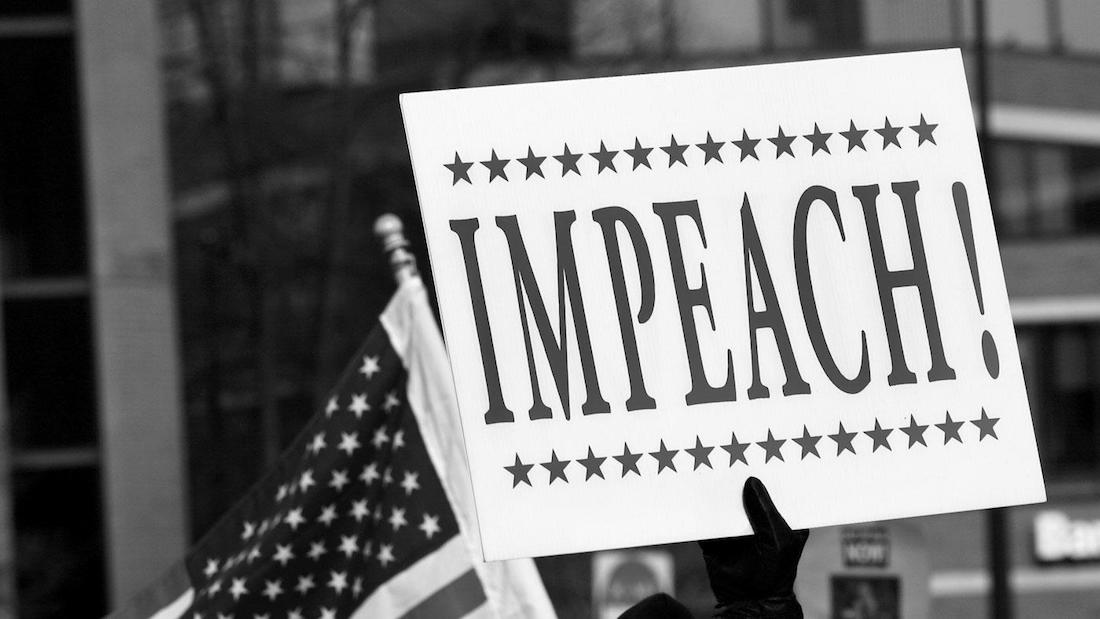

CNN White House reporter Stephen Collinson claims, “Many Democrats fear Trump is laying an impeachment trap.” “What’s an impeachment trap?” you might be wondering?
It seems a crazy idea that any president would actually want to be impeached.
But Donald Trump has so subverted Washington logic with his wild, norm-crushing presidency that there is now a serious conversation — at least among Democrats — about whether he views the ultimate constitutional crisis as a weapon in his re-election campaign.
The possibility is shaping the strategies of Democratic leaders as they weigh the political risks of impeachment and their duty to defend principles of American governance.
Many Democrats fear that Trump may be laying an impeachment trap that could consume the House majority, distract them from key issues like health care and alienate persuadable voters.
But it’s also possible their leaders could be talking up the idea that Trump wants to be impeached as a way to quell discontent among some base activists that Washington Democrats are not doing more to constrain the President.
It does indeed seem like a crazy idea. And I’d note that, five paragraphs in, not a single actual Democrat has been cited to hold it.
The question is not going away, given Trump’s staggeringly broad effort to subvert investigations of his presidency, campaign, personal finances and business career.
“The President is almost self-impeaching because he is, every day, demonstrating more obstruction of justice and disrespect for Congress’ legitimate role to subpoena,” Democratic House Speaker Nancy Pelosi said Friday.
One of Pelosi’s top lieutenants, House Intelligence Committee chairman Adam Schiff, is, like Pelosi, wary of the risks of impeachment. But he acknowledged Trump’s own actions might be propelling Washington toward a precipice.
“Part of our reluctance is we are already a bitterly divided country and an impeachment process will divide us further,” Schiff said Sunday on “This Week” on ABC News. “He certainly seems to be trying and maybe this is his perverse way of dividing us more … He thinks that’s to his political advantage, but it’s certainly not to the country’s advantage.”
This doesn’t really be a claim of an impeachment trap so much as consternation that Trump’s transgressions are so blatant that the Democrats may not have much choice but to do something they think is politically unwise.
Trump dodged a question in a Politico interview last week about whether he wanted to be impeached. And he argues that if anyone committed crimes over the 2016 campaign, it is Democrats, not him.
At other times he has, however, seemed to be testing out arguments that he could use in his defense in an impeachment showdown.
“It’s hard to impeach somebody who hasn’t done anything wrong and who’s created the greatest economy in the history of our country,” Trump told Reuters in an interview in December.
“I’m not concerned, no. I think that the people would revolt if that happened,” he said.
Even by Trump standards, that’s rather innocuous. I don’t see a briar patch anywhere near it.
Trump has unapologetically based his political appeal on widening national divides — so he is unlikely to worry about exacerbating them if it benefits him politically. And like everyone else, he reads polls that show that most Americans do not want to go through the trauma of an impeachment drama for the third time in 50 years.
It’s possible that the wider political divides get, the more Trump benefits. The spectacle would help him charge up the political base he needs to turn out in droves in 2020 with claims their 2016 votes were being stolen by political elites.
Trump would also hope to turn more moderate voters against the Democrats by painting their efforts as cravenly partisan political overreach.
I happen to think that this is right based on where we are now. But, of course, an actual impeachment hearing might change people’s minds.
Regardless, it’s all conjecture from Collinson, not an indication that Trump is laying a trap or that Democrats—let alone many of them—fear falling into it.
Suspicions that Trump may perversely see an upside to impeachment are supported by a simple fact: It is very unlikely to force him from office.
He has proven that there are almost no circumstances in which a two-thirds Senate super majority swelled by defecting Republicans would vote to convict him in an impeachment trial.
Republican Senate Majority Leader Mitch McConnell — building on a political narrative sketched by Attorney General William Barr — is framing the end of the special counsel investigation as “case closed.”
Again, that’s almost certainly right.
Much Democratic reticence about impeachment is shaped by a certain reading of the history of the Bill Clinton era.
In midterm elections in 1998 that took place after Republicans had initiated the impeachment process, Democrats actually picked up House seats in a reverse of historical trends. The result has been read ever since as a judgment by voters to rebuke Republicans who sought unsuccessfully to oust a twice-elected President.
Some Democrats fear that an impeachment process now could play into the current President’s hands and allow him to rally the country against them.
It is not often remembered, however, that Republicans went on to win the presidency less than two years after Clinton survived his Senate trial — after a campaign in which George W. Bush promised to restore “honor and dignity” to the White House in an oblique reference to impeachment.
All of which is true. But, again, Democrats know this and Pelosi has long since said that impeachment isn’t worth it precisely because she believes the outcome is foreordained.
After a lot more setup, Collinson finally gets to something that we haven’t beaten to death here over the past few months: a sense that House Democrats may be essentially forced to impeach Trump.
Many disputes between the White House and Congress are now likely to churn through the court system and could even rise to the Supreme Court.
If the White House were to refuse a Court order to honor subpoenas, the Democratic House majority, having exhausted lesser powers to hold a President to account, may have no option but to proceed to impeachment to preserve the integrity of Congress itself.
That possibility may have been in Pelosi’s mind when she was talking about “self-impeachment.”
Impeachment is ultimately a political decision. But, yes, I think the House would be duty-bound to impeach under those circumstances. It’s one thing for a President to routinely disregard the law, as Trump does daily with his emoluments violations and other personal financial misdeeds. Law enforcement agencies routinely decline to enforce comparatively minor crimes (low-grade speeding or marijuana use, for example) in order to concentrate on more serious offenses. But ignoring a Supreme Court order would simply put the President above the law in a manner the Constitution can’t abide.
The party is already trying to build a case of administration-wide malfeasance and obstruction that could shape public perceptions about the Trump presidency.
There is now talk of “bundling” several contempt of Congress citations for top Cabinet officials in one House vote to maximize the political fallout for the administration.
Barr was found to be in contempt last week by the House Judiciary Committee for refusing to hand over an unredacted version of the report from special counsel Robert Mueller. Treasury Secretary Steve Mnuchin and IRS Commissioner Charles Rettig could soon face similar censure after being subpoenaed to hand over six years of Trump’s tax returns by the House Ways and Means Committee.
Given America’s entrenched polarization, it seems unlikely that views of the President will shift dramatically enough to change the political calculation over impeachment.
But historians sometimes point out that public opinion became more favorable to the possibility of impeaching President Richard Nixon as his administration’s misdeeds were revealed by Senate Watergate hearings chaired by North Carolina Sen. Sam Ervin. In the end, Nixon resigned before he was impeached, a step it is impossible to imagine Trump emulating.
Some Democrats seem to believe that a concentrated public airing of Trump’s behavior, with testimony from central players like Mueller and former White House counsel Don McGahn, could damage the Trump presidency sufficiently to weaken him in 2020.
One potential Democratic nominee, Massachusetts Sen. Elizabeth Warren is ready to take on the risks of impeachment.“Congress can simply not look the other way. There is no political convenience exception to the Constitution of the United States of America,” Warren said in a swing through Ohio on Saturday.
We may simply be a different country than we were during Watergate.
For one thing, the media environment is completely different. PBS described the scene on the 40th anniversary:
During the summer of 1973, a special Senate Committee held hearings, co-chaired by Sens. Sam Ervin, D-N.C., and Howard Baker, R-Tenn., to investigate the burglaries and whether “illegal, improper or unethical activities” had been committed in connection to President Richard Nixon’s 1972 campaign for re-election.
Public television aired all 250 hours of the hearings, gavel-to-gavel. The parade of witnesses and testimony, from former White House counsel John Dean’s allegation that President Nixon knew about the cover-up of the burglary, to former presidential aide Alexander Butterfield’s revelation that there were tapes that could prove it, shocked the country and ultimately led Nixon to resign from office — the only time an American president has done so.
I was 7 at the time—too young to understand what was happening in real time. But I do recall the hearings because they interrupted whatever television programming I would otherwise have watched that summer.
I can’t easily verify whether PBS was the only network to air the hearings in their entirety but I’m pretty sure there was at least some live coverage on the other networks. These were the days when there were only three national commercial networks—ABC, CBS, and NBC—plus PBS. We lived in Houston at the time and there were, I believe, two channels on the UHF dial showing various re-runs and such.
Regardless, it was not only essential impossible to escape Watergate coverage but, more importantly, nowhere to go to get coverage from a decidedly partisan viewpoint.
Trump voters aren’t in the main going to be watching PBS, much less MSNBC, for their coverage of these future hearings. They’ll be watching, if they watch at all, via Fox News and reading Breitbart, listening to Rush Limbaugh, and otherwise getting their news filtered through a Trumpist lens. Unless those outlets turn against him, the hearings would almost certainly further polarize the country.